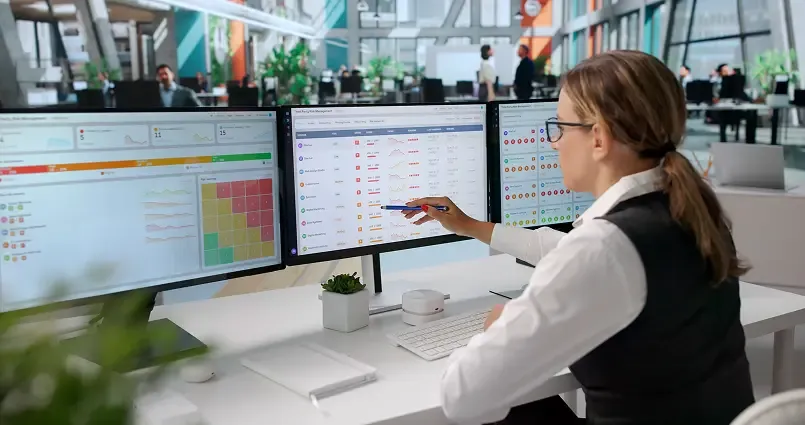


The Best IT Vendor Risk Management Tools in 2027
IT vendors now sit inside nearly every critical process an enterprise runs, from cloud infrastructure to payment processing to customer data storage. That access comes with exposure. When a vendor's security fails, the risk does not stay contained to their environment; it flows straight into the organizations that depend on them.
According to SecurityScorecard's 2025 Global Third-Party Breach Report, 35.5 percent of all breaches in 2024 were third-party related, a jump of 6.5 percentage points from the year before. IT service providers, cloud platforms, and file transfer software were among the most frequently compromised vendor categories. That trend is exactly why IT vendor risk management has moved from a procurement checkbox to a standing risk and security priority, and why choosing the right platform to manage it matters more than ever.
We reviewed the leading IT vendor risk management platforms available in 2027, from enterprise GRC suites to specialized cyber risk exchanges. Here is what you need to know.
Quick Comparison: The Top 5 IT Vendor Risk Management Tools at a Glance
| Tool | Best for | AI capabilities | Continuous monitoring | Ideal org size |
|---|---|---|---|---|
| MetricStream | Large enterprises managing vendor risk alongside a broader GRC program | Advanced | Yes | Large and multinational corporations, including Fortune 500 companies |
| Archer | Large enterprises with complex, highly customized IT vendor risk programs | Moderate | Yes | Large enterprises |
| IBM OpenPages | Enterprises that want IT vendor risk on the same platform as broader operational risk | Advanced | Yes | Large and global enterprises |
| ServiceNow | Organizations already running the Now Platform | Moderate | Yes | Mid-to-large enterprises |
| Diligent | Organizations that want board-level visibility into vendor and third-party exposure | Advanced | Yes | Mid-market to enterprise |
1. MetricStream – Best for Large Enterprises Managing Vendor Risk Alongside a Broader GRC Program
MetricStream IT Vendor Risk Management gives organizations a single, real-time view of their IT vendor ecosystem instead of a patchwork of spreadsheets and one-off assessments. The platform automates the full vendor lifecycle: information gathering, continuous monitoring, onboarding, risk and compliance assessments, and offboarding, all connected through an integrated, federated data model. That connected structure means a vendor's risk rating, contract status, and open issues live in one place rather than scattered across procurement, IT, and security tools.
The AI capabilities go beyond basic automation. AI Survey and Questionnaire Autofill drafts responses to vendor assessments directly from uploaded documentation and evidence, with confidence indicators and citations for every suggested answer, so reviewers can verify rather than start from a blank form. Automated red flags surface high-risk or out-of-threshold responses in vendor surveys and assessments so reviewers can focus on the exceptions that matter instead of reading every line.
MetricStream also integrates directly with trusted third-party intelligence providers, including Dow Jones, Dun & Bradstreet, BitSight, and SecurityScorecard, pulling in cyber, financial health, and anti-corruption signals so risk teams are not relying on vendor-submitted information alone. Based on customer data reported through the GRC Journey Business Value Calculator, organizations using MetricStream IT Vendor Risk Management have achieved an 80 percent reduction in vendor onboarding time and a 50 percent decrease in the time and cost required to complete vendor assessments and identify risks. According to G2 reviews, users consistently point to the platform's configurability and its ability to handle complex, industry-specific vendor risk requirements without forcing a rigid template onto the process.
Key Features
- AI Survey and Questionnaire Autofill: Generates draft responses to vendor assessments from existing documentation, with confidence scores and source citations for reviewer verification.
- Automated Red Flag Detection: Flags high-risk or out-of-threshold responses in vendor surveys automatically, so reviewers can prioritize exceptions.
- Continuous Monitoring and Risk Intelligence: Integrates with Dow Jones, D&B, BitSight, and SecurityScorecard for real-time cyber, financial, and reputational signals on every vendor.
- AI-Powered Issue Management: Identifies and classifies vendor-related issues automatically and routes them for remediation.
- Vendor Performance Scorecards: Tracks KPI scores over time, enriched with internal audit and assessment data, to flag underperforming vendors before they become a liability.
- Structured Vendor Portal: Centralizes vendor profiles, contracts, certifications, and due diligence status, with self-service access for vendors to update their own information.
Who Should Choose MetricStream
MetricStream is the right fit for large enterprises and organizations in regulated industries that need to manage IT vendor risk as part of a broader, connected GRC program rather than as an isolated point solution. This includes banking and financial services, insurance, healthcare, energy, and technology companies with large vendor portfolios spanning multiple business units and jurisdictions.
Ready to see connected IT vendor risk management in action? Get a demo and find out how MetricStream can cut your vendor onboarding time. Schedule a Demo
2. Archer – Best for Large Enterprises With Complex, Highly Customized IT Vendor Risk Programs
Archer Third-Party Governance is one of the longest-established platforms in this category, tracking vendor relationships, risk assessments, and performance across the full vendor lifecycle. Archer evaluates residual risk across several categories, including information security, resiliency, and fourth-party exposure, and lets organizations tailor scoring methodologies and workflows to match their own risk taxonomy. A companion tool, Archer Engage for Vendors, gives vendors a mobile-friendly interface to respond to assessments directly, cutting down the email cycles that typically slow down due diligence.
Key Features
- Configurable residual risk scoring across information security, compliance, financial, and resiliency categories
- Vendor Portal and Engage for Vendors for self-service, mobile-friendly vendor responses
- Centralized third-party profile repository tracking relationships, contracts, and assessment history
- Extensive customization of workflows, questionnaires, and approval chains to match existing risk taxonomies
Who should consider Archer
Large enterprises with complex, highly customized IT vendor risk programs, particularly those with an existing Archer deployment for other risk domains. Organizations evaluating a platform for the first time should weigh Archer's configurability against its longer implementation timeline compared to newer, more prescriptive tools.
3. IBM OpenPages – Best for Enterprises That Want IT Vendor Risk on the Same Platform as Broader Operational Risk
IBM OpenPages Third Party Risk Management sits inside IBM's broader OpenPages GRC platform, giving organizations a way to manage IT vendor risk on the same system they already use for operational risk, compliance, and resilience. The module builds a centralized, risk-weighted hierarchy of vendors, complete with configurable inherent and residual risk scoring, and connects vendor issues directly into OpenPages' broader issue and incident management workflow rather than treating vendor risk as a separate silo.
Key Features
- Centralized third-party risk hierarchy mapped to risks, controls, KRIs, and regulations
- Configurable inherent and residual risk scoring methodologies
- Integration with external risk intelligence sources, including SecurityScorecard and Supply Wisdom
- Embedded AI for issue classification and automated third-party questionnaire processing, built on IBM's watsonx.ai
Who Should Consider IBM OpenPages
Large enterprises, particularly in banking and financial services, that already run other risk domains on OpenPages and want IT vendor risk connected to that same data model rather than managed through a separate point tool.
4. ServiceNow – Best for Organizations Already Running the Now Platform
ServiceNow Third-Party Risk Management, built on ServiceNow's original Vendor Risk Management product, centralizes vendor risk data on the same Now Platform that many organizations already use for IT service management and security operations. That shared architecture means vendor risk assessments, incident data, and remediation tasks can draw on operational data the organization is already capturing elsewhere in ServiceNow.
Key Features
- Native integration with ServiceNow's IT service management, incident, and vulnerability data
- Risk concentration mapping to visualize vendor exposure by geography and engagement
- Smart assessment templates with automated risk scoring and normalization
- Self-service vendor portal for document requests and assessment responses
Who Should Consider ServiceNow
Organizations already deeply invested in the ServiceNow ecosystem for ITSM or security operations, where extending vendor risk workflows into existing infrastructure outweighs the benefit of a dedicated, standalone vendor risk platform.
5. Diligent – Best for Board-Level Visibility Into Vendor and Third-Party Exposure
Diligent's IT Vendor Risk Management software, built on its 2026 acquisition of 3rdRisk, uses AI to automate vendor profiling, streamline assessment workflows, and analyze supporting documentation such as contracts and certifications. Diligent's differentiator is the direct line between vendor risk data and its board governance products, giving audit committees and boards a near real-time view of vendor exposure without waiting for a quarterly report.
Key Features
- AI-native vendor profiling and assessment workflows through the 3rdRisk acquisition
- Automated document and contract analysis to speed up due diligence
- Direct integration with Diligent's board portal and governance reporting tools
- Adverse media and ownership screening across a large global entity database
Who Should Consider Diligent
Organizations where board and audit committee oversight of vendor and third-party risk is a standing priority, particularly public companies and regulated financial institutions. It is less suited to organizations looking purely for a security-operations-focused vendor risk tool without the governance layer.
Want to compare these platforms side by side on your own criteria? Download our free RFP template built specifically for IT vendor risk management evaluations. Download Now
What Is IT Vendor Risk Management?
IT vendor risk management is the practice of identifying, assessing, monitoring, and mitigating the risks that technology vendors, cloud providers, and IT service partners introduce to an organization. It covers the full vendor lifecycle, from due diligence during onboarding through continuous monitoring and, where necessary, structured offboarding. The goal is to give organizations visibility into vendor cyber posture, financial stability, compliance status, and performance before those factors become the organization's own problem.
IT vendor risk management is closely related to third-party risk management (TPRM) but more narrowly scoped. TPRM covers the full range of an organization's external relationships, including suppliers, contractors, and business partners, while IT vendor risk management focuses specifically on technology vendors with access to systems, infrastructure, or data. Fourth-party risk extends the concept one step further: the risk introduced by a vendor's own vendors, which most organizations still struggle to assess directly.
How to Choose the Best IT Vendor Risk Management Software
A few criteria consistently separate a strong fit from a costly mismatch when evaluating IT vendor risk platforms.
- Depth of continuous monitoring: Look for platforms that pull in external risk signals, such as cybersecurity ratings, financial health data, and adverse media, rather than relying solely on vendor-submitted questionnaires.
- AI maturity in daily workflows: Evaluate whether AI genuinely speeds up questionnaire review, issue classification, and document analysis, or whether it is a surface-level feature added for marketing purposes.
- Integration with the broader risk and GRC program: Vendor risk rarely exists in isolation. A platform that connects vendor data to the organization's broader enterprise risk, compliance, and audit program avoids creating another data silo.
- Vendor collaboration experience: Platforms that let vendors respond directly, upload evidence, and track remediation in-platform reduce the email back-and-forth that slows down assessments.
- Framework and content coverage: Confirm the platform supports the specific frameworks your organization needs, whether that is NIST CSF, ISO 27001, SOC 2, DORA, or industry-specific requirements.
- Scalability to your vendor portfolio: A platform built for a few hundred vendors will behave very differently from one designed to manage thousands across multiple business units and geographies. Match the tool to your actual scale.
Not sure where your vendor risk program has gaps? Talk to a GRC expert and get a clear read on what to prioritize. Talk to an Expert
Benefits of IT Vendor Risk Management Software
Implementing a dedicated IT vendor risk platform delivers measurable value well beyond audit readiness.
- Faster onboarding: Automated screening and risk evaluation let organizations bring new vendors online in days rather than weeks, without skipping due diligence.
- Reduced assessment burden: AI-assisted questionnaire review and pre-completed assessment exchanges cut the manual effort involved in evaluating vendor responses.
- Earlier risk detection: Continuous monitoring surfaces vendor security incidents, financial distress, or compliance gaps as they happen, rather than at the next scheduled review.
- Stronger negotiating position: Vendor performance scorecards and historical risk data give procurement and risk teams objective evidence to support renewal, renegotiation, or termination decisions.
- Lower exposure to cascading incidents: Faster identification of vendor risk translates directly into faster containment when something goes wrong at a vendor.
Common Challenges in IT Vendor Risk Management Implementation
Standing up a new vendor risk program, or replacing an existing one, tends to surface a few recurring obstacles.
Incomplete vendor inventories: Many organizations underestimate how many IT vendors they actually use, particularly when business units onboard tools outside of a formal procurement process. Building an accurate, centralized inventory is often the first and most time-consuming step.
Ownership gaps between procurement, IT, and security: Vendor risk decisions frequently involve three or more teams with different priorities. Without clear ownership of the assessment and approval process, vendor onboarding can stall or, worse, bypass the risk review entirely.
Alert fatigue from continuous monitoring: Continuous monitoring tools can generate a high volume of alerts, especially early in implementation. Tuning thresholds and prioritization rules takes time, and without that tuning, teams risk missing the alerts that actually matter.
Vendor cooperation and response time: Even automated platforms depend on vendors responding to assessments and providing evidence. Smaller or less mature vendors may lack the documentation or resources to respond quickly, which can slow down onboarding for otherwise low-risk relationships.
How MetricStream Can Help
MetricStream’s AI-powered GRC platform supports IT vendor risk management through questionnaire processing, automated red flag detection, and integrations with leading risk intelligence providers. Its IT Vendor Risk Management solution helps organizations maintain a current view of vendor exposure, supporting continuous oversight beyond periodic assessments.
The platform connects vendor risk data with MetricStream’s broader Third-Party Risk Management and Cyber GRC capabilities. This gives risk, security, and procurement teams a shared view of exposure across the vendor ecosystem, helping them coordinate assessments and address risks across interconnected third-party relationships.
With connected risk data and defined guardrails for AI, MetricStream helps enterprises manage complex vendor portfolios across business units and regulatory environments. Human oversight supports accountable risk evaluation, while the broader GRC architecture helps teams understand vendor-related risks in the context of the organization’s wider risk posture.
See what a connected vendor risk program could look like for your organization. Talk to a GRC expert today. Talk to an Expert