





MetricStream simplifies CCPA compliance for businesses by enabling them to manage data privacy requirements in an integrated manner. Integrate content from the Unified Compliance Framework (UCF) and the MetricStream GRC Library for harmonized policy controls. Map CCPA privacy regulations to specific controls, risks, policies, and processes to easily plan and execute certifications. Ensure greater visibility into the overall compliance posture, issues, and completion of actions. Leverage a systematic process to capture and resolve privacy-related issues and manage issue remediation.


CCPA Compliance Streamlined
Strengthen Privacy Compliance, Monitor Regulations, and Simplify Risk Assessments

Achieve and Manage CCPA Compliance Easily
MetricStream simplifies CCPA compliance for businesses by enabling them to manage data privacy requirements in an integrated manner. Integrate content from the Unified Compliance Framework (UCF) and the MetricStream GRC Library for harmonized policy controls. Map CCPA privacy regulations to specific controls, risks, policies, and processes to easily plan and execute certifications. Ensure greater visibility into the overall compliance posture, issues, and completion of actions. Leverage a systematic process to capture and resolve privacy-related issues and manage issue remediation. Streamline privacy management processes with intuitive dashboards and charts that provide real-time insights.
How Does MetricStream Help You With CCPA Compliance?
Unified Compliance Environment and Process Design
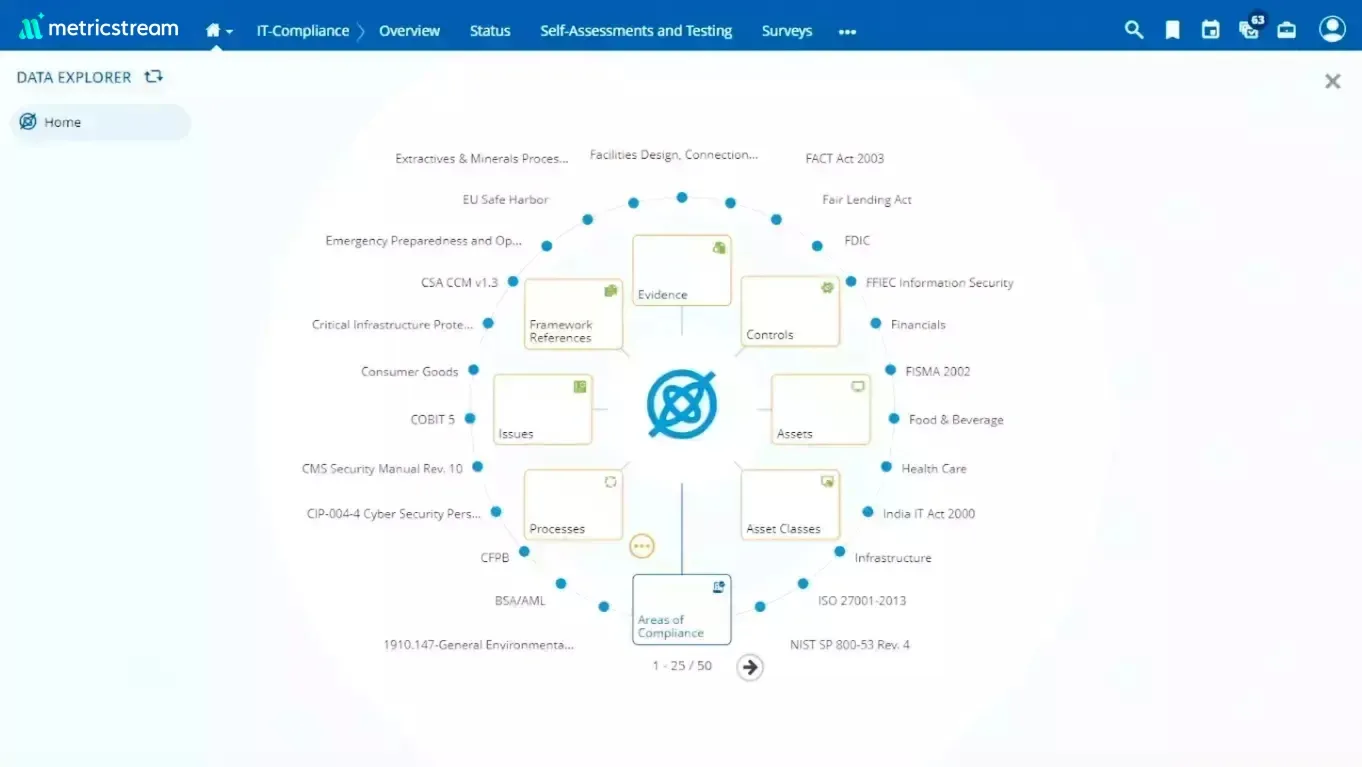
Easily create a structured and logical internal control hierarchy for processes, assets, risks, controls, and control activities. Generate appropriate linkages between these data elements. Eliminate gaps in CCPA data privacy compliance regulations.
Easy-to-Create Compliance Assessments and Surveys
Quickly design assessments and surveys with predefined templates and schedules. Easily document the results to capture non-compliance issues. Use online sign-offs to accelerate executive certifications and certify the effectiveness of the controls.
Automated Compliance and Control Assessments
Strengthen CCPA data privacy compliance by easily linking IT compliance controls and assessment activities to regulatory requirements. Automatically schedule assessments by leveraging predefined criteria and checklists. Perform control tests and attach assessment findings with ease.
Effective Issue and Remediation Management
Quickly resolve any CCPA compliance and control issues with MetricStream’s AI-powered issue management. Make use of intelligent classification to fast-track issue remediation. Automatically route identified issues for immediate actions.
Enhanced View with Dashboards and Reports
Increase visibility into processes with sophisticated graphical dashboards equipped with drill-down capabilities. Get comprehensive visibility into compliance processes with user-specific graphical snapshots and real-time reports.


What Benefits You Can Expect?
- Build confidence with customers, partners, and regulators by ensuring compliance with data privacy and CCPA processes
- Effectively communicate data privacy compliance to the board through easy-to-generate reports
- Save time and costs with automated processes, simplified IT risk assessment, and tracking and linking of policies to regulations
- Avoid CCPA enforcement fines and penalties with automated workflows that enable quick issue identification and remediation within the prescribed timelines








Related Resources




Frequently Asked Questions
Amendments to the California Consumer Privacy Act (CCPA) regulations took effect on January 1, 2026, introducing formal risk assessment requirements, mandatory cybersecurity audits, and new rules for Automated Decision-Making Technology (ADMT). The updates also require that consumer consent be obtained through an active, unambiguous action, rather than through default settings or inaction. Businesses must now provide visible confirmation when an opt-out request has been processed. The California Privacy Protection Agency (CPPA) approved these amendments in September 2025, following several years of public comment and rulemaking. Organizations should review consent flows, risk assessment processes, and audit readiness against the updated timeline.
Cybersecurity audit and risk assessment deadlines under the CCPA are phased by business size and revenue. Risk assessments conducted in 2026 and 2027 must be submitted to the CPPA by April 1, 2028, with later assessments due annually the following April. Businesses with gross revenue exceeding $100 million in 2026 must submit a cybersecurity audit by April 1, 2028, while smaller businesses have later deadlines extending through April 1, 2030. Organizations should establish audit and assessment documentation processes well ahead of these dates to avoid last-minute compliance gaps.
Automated Decision-Making Technology (ADMT) refers to systems that use automated processing, including artificial intelligence, to make or materially influence significant decisions about consumers, such as those related to credit, employment, or healthcare eligibility. Under the CCPA's 2026 regulatory amendments, businesses using ADMT for such decisions must provide consumers with a pre-use notice explaining how the technology works and what data it uses. ADMT-specific notice and opt-out requirements take effect on January 1, 2027. Businesses should begin identifying and inventorying ADMT use cases now to prepare for these obligations.
Businesses that process California residents' personal information, sell or share that information, use sensitive personal information, or deploy Automated Decision-Making Technology (ADMT) for significant decisions fall within scope of the CCPA's expanded 2026 requirements. Insurance companies are also explicitly covered for personal information not otherwise regulated under the California Insurance Code. Businesses relying on third-party processors or service providers remain responsible for ensuring those parties meet the same obligations. Organizations of all sizes should assess whether their processing activities trigger these new requirements.
Organizations can track CCPA and related privacy regulation changes by using regulatory change management tools that automatically map new or amended requirements to existing risks, controls, and policies. This reduces the manual effort involved in monitoring rulemaking activity from bodies such as the California Privacy Protection Agency (CPPA). MetricStream Regulatory Change Management helps organizations maintain a centralized view of applicable privacy regulations and their downstream compliance impact. Consistent monitoring supports timely updates to internal policies as deadlines for cybersecurity audits, risk assessments, and ADMT compliance approach.