





MetricStream empowers organizations to effectively meet HIPAA compliance requirements across the enterprise. Eliminate manual compliance processes with a centralized solution to efficiently store, manage, and access evidence of HIPAA compliance. Track compliance progress and identify and close gaps in real time with user-specific dashboards and graphical snapshots. Leverage a unified control framework to map HIPAA security and privacy rules to other cybersecurity frameworks such as NIST and ISO to achieve a robust cyber risk posture.


Fast-Track HIPAA Compliance
Achieve PHI Security, Enhance Control Visibility, and Meet Regulatory Compliance

Benefit from Systematic and Consistent HIPAA Compliance
MetricStream empowers organizations to effectively meet HIPAA compliance requirements across the enterprise. Eliminate manual compliance processes with a centralized solution to efficiently store, manage, and access evidence of HIPAA compliance. Track compliance progress and identify and close gaps in real time with user-specific dashboards and graphical snapshots. Leverage a unified control framework to map HIPAA security and privacy rules to other cybersecurity frameworks such as NIST and ISO to achieve a robust cyber risk posture. Gain the confidence of your customers, partners, and regulators by easily demonstrating the maturity levels of your organization’s HIPAA compliance.
How Does MetricStream Help You Comply With HIPAA Compliance?
Centralized Compliance Environment Design
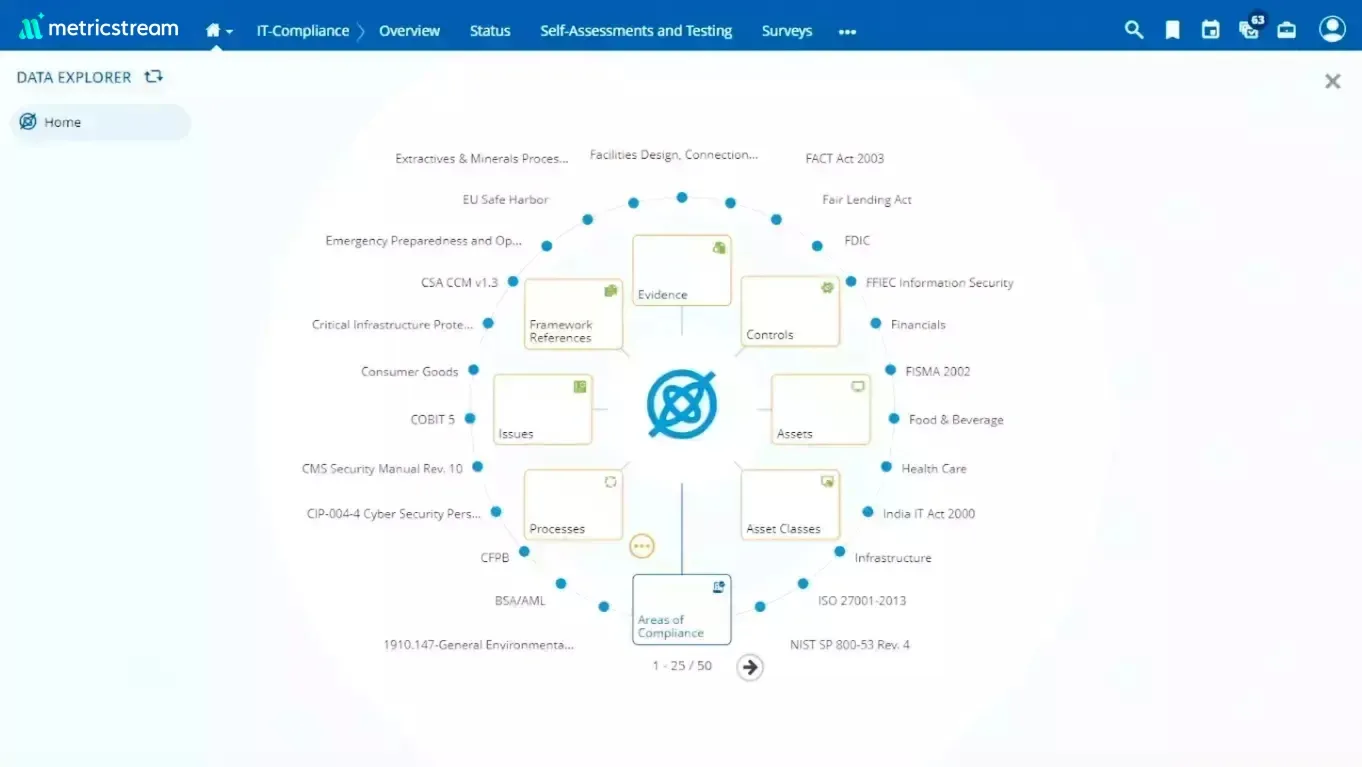
Simplify the creation and management of the IT compliance environment, including HIPAA-specific processes, risks, controls, and audits. Enable an integrated, holistic approach to IT compliance by easily mapping regulatory updates to risks, controls, and policies.
Effective Monitoring of Compliance Assessments
Design and send out surveys and questionnaires for control tests or self-assessment. Easily assign control samples and assign them to control owners, including testers and assessors. Use the scope advisor to select the scope of the test based on risk scores and ratings against selected regulations.
Harmonization and Standardization of IT Compliance
Ensure HIPAA controls are harmonized across multiple IT regulations such as NIST and ISO with the UCF Common Controls Hub and MetricStream GRC Library. Improve IT risk and governance by strengthening your focus on the right areas for cyber risk and compliance management.
Accelerated Issue and Remediation Management
Effortlessly classify issues based on relationships, criticality, and business impact and recommend issue classification with built-in artificial intelligence and machine learning (AI/ML). Accelerate the process of creating and implementing remediation plans and routing to reviewers for approval with real-time tracking of issue remediation.
Real-Time View of IT Compliance
Leverage online dashboards and configurable reports to monitor IT compliance assessments in real time. Drill down on different parameters such as category, line of business, and information classification to view HIPAA compliance advisory-related statistics.


What Benefits You Can Expect?
- Successfully achieve and maintain HIPAA compliance requirements and earn the trust of your partners and customers
- Benefit from time and cost savings with easy IT risk assessment tracking, reduction of de-duplication of evidence requests, and AI-powered automated processes
- Gain a single source of truth of your integrated risk and compliance management for effective business decision making
- Spot HIPAA compliance risks early with improved collaboration among compliance teams and intuitive dashboards and charts that highlight critical insights








Related Resources




Frequently Asked Questions
As of mid-2026, the proposed update to the HIPAA Security Rule remains under review by the Office for Civil Rights (OCR) and has not been finalized. OCR published the Notice of Proposed Rulemaking (NPRM) in January 2025 and received more than 4,700 public comments before the comment period closed. While OCR's regulatory agenda had targeted a final rule for spring 2026, that timeline has passed without a final rule being issued, and the current HIPAA Security Rule remains fully in effect and enforced. Healthcare organizations should continue complying with existing requirements while monitoring for updates.
The proposed HIPAA Security Rule update would remove the distinction between required and addressable implementation specifications, making safeguards such as encryption and multi-factor authentication mandatory rather than optional. Other proposed changes include annual security risk assessments, defined technical testing frequencies, network segmentation requirements, and shorter incident reporting windows for business associates. If finalized, the update would represent the first major revision to the Security Rule since 2003. Organizations can reduce future compliance risk by treating many of these proposed practices as current best practices.
HIPAA's Security Rule does not prescribe specific technical controls in the same way that frameworks like NIST or ISO/IEC 27001 do, which allows organizations to map HIPAA requirements to a broader cybersecurity framework of their choosing. Many healthcare organizations align their HIPAA compliance programs with the NIST Cybersecurity Framework (CSF) or ISO/IEC 27001 information security controls to achieve a more unified risk posture. This harmonization reduces duplicated effort when demonstrating compliance to multiple frameworks. Aligning frameworks can also strengthen readiness for a more prescriptive HIPAA Security Rule, if finalized.
HIPAA compliance applies to covered entities, meaning any individual or organization involved in the treatment, payment, or operations of healthcare, as well as business associates that access protected health information (PHI) on their behalf. This includes third and fourth-party vendors that process, store, or transmit PHI as part of their services to a covered entity. Violations of HIPAA's privacy, security, or breach notification rules can result in civil monetary penalties, which were adjusted upward for inflation effective January 28, 2026. Both covered entities and their vendors share responsibility for compliance.
Healthcare organizations that centralize HIPAA compliance with MetricStream gain a single environment to store, manage, and access evidence of compliance across privacy and security rule requirements. Mapping HIPAA controls to other cybersecurity frameworks, such as NIST and ISO, through a unified control library reduces the effort of maintaining separate documentation for each. Real-time dashboards help compliance teams identify and close gaps before they are flagged in an OCR investigation. This centralized approach also supports faster response if the proposed HIPAA Security Rule update is finalized.