





MetricStream enables organizations to ensure compliance with multiple regulations and established security standards, including those outlined by the National Institute of Standards and Technology (NIST) by harmonizing mappings with a ‘test once, comply with many’ approach. Organizations can adopt NIST’s guidance by configuring it to best suit their risk profile and security needs. MetricStream’s Federated Data Model enables an integrated approach to managing various requirements, risks, controls, and policies, strengthening compliance and risk visibility.


Achieve NIST Compliance Easily and Quickly
Strengthen Cyber Resilience by Effectively Managing and Reducing Cyber Risks

NIST Compliance Simplified
MetricStream enables organizations to ensure compliance with multiple regulations and established security standards, including those outlined by the National Institute of Standards and Technology (NIST) by harmonizing mappings with a ‘test once, comply with many’ approach. Organizations can adopt NIST’s guidance by configuring it to best suit their risk profile and security needs. MetricStream’s Federated Data Model enables an integrated approach to manage various requirements, risks, controls, and policies, strengthening compliance and risk visibility. Organizations can upload pre-packaged content, such as NIST CSF and NIST SP800-53, and get their IT Compliance program up and running in no time.
How Does MetricStream Help You Achieve NIST Compliance?
Proactive Risk Identification and Mitigation
Adopt a proactive and business-driven approach to managing and mitigating IT and cyber risks. Actively conduct IT risk assessments, implement controls, and take mitigation actions as needed. Leverage advanced analytics and reports to gain actionable IT risk intelligence in a timely manner, providing comprehensive visibility into the top cyber risks faced by the organization.
Structured and Streamlined IT Compliance Management
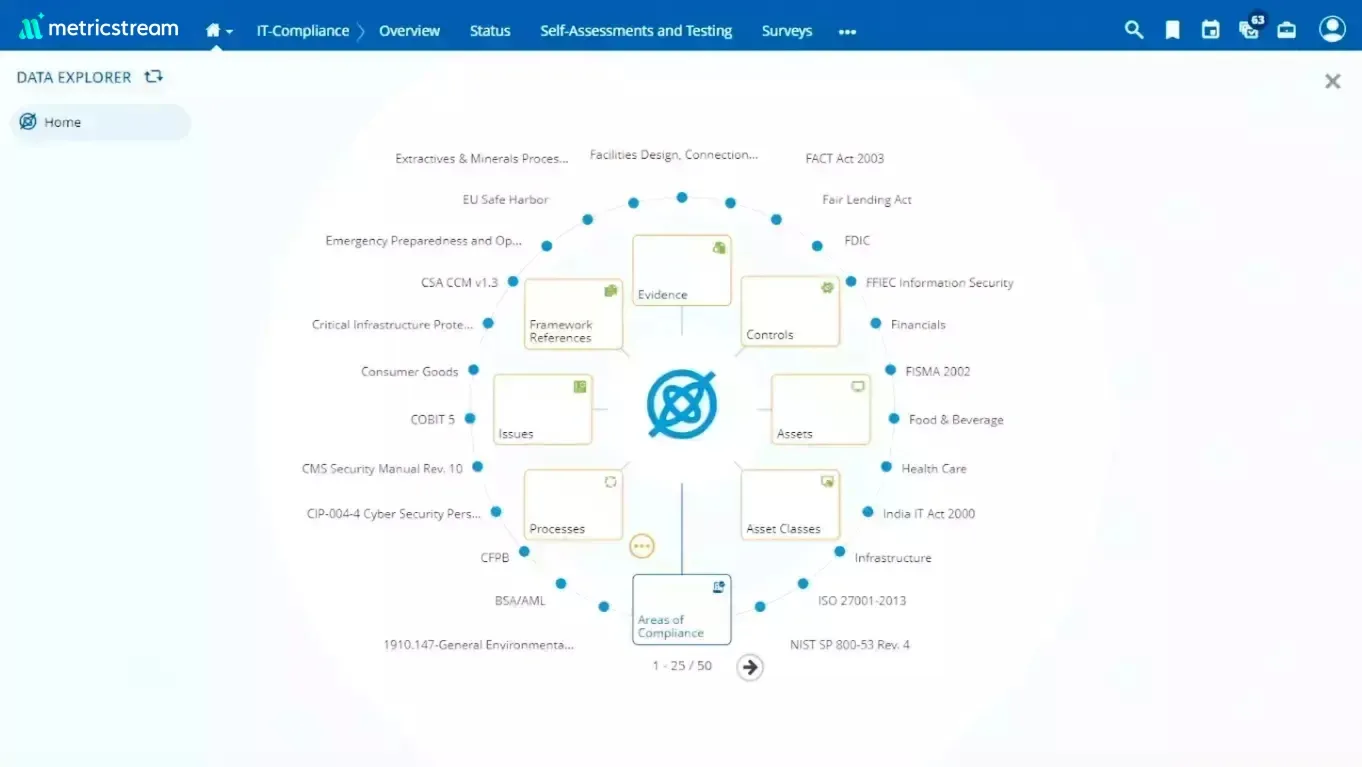
Establish a centralized structure that provides top-level visibility into the overall IT compliance hierarchy, including processes, assets, risks, controls, and audits, and eliminates duplication of efforts. Intelligently map controls to IT regulations and policies and quickly identify the controls for a given regulation, the assessments done on a specific control, and the issues logged from the control assessments.
Harmonized Controls Across Various Compliance Requirements
Standardize and harmonize controls across multiple IT regulations and frameworks, improving compliance and saving effort and costs. Leverage the integration between the Unified Compliance Framework (UCF) and the MetricStream GRC library to enable dynamic linking of IT regulations with UCF control statements.
Simplified Self-Assessments and Surveys
Leverage pre-defined templates and schedules to easily deploy IT compliance surveys, certifications, and control self-assessments, and upload data using a simple form-based interface. Aggregate and analyze survey and assessment data and unlock valuable insights for better-informed business decisions.
Intelligent Issue and Remediation Management
Document, investigate, and resolve IT compliance and control issues in a systematic and automated manner. Leverage AI/ML to quickly and intuitively identify and classify issues. Automatically send out alerts to relevant stakeholders to ensure remediation actions are on track and track progress until closure.


What Benefits You Can Expect?
- Considerable time and cost savings in executing and completing risk assessments when using a framework such as NIST
- Reduced evidence requests through de-duplication
- Significant operational efficiencies from harmonization of controls and rationalized IT control assessments across standards and frameworks
- Enhanced maturity of the IT compliance function, resulting in better corporate brand recall among auditors, governing bodies, and investors
Trusted by Leading Brands








Related Resources




Frequently Asked Questions
The NIST Cybersecurity Framework (CSF) 2.0 is a voluntary, outcome-based framework published by the National Institute of Standards and Technology (NIST) that organizes cybersecurity risk management around six functions: Govern, Identify, Protect, Detect, Respond, and Recover. Released in February 2024, CSF 2.0 expanded the original framework by adding the Govern function and broadening its applicability beyond critical infrastructure to organizations of any size or sector. NIST continues to publish supporting resources, including community profiles and informative references, to help organizations apply CSF 2.0 to specific use cases such as artificial intelligence.
NIST released SP 800-53 Release 5.2.0 in 2025, adding new controls covering logging syntax, design for cyber resiliency, and root cause analysis, in response to a federal executive order directing agencies to strengthen software supply chain security. NIST SP 800-53 remains the foundational catalog of security and privacy controls used across federal agencies, cloud service providers pursuing FedRAMP authorization, and private-sector organizations aligning with frameworks such as CMMC and ISO/IEC 27001. Organizations should review the updated control set to determine whether new requirements apply to their environment.
NIST CSF 2.0 differs from earlier versions primarily through the addition of a sixth function, Govern, which addresses how an organization establishes and monitors its cybersecurity risk management strategy, roles, and policies. CSF 2.0 also broadened its scope beyond critical infrastructure sectors to explicitly serve organizations of any size, sector, or maturity level. NIST has since published Online Informative References (OLIRs) mapping CSF 2.0 to other frameworks, including ISO/IEC 27001:2022 and NIST SP 800-171, to help organizations cross-reference their existing compliance programs.
Any organization seeking a structured, outcome-based approach to managing cybersecurity risk can adopt the NIST Cybersecurity Framework (CSF), regardless of size, sector, or existing regulatory obligations. While NIST SP 800-53 controls are mandatory for U.S. federal agencies under the Federal Information Security Modernization Act (FISMA), many private-sector organizations in healthcare, financial services, and defense manufacturing voluntarily adopt NIST standards to strengthen their cyber risk posture and align with frameworks such as CMMC or HIPAA. Organizations already using another framework can typically map existing controls to NIST with modest additional effort.
Organizations managing NIST compliance with MetricStream can upload pre-packaged content, such as NIST CSF and NIST SP 800-53, to accelerate deployment of their IT compliance program. MetricStream's Federated Data Model supports an integrated approach to managing requirements, risks, controls, and policies across NIST and other harmonized frameworks, reducing duplicated assessment effort. Automated workflows for issue classification and remediation help organizations respond more quickly as NIST releases control updates, such as SP 800-53 Release 5.2.0. This integrated visibility supports stronger, more consistent cyber risk management over time.