





MetricStream enables organizations to achieve comprehensive PCI DSS compliance. Create a structured compliance environment that easily links various processes, assets, risks, controls, and compliance activities. Stay on top of compliance management activities with enterprise-wide visibility into auditing and reporting. Leverage Artificial Intelligence and Machine Learning (AI/ML) to seamlessly create policies for PCI DSS compliance and trigger proactive remediation. Identify potential PCI compliance risks and mitigate them with a unified view into processes for control documentation, assessments, and testing.


PCI Compliance Made Easy
Secure Critical Systems, Prevent Breaches, and Build Customer Confidence

Gain a Comprehensive Solution for PCI DSS Compliance
MetricStream enables organizations to achieve comprehensive PCI DSS compliance. Create a structured compliance environment that easily links various processes, assets, risks, controls, and compliance activities. Stay on top of compliance management activities with enterprise-wide visibility into auditing and reporting. Leverage Artificial Intelligence and Machine Learning (AI/ML) to seamlessly create policies for PCI DSS compliance and trigger proactive remediation. Identify potential PCI compliance risks and mitigate them with a unified view into processes for control documentation, assessments, and testing. Earn the trust of your customers and keep PCI compliance costs low by effectively evaluating the effectiveness of controls.
How Does MetricStream Help You Comply With PCI DSS?
Streamlined Compliance Structure
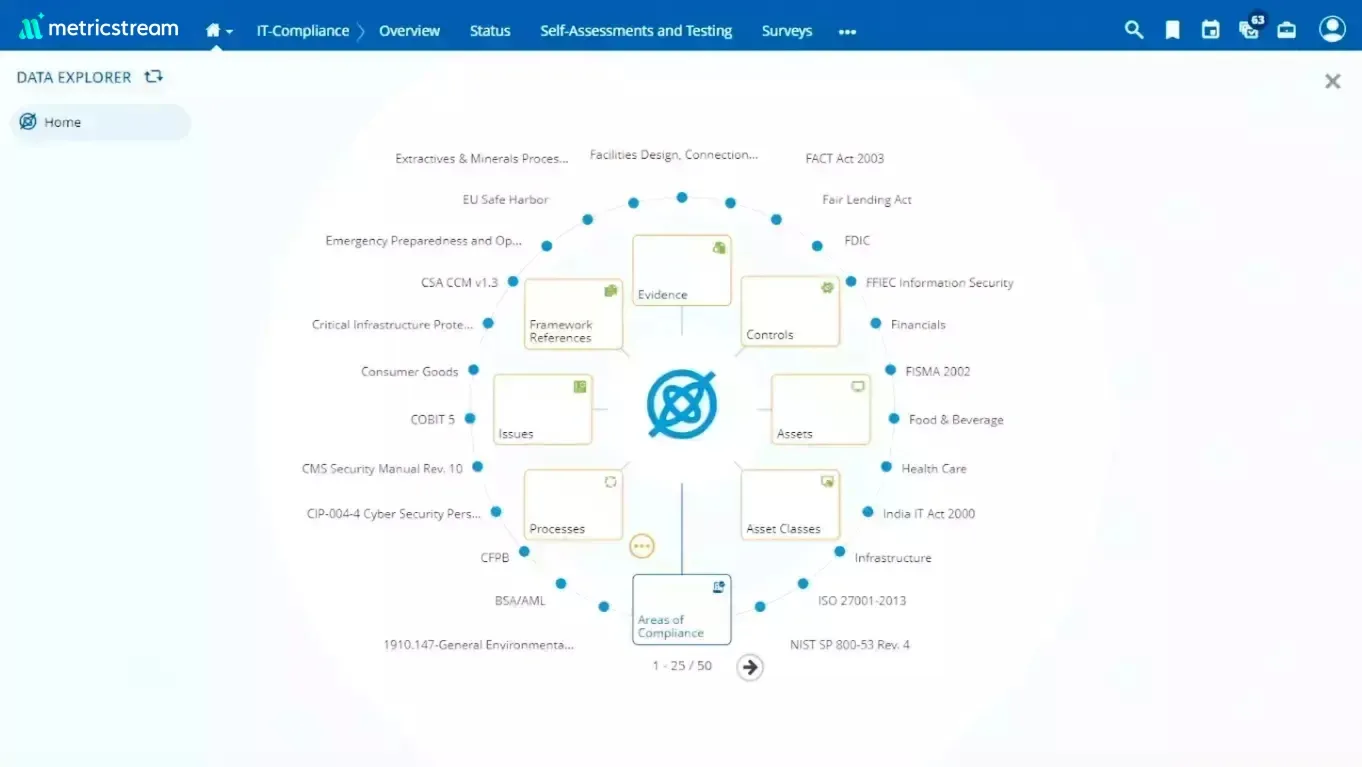
Effortlessly create a structured and logical internal control hierarchy that maps PCI compliance regulations and policies to your organization’s processes, assets, risks, and controls. Eliminate gaps in PCI compliance by maintaining individual PCI requirements in the 12 categories.
Easy-to-Execute Self-Assessments and Surveys
Make use of simple interfaces to upload data and quickly configure and execute IT compliance surveys, certifications, and control self-assessments with predefined templates and schedules. Accelerate executive certifications by leveraging online sign-offs at individual departmental and functional levels.
Simplified IT Compliance and Control Assessments
Easily link IT compliance controls and assessment activities to PCI regulatory requirements. Strengthen PCI compliance by scheduling automatic assessments with the help of predefined criteria and checklists. Complete control tests based on questions and procedures and easily attach assessment findings.
Effective Issue and Remediation Management
Quickly resolve PCI compliance and control issues via AI-powered issue management. Fast-track issue remediation with intelligent classification and automatically route issues for immediate actions. Gain organization-wide visibility into issue and remediation actions in real-time.
Holistic View of PCI Compliance Reporting
Gain comprehensive visibility into your PCI compliance management processes with graphical dashboards equipped with drill-down capabilities. Dive deep into the status of PCI compliance assessment efforts with user-specific dashboards, graphical snapshots, and real-time reports.


What Benefits You Can Expect?
- Avoid non-compliance penalties and earn customer and partner trust by effectively demonstrating the maturity levels of your IT compliance function
- Discover significant time savings with simplified IT risk assessment tracking, easy linking of policies to regulations, and reduced evidence requests through de-duplication
- Enjoy cost efficiencies by leveraging automated processes and AI/ML capabilities for IT compliance
- Strategize business priorities with a unified view of integrated risk and compliance management
Frequently Asked Questions
PCI DSS v4.0.1 is the current and only active version of the Payment Card Industry Data Security Standard as of 2026, since v3.2.1 was retired on March 31, 2024, and v4.0 was superseded by the limited revision v4.0.1 in mid-2024. All formal assessments conducted in 2026 are evaluated against v4.0.1, and every one of its 64 new or updated requirements is now in scope. Organizations still assessing against older versions should transition immediately to avoid failing their next compliance assessment.
Of the 64 new or updated requirements introduced in PCI DSS v4.0, 51 were designated as future-dated best practices until March 31, 2025, when they became fully mandatory for all assessments. These requirements include expanded multi-factor authentication (MFA) for all access into the cardholder data environment (CDE), stronger password requirements, and more frequent vulnerability scanning for certain merchant categories. Organizations that delayed implementing these controls now face assessment failure risk if gaps remain. A gap analysis against the complete v4.0.1 requirement set helps identify remaining remediation priorities.
PCI DSS v4.0.1 is a limited revision of v4.0 that introduces zero new or deleted requirements, focusing instead on correcting typographical errors and clarifying existing requirement language. Notable clarifications include how payment page script management under Requirement 6.4.3 applies to merchants versus third-party service providers, and confirmation that phishing-resistant authentication methods can satisfy certain multi-factor authentication (MFA) provisions. Because the substantive compliance obligations remain those introduced in v4.0, organizations should treat v4.0.1 as the authoritative reference text rather than a separate compliance milestone.
PCI DSS compliance applies to any organization that accepts, transmits, or stores payment cardholder data, including merchants, payment processors, acquirers, issuers, and their service providers. This obligation extends to organizations that outsource payment processing to third parties, since the merchant remains responsible for confirming that those providers maintain compliance. The standard is maintained by the PCI Security Standards Council and enforced by payment card brands and acquiring banks rather than by government regulation. Non-compliance can result in significant fines and, in serious cases, loss of the ability to process card payments.
Organizations managing PCI DSS compliance with MetricStream gain a structured environment that links processes, assets, risks, and controls to the 12 PCI DSS requirement categories, reducing the effort of tracking compliance across multiple business units. AI-powered issue management helps organizations classify and remediate PCI compliance gaps more quickly as new requirements, such as those introduced in PCI DSS v4.0.1, become mandatory. Real-time dashboards give stakeholders visibility into assessment status and control effectiveness. This structured approach helps organizations maintain customer trust while reducing the administrative burden of recurring assessments.