

Introduction
As organizations operate in an increasingly complex and volatile business landscape, the role of Governance, Risk, and Compliance (GRC) has never been more crucial. To better understand the challenges and priorities of global GRC professionals, MetricStream and the GRC Report conducted a comprehensive survey in December 2024 and January 2025, gathering insights from over 100 industry professionals worldwide, including Chief Risk Officers (CROs), Chief Compliance Officers (CCOs), Chief Information Security Officers (CISOs), risk and compliance managers, and audit professionals.
The survey captured key concerns and priorities shaping GRC strategies today. Participants shared their perspectives on regulatory complexity, enterprise resilience, cybersecurity, and AI’s growing role in risk management. Their responses highlight the most pressing issues and opportunities in the field, providing a benchmark for organizations to assess and refine their own GRC approaches.
Here are five critical findings from the survey that every risk and compliance leader should know.
48% of GRC Professionals Find Cyber Risk a Major Challenge
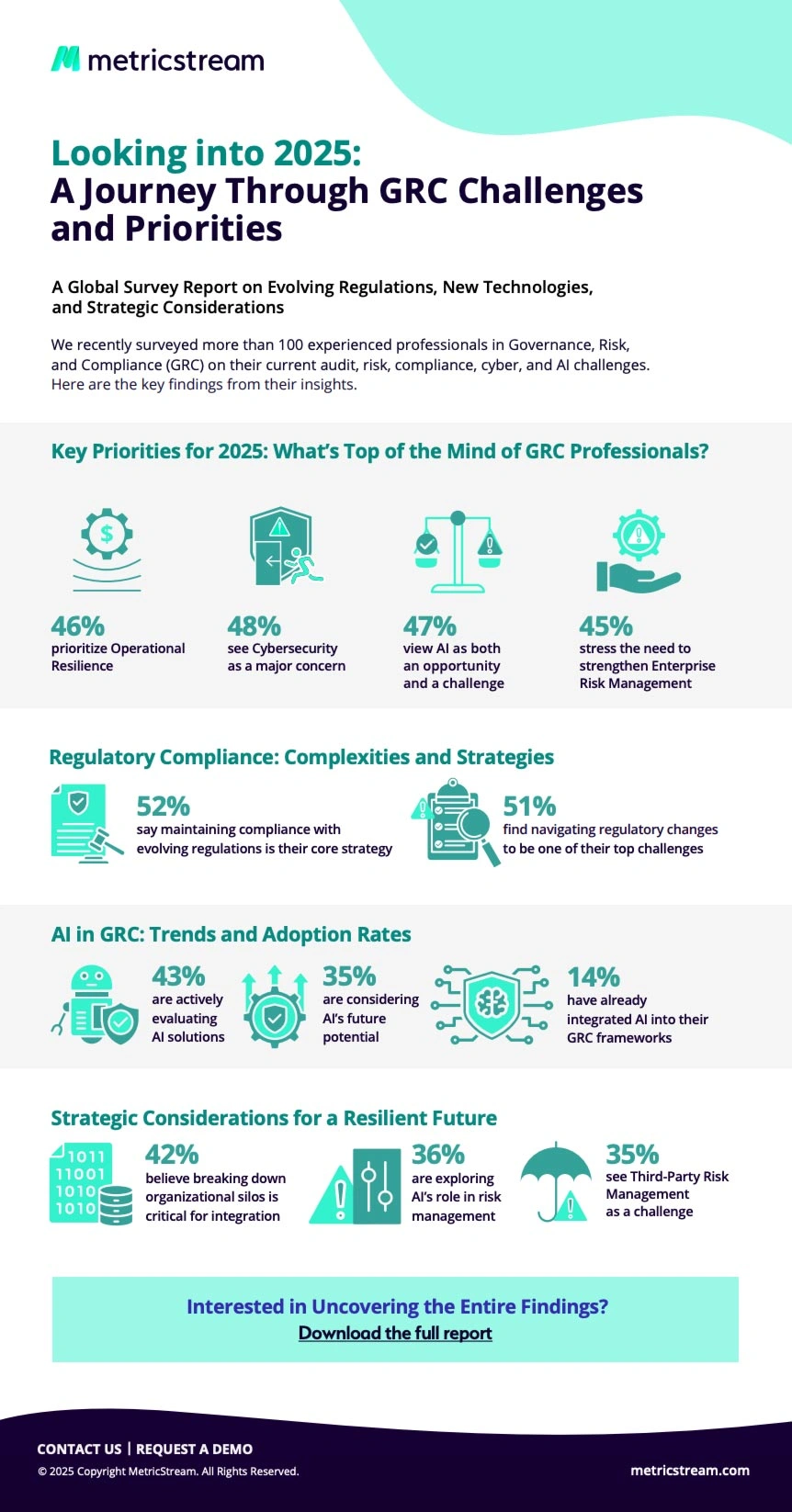
The rapid digitization of business processes, coupled with the rising threat of ransomware attacks, supply chain vulnerabilities, and AI-driven cyber risks, is putting organizations on high alert. “The increase in sophistication of cyber-attacks and breaches remains top on the agenda,” said one of our respondents, reflecting the views of 48% of professionals who said they struggle to keep up with increasingly sophisticated cybersecurity threats.
GRC and cyber risk leaders must prioritize robust cybersecurity frameworks, implement continuous monitoring, and enhance threat intelligence capabilities. Proactive measures such as cyber resilience planning, zero-trust architectures, and employee training will be key to mitigating these evolving risks.
47% Recognize AI's Value, but Only 14% Have Integrated It
Artificial Intelligence (AI) has the potential to revolutionize GRC by automating risk assessments, detecting anomalies in near real-time, and streamlining complicated compliance processes. However, adoption remains slow, indicating that many organizations are still in the early stages of leveraging. AI-driven insights. According to the report, those who have embraced AI use it for risk monitoring, automating compliance tasks, and enhancing threat detection.
When asked about their concerns regarding AI in GRC, respondents emphasized the need for governance frameworks specific to AI. Some highlighted “the challenge of adding in governance for AI while also leveraging AI within security responsibly,” while others warned that "AI is being pushed and adopted too rapidly, regardless of compliance."
Overcoming barriers such as lack of expertise, integration challenges, and regulatory uncertainties will also be crucial to accelerating AI adoption in GRC. Companies that successfully incorporate AI-powered analytics and automation into their risk management strategies stand to gain a significant competitive advantage.
46% of Respondents Named Resilience as a Critical Priority
From geopolitical disruptions to climate-related risks, organizations are facing a deluge of challenges that demand a more resilient approach. 46% of respondents highlighted an urgent need to build resilient enterprises to navigate an unpredictable risk landscape. One respondent captured the importance of resilience accurately, “Juggling all sorts of challenges, but Operational Resilience will probably be the highest focus.”
Resilience in GRC goes beyond risk mitigation—it involves anticipating disruptions, strengthening supply chains, and ensuring business continuity under any circumstances. Leaders must invest in scenario planning, stress testing, and integrated risk management frameworks to enhance organizational resilience and adaptability.
45% of GRC Professionals Stressed the Need to Strengthen ERM
Enterprise Risk Management (ERM) is at the core of an organization’s ability to identify, assess, and respond to risks effectively, and 45% of respondents agree that it will be a top priority for them in 2025. ERM featured in the biggest concerns listed by GRC professionals when it came to planning for GRC and risk for the year ahead. As one respondent captured it, the key priority is to “break down silos between risk, compliance, and operations teams to improve collaboration.”
With risks becoming more interconnected, GRC teams must move beyond siloed risk management approaches and adopt a holistic, enterprise-wide view. Aligning ERM strategies with business objectives, embedding risk culture at all levels, and leveraging real-time data analytics will be critical to managing uncertainties in 2025 and beyond.
Final Thoughts
The survey findings underscore the evolving nature of GRC and the need for organizations to stay prepared to effectively manage regulatory shifts, cybersecurity threats, AI-driven transformations, and resilience-building efforts. As risk and compliance leaders navigate the complexities of 2025, a proactive and technology-driven approach will be essential to ensuring long-term success. Investing in advanced GRC solutions, fostering a culture of risk awareness, and embracing innovation will position organizations to thrive in an increasingly uncertain world.
Download the full report: Looking into 2025 – A Journey Through GRC Challenges and Priorities