




Overview
IT systems play a critical role in ensuring the accuracy of a company's financial reports. As a result, validation of IT controls is a key part of Sarbanes-Oxley compliance initiative.
Key Takeaways
- SOX controls are crucial for ensuring accurate, transparent financial reporting and preventing fraud.
- They encompass both process-level and IT-level safeguards, particularly IT General Controls (ITGCs) and Application Controls.
- Section 302 mandates executive certification of financial reports, while Section 404 requires testing and documentation of internal controls.
- Dynamic, risk-based testing (SOX 404 top-down approach) helps identify “key” controls linked to material misstatement risks.
Definition
SOX controls are internal measures mandated by the Sarbanes-Oxley Act of 2002 to ensure the accuracy, integrity, and transparency of financial reporting and to prevent corporate fraud and material misstatements.
What Are SOX Controls?
SOX Controls are internal measures established by companies to ensure transparency, accuracy and integrity of a company's financial reporting process. These controls are designed to mitigate risks and prevent fraud, errors, and misstatements.
However, in Year 1 most companies pursued IT control validation in a reactive manner. As a result, the cost of compliance was very high. This brief reviews the most common weaknesses in IT controls, discusses a framework for defining and assessing IT controls in Year 2 and examines how the proposed IT controls structure will map to the COSO framework used for SOX compliance.
Based on our recent research, the leading control weakness discovered in IT controls during the IT audit was in the improper provisioning of user accounts with Segregation of Duties (SOD). SOD reduces risks by providing an internal control on performance through separation of custody of assets from accounting personnel, separation of authorization of transactions from custody of related assets and separation of operational responsibilities from record keeping responsibilities. Commonly used SOD controls include segregating expense approval from accounts payable or segregating requisitioning from purchasing or segregating receiving from purchasing.
There are various alternatives available to implement SOD and the chosen method should be clearly documented for the appropriate IT applications, so the SOD control can be easily tested and retested. Alternatives include:
- Forbid the transaction under all circumstances
- Forbid the transaction except with high-level authority
- Permit the transaction based on rules, such as dollar value approval levels
- Permit the transaction with "reason codes" to justify the action for subsequent review
- Permit the transaction with subsequent approval (transaction should be flagged and the approval logged)
The other common weaknesses discovered during the IT audit include insufficient controls for change management; a general lack of understanding around key system configurations; audit logs not being reviewed (or that review itself not being logged) and abnormal transactions not identified in a timely manner. These key weaknesses in IT controls can materially affect the integrity of financial data within a company, leading to inaccurate (or false) financial reporting.
Companies are deploying COBIT-based controls structure to identify and design key IT level controls. The picture below shows the recommended IT control structure that was derived from the COBIT model. The general IT level controls in this structure map to the entity-level controls for the IT function within the SOx controls hierarchy, while the application-level controls in this structure should be included in process/sub-process level controls defined within the SOx controls hierarchy. For further details, refer to the documentation on COBIT from Information Systems Audit & Control Association, available at their website on www.isaca.org.
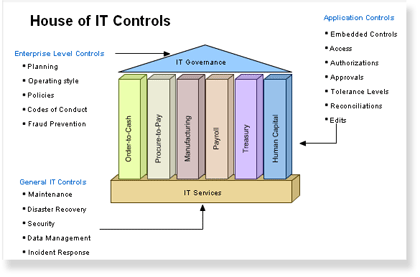
Once the IT level controls are defined using the above structure, they are ready to be assessed for design effectiveness and operational effectiveness. The following seven step process streamlines the design, assessment and remediation process.
- Identify the IT-related controls based on the "House of IT Controls" structure displayed above
- Document the existing IT controls and the associated processes related to the IT control
- Create a checklist for assessing the operational effectiveness of controls
- Test the controls
- Identify issues needing to be addressed
- Define corrective actions and ensure they have been implemented
- Audit the IT controls to ensure the corrective actions have addressed the issue
Since IT systems are at the core of the financial reporting process for any organization, the automation of assessment and remediation of IT controls should not be done in isolation from the automation of assessment and remediation of internal controls for Sarbanes-Oxley compliance. In addition, the process for assessment and remediation of internal controls for Sarbanes-Oxley compliance also maps very closely to the seven step process described above. Hence, it is essential that user select a software vendor that supports both - automation of assessment and remediation of internal controls for Sarbanes-Oxley compliance and automation of audit & assessment of IT controls.
Purpose of SOX Controls
- Establish Accountability: Require management, particularly CEOs and CFOs, to certify financial statements and internal controls.
- Safeguard Integrity: Protect against manipulation or errors in financial systems through strong internal controls.
Rebuild Trust: Responding to earlier corporate scandals, SOX aims to restore investor confidence and strengthen corporate governance.
Types of SOX Controls
- IT General Controls (ITGCs): Foundational controls such as access management, change control, and backup processes that support the integrity of financial systems.
- Application Controls: Controls specific to financial processes—like calculations, reconciliations, and data validity checks—embedded in applications.
- Executive Certification Controls: Mandated under Section 302, requiring formal attestation of financial accuracy by senior executives.
Top-Down Risk Assessments: An approach under SOX 404 that focuses testing on controls that mitigate material misstatement risks.
Examples of SOX Controls
- User Access Controls: Ensuring only authorized personnel can access financial systems.
- Change Management Controls: Enforcing formal approval processes for modifications in financial applications.
- Backup and Recovery Procedures: Ensuring data resilience in case of system disruptions.
- Segregation of Duties: Preventing any single person from controlling multiple critical financial tasks.
- Executive Certifications: CEO/CFO certifications under Section 302 to attest the accuracy of financial reports.
Best Practices for SOX Controls
- Adopt a Top-Down, Risk-Based Approach: Prioritize and test controls tied to key financial risks.
- Document Thoroughly: Maintain clear evidence for control design, operating effectiveness, and executive attestations.
- Automate Where Possible: Use audit and GRC tools (such as MetricStream) to streamline testing, documentation, and certification workflows.
- Test Regularly and Consistently: Apply testing methods like inquiry, observation, and reperformance to validate control effectiveness. Also, ensure remediation of identified deficiencies.
SOX controls—spanning IT General Controls, Application Controls, and executive certifications—are essential for safeguarding financial reporting integrity. A top-down, risk-based testing approach ensures testing focuses on critical areas. Robust documentation, automation, and regular testing are foundational to both compliance and resilient internal control systems.
FAQs
What are SOX controls?
Internal procedures required under the Sarbanes-Oxley Act (2002) to ensure accurate financial reporting, detect fraud, and maintain transparency.
What’s the difference between ITGCs and Application Controls?
ITGCs secure the environment supporting financial systems, while Application Controls ensure accuracy and completeness within financial applications themselves.
What do Sections 302 and 404 cover?
Section 302 requires top executives to certify financial statements; Section 404 mandates management and auditors to evaluate and report on internal control effectiveness.
How does a top-down risk-based approach work?
It targets and tests only those controls that mitigate the highest-risk areas of financial reporting, enhancing compliance efficiency and effectiveness.

Subscribe for Latest Updates
Subscribe Now