





Introduction
Today's world is a bustling marketplace of ideas, innovations, and intricate networks. Every business, regardless of its size, operates within this complex framework, continuously exposed to a multitude of risks. The March 2025 KPMG Risk and Resilience Survey of 208 US C-suite leaders found that while 68% of organisations are using specialised technology, AI, or advanced analytics to manage risks, only 26% report strong cross-functional collaboration and a holistic view of risks, pointing to a gap between tool adoption and programme integration that purpose-built risk assessment software is specifically designed to close.
Risk assessment software is a technology platform that automates and standardizes the identification, evaluation, prioritization, and documentation of risks across an organization, replacing manual spreadsheet processes with structured templates, automated scoring, collaborative workflows, and integrated dashboards. It is a core module within GRC and enterprise risk management platforms, applicable across operational, financial, cyber, compliance, and third-party risk domains.
With such formidable challenges, organizations are increasingly turning to technology for help. With an array of options available, how do you select the right risk assessment software to bolster your organization's defenses and optimize your risk management processes?
Key Takeaways
- Risk assessment software identifies, evaluates, and prioritizes risks with analytical tools to enhance proactive risk management.
- Top Benefits: It provides clear risk visualization, improves resource allocation, offers real-time updates, fosters departmental collaboration, and reduces human error through automation.
- Key Features to Look For: Seek software with scalable architecture, strong security, real-time alerts, custom reporting, a user-friendly interface, and cross-collaborative tools.
- Some of the top risk assessment software in the market include MetricStream, LogicManager, RSA Archer, and Riskonnect.
What is Risk Assessment Software?
Risk assessment software is a sophisticated tool designed to identify, evaluate, and prioritize organizational risks. These risks can range from operational and financial to strategic and compliance-related. The software facilitates a systematic approach to risk management by providing frameworks, methodologies, and analytics to assess potential threats. By doing so, it enables organizations to mitigate risks proactively, ensuring business continuity and regulatory compliance.
Risk Assessment Software Use Cases
| Use Case | Primary Focus | Key Features | Typical Users |
| Enterprise Risk Management | Cross-enterprise risk portfolio management | Risk taxonomy; heat maps; appetite alignment; board reporting | CRO; Risk Committee |
| Operational Risk (Basel IV) | Operational loss capture and RCSA | Loss event capture; RCSA workflows; scenario analysis; SMA calculation | ORM teams; Basel compliance |
| IT and Cyber Risk | Technology and cybersecurity risk | IT asset inventory; threat library; vulnerability integration; FAIR methodology | CISO; IT Risk Manager |
| Compliance Risk | Regulatory obligation mapping and gap analysis | Regulatory library; compliance gap analysis; control mapping | CCO; Compliance teams |
| Third-Party Risk | Vendor and supply chain risk management | Vendor questionnaires; risk scoring; continuous monitoring | Procurement; TPRM teams |
| Project Risk | Project-specific risk assessment | Monte Carlo simulation; project risk register | PMO; Project Managers |
Top 5 Benefits of Using a Risk Assessment Software
Risk assessment software enhances organizational efficiency by offering clear risk visualization, improving resource allocation, providing real-time updates, fostering cross-departmental collaboration, and reducing human error through automation.
Here are the main benefits of utilizing a comprehensive risk assessment software:
- Comprehensive Risk Visualization Visualizing risks clearly and concisely can significantly enhance understanding and communication across an organization. Risk assessment software typically includes sophisticated visualization tools such as heat maps, risk matrices, and scenario analysis graphs. These visual aids transform complex data into easily digestible formats, making it simpler for stakeholders to comprehend the risk at hand.
- Improved Resource Allocation Allocating resources effectively is crucial for minimizing risks and maximizing opportunities. Risk assessment software provides valuable insights into where resources should be deployed for optimal impact. By identifying high-risk areas and potential vulnerabilities, businesses can allocate their resources more judiciously, ensuring that critical areas receive the attention they need.
- Real-Time Risk Updates for Effective Decision-Making Risk assessment software offers real-time insights, providing up-to-date information on emerging threats and vulnerabilities. This immediacy allows decision-makers to react swiftly, recalibrating strategies and mitigating risks before they escalate.
- Enhanced Collaboration Across Departments Risk management should not be confined to a single department. Risk assessment software fosters cross-departmental collaboration by centralizing data, making it accessible to relevant teams across the organization. This encourages a more holistic view of risks, as different departments can share insights and work together on mitigation strategies, strengthening the overall risk posture.
- Minimized Human Error through Automation Manual processes in risk assessment often leave room for mistakes, misjudgments, or oversight. Risk assessment software reduces the margin for error by automating data collection, analysis, and reporting. With automated workflows, businesses can ensure that risks are accurately identified and assessed without human miscalculations, providing greater reliability and consistency across the board.
Manual vs Software-Driven Risk Assessment
| Dimension | Manual (Spreadsheet) | Risk Assessment Software |
| Consistency | Varies by assessor with no enforced methodology | Standardised methodology applied uniformly across all assessors and business units |
| Collaboration | Email-based with version control issues | Real-time multi-user input with complete audit trail |
| Aggregation | Manual consolidation that is error-prone and time-consuming | Automatic portfolio aggregation and heat map generation |
| Residual Risk Calculation | Manual and easily missed when controls change | Auto-recalculated from control effectiveness updates in real time |
| Evidence Management | Scattered across emails and shared files | Centralised and linked directly to each risk assessment |
| Regulatory Reporting | Manual extraction that is time-consuming and inconsistent | Automated regulatory reports generated on demand |
| Dynamic Updates | Requires manual intervention to reflect changing conditions | Auto-triggered from live data feeds and KRI threshold breaches |
Top Risk Assessment Software in the Market
Here are some of the top risk assessment software in the market:
MetricStream
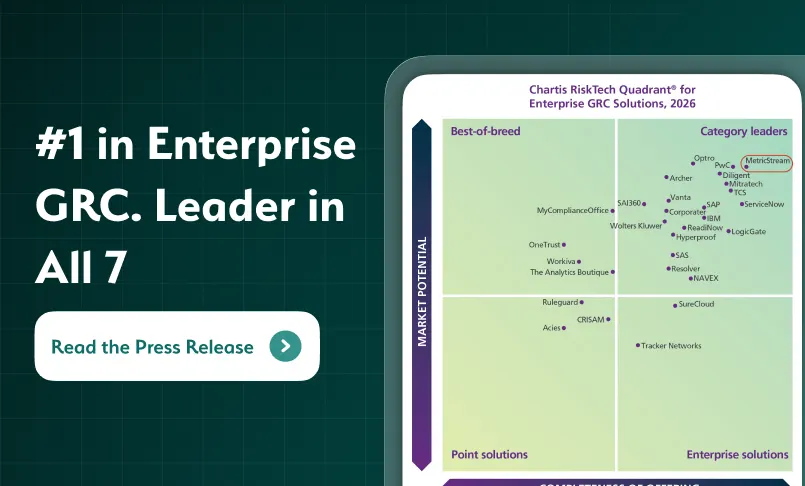
MetricStream is widely respected for its comprehensive range of governance, risk, and compliance (GRC) solutions. With risk quantification tools, organizations can assess the financial impact of risks, offering clarity on decision-making.
Its flexibility allows businesses to customize features and workflows, making it a versatile solution for various industries of all sizes.
Integration with third-party systems also ensures that users can seamlessly integrate risk management into broader operational processes. What truly shines is its commitment to continuous risk monitoring, allowing real-time adaptation to dynamic risks.
MetricStream is ideal for organizations needing a risk assessment platform that can be tailored to their specific needs.
LogicManager
LogicManager is beloved for its intuitive user interface and focus on self-service customization. It lets users tailor risk workflows without needing heavy IT involvement.
Its taxonomy technology allows businesses to easily categorize risks across departments, giving a holistic view of interconnected risks. Risk visualization dashboards provide a clear, birds-eye view of all current risks, and their automated reporting tools make it simple for organizations to track and present data to stakeholders.
LogicManager is often praised for its accessibility and ease of use, making it ideal for small to medium-sized businesses. The platform also offers extensive pre-built frameworks for quick implementation, allowing companies to hit the ground running with their risk management strategy.
RSA Archer
RSA Archer is renowned for its customizability and modular approach to risk management. This flexibility allows organizations to build their risk management system based on their unique needs, making it highly popular in regulated sectors like finance and government.
Archer’s advanced reporting capabilities give stakeholders access to detailed insights into risk exposure, which supports more strategic decision-making. Another differentiating feature is its ability to manage various types of risks (including operational, IT, and third-party risks) within a unified platform, creating a truly integrated risk management framework.
RSA Archer is particularly well-suited for businesses dealing with complex regulatory outlines and demanding governance needs. Their comprehensive audit tracking is beneficial for organizations that need to track compliance across multiple standards and regulations, allowing them to stay ahead of audits and certifications. Riskonnect Riskonnect excels with its integrated incident management capabilities, ensuring that organizations can quickly capture and respond to risks as they arise. It provides real-time risk data, which is critical for organizations dealing with constantly changing environments like healthcare or manufacturing. One standout feature is Riskonnect’s scenario analysis tools, which allow companies to model potential future risks based on current conditions. Additionally, the platform supports automated workflows to streamline risk management tasks, reducing manual effort. It’s also highly regarded for its ability to centralize risk data from various departments, giving decision-makers a unified view of organizational risks. The software’s regulatory compliance tracking tools are another standout, helping organizations in heavily regulated industries stay compliant.
Features to Look For in Risk Assessment Software
Let's explore some must-features that should be on your radar:
- Scalable Architecture for Growing Needs As your organization grows, your risk assessment needs will inevitably become more complex. Therefore, the software you choose should have a scalable architecture that can accommodate this growth. Look for features that allow for easy integration with other enterprise systems, such as ERP, CRM, and BI tools.
- Strong Security Measures Ensure that the risk assessment software you choose has robust security measures in place to protect your information. This includes data encryption, access controls, regular security audits, and compliance with data protection regulations. Secure software helps instill confidence in your stakeholders about the integrity of your risk management processes.
- Real-Time Risk Warnings When seconds matter, real-time alerts make all the difference. Ensure your software keeps you in the loop with instant notifications about evolving threats or emerging vulnerabilities. With automated alerts, you can respond immediately, reducing risks before they disrupt operations.
- Custom Reporting Tools No two organizations are alike, and neither should be their risk reports. Choose software that lets you shape your data presentation; tailored dashboards, personalized filters, and unique visualizations. This ensures that every department receives reports relevant to their specific concerns, enhancing targeted decision-making and overall efficiency.
- User-Friendly Interface The software should have a user-friendly interface that makes it easy for both risk management professionals and non-experts to use effectively. Features like drag-and-drop functionalities, intuitive navigation, and clear instructions can significantly enhance user experience.
- Collaborative Risk Solutions Risk management thrives on cross-department collaboration. Look for software that bridges the gap with tools for shared workspaces, real-time updates, and task coordination. This fosters better communication between teams and aligns everyone on the path to mitigating risks, streamlining company-wide efforts.
Risk Assessment Software Evaluation Criteria
The table below translates each capability into concrete assessment questions to put to vendors during evaluation:
| Criterion | What to Look For | Questions to Ask |
| Methodology Flexibility | Configurable qualitative, semi-quantitative, and quantitative assessment support | Can I configure my own scales and rating thresholds without vendor involvement? |
| Risk Taxonomy and Library | Pre-built industry risk libraries with customisable taxonomy | Is there a pre-built risk library for my industry and regulatory context? |
| Workflow Automation | Auto-distribution of assessments, completion reminders, and escalation routing | How are risk owners notified, and what happens when they do not respond? |
| Scoring Engine | Automated residual risk calculation driven by control effectiveness data | Does residual risk auto-update when control test results change? |
| Integration | Connectivity to ERP, SIEM, and external data sources for dynamic risk inputs | What data sources can automatically feed into risk assessments? |
| Reporting and Dashboards | Executive dashboards, regulatory reporting outputs, and trend analysis | Show me a board-level risk report generated from live data. |
| AI Capabilities | Anomaly detection, predictive risk signals, and intelligent prioritisation | What specific AI features are available and can you demonstrate them live? |
Conclusion
The choice of risk assessment software should align with the specific complexities of your organization’s environment. Solutions that offer flexibility, scalability, and comprehensive insights can transform risk management from a routine task into a strategic advantage. By leveraging these capabilities, organizations can enhance their ability to anticipate, navigate, and capitalize on risks.
Among the leading solutions in this space, MetricStream’s Operational Risk Management and Enterprise Risk Management solutions distinguish themselves with its integrated platform that addresses the full spectrum of risk management needs. Our approach combines robust functionality with a deep understanding of risk dynamics, providing organizations with just the right tools necessary to turn risk into opportunity and strengthen their strategic position.
Today's world is a bustling marketplace of ideas, innovations, and intricate networks. Every business, regardless of its size, operates within this complex framework, continuously exposed to a multitude of risks. The March 2025 KPMG Risk and Resilience Survey of 208 US C-suite leaders found that while 68% of organisations are using specialised technology, AI, or advanced analytics to manage risks, only 26% report strong cross-functional collaboration and a holistic view of risks, pointing to a gap between tool adoption and programme integration that purpose-built risk assessment software is specifically designed to close.
Risk assessment software is a technology platform that automates and standardizes the identification, evaluation, prioritization, and documentation of risks across an organization, replacing manual spreadsheet processes with structured templates, automated scoring, collaborative workflows, and integrated dashboards. It is a core module within GRC and enterprise risk management platforms, applicable across operational, financial, cyber, compliance, and third-party risk domains.
With such formidable challenges, organizations are increasingly turning to technology for help. With an array of options available, how do you select the right risk assessment software to bolster your organization's defenses and optimize your risk management processes?
- Risk assessment software identifies, evaluates, and prioritizes risks with analytical tools to enhance proactive risk management.
- Top Benefits: It provides clear risk visualization, improves resource allocation, offers real-time updates, fosters departmental collaboration, and reduces human error through automation.
- Key Features to Look For: Seek software with scalable architecture, strong security, real-time alerts, custom reporting, a user-friendly interface, and cross-collaborative tools.
- Some of the top risk assessment software in the market include MetricStream, LogicManager, RSA Archer, and Riskonnect.
Risk assessment software is a sophisticated tool designed to identify, evaluate, and prioritize organizational risks. These risks can range from operational and financial to strategic and compliance-related. The software facilitates a systematic approach to risk management by providing frameworks, methodologies, and analytics to assess potential threats. By doing so, it enables organizations to mitigate risks proactively, ensuring business continuity and regulatory compliance.
Risk Assessment Software Use Cases
| Use Case | Primary Focus | Key Features | Typical Users |
| Enterprise Risk Management | Cross-enterprise risk portfolio management | Risk taxonomy; heat maps; appetite alignment; board reporting | CRO; Risk Committee |
| Operational Risk (Basel IV) | Operational loss capture and RCSA | Loss event capture; RCSA workflows; scenario analysis; SMA calculation | ORM teams; Basel compliance |
| IT and Cyber Risk | Technology and cybersecurity risk | IT asset inventory; threat library; vulnerability integration; FAIR methodology | CISO; IT Risk Manager |
| Compliance Risk | Regulatory obligation mapping and gap analysis | Regulatory library; compliance gap analysis; control mapping | CCO; Compliance teams |
| Third-Party Risk | Vendor and supply chain risk management | Vendor questionnaires; risk scoring; continuous monitoring | Procurement; TPRM teams |
| Project Risk | Project-specific risk assessment | Monte Carlo simulation; project risk register | PMO; Project Managers |
Risk assessment software enhances organizational efficiency by offering clear risk visualization, improving resource allocation, providing real-time updates, fostering cross-departmental collaboration, and reducing human error through automation.
Here are the main benefits of utilizing a comprehensive risk assessment software:
- Comprehensive Risk Visualization Visualizing risks clearly and concisely can significantly enhance understanding and communication across an organization. Risk assessment software typically includes sophisticated visualization tools such as heat maps, risk matrices, and scenario analysis graphs. These visual aids transform complex data into easily digestible formats, making it simpler for stakeholders to comprehend the risk at hand.
- Improved Resource Allocation Allocating resources effectively is crucial for minimizing risks and maximizing opportunities. Risk assessment software provides valuable insights into where resources should be deployed for optimal impact. By identifying high-risk areas and potential vulnerabilities, businesses can allocate their resources more judiciously, ensuring that critical areas receive the attention they need.
- Real-Time Risk Updates for Effective Decision-Making Risk assessment software offers real-time insights, providing up-to-date information on emerging threats and vulnerabilities. This immediacy allows decision-makers to react swiftly, recalibrating strategies and mitigating risks before they escalate.
- Enhanced Collaboration Across Departments Risk management should not be confined to a single department. Risk assessment software fosters cross-departmental collaboration by centralizing data, making it accessible to relevant teams across the organization. This encourages a more holistic view of risks, as different departments can share insights and work together on mitigation strategies, strengthening the overall risk posture.
- Minimized Human Error through Automation Manual processes in risk assessment often leave room for mistakes, misjudgments, or oversight. Risk assessment software reduces the margin for error by automating data collection, analysis, and reporting. With automated workflows, businesses can ensure that risks are accurately identified and assessed without human miscalculations, providing greater reliability and consistency across the board.
Manual vs Software-Driven Risk Assessment
| Dimension | Manual (Spreadsheet) | Risk Assessment Software |
| Consistency | Varies by assessor with no enforced methodology | Standardised methodology applied uniformly across all assessors and business units |
| Collaboration | Email-based with version control issues | Real-time multi-user input with complete audit trail |
| Aggregation | Manual consolidation that is error-prone and time-consuming | Automatic portfolio aggregation and heat map generation |
| Residual Risk Calculation | Manual and easily missed when controls change | Auto-recalculated from control effectiveness updates in real time |
| Evidence Management | Scattered across emails and shared files | Centralised and linked directly to each risk assessment |
| Regulatory Reporting | Manual extraction that is time-consuming and inconsistent | Automated regulatory reports generated on demand |
| Dynamic Updates | Requires manual intervention to reflect changing conditions | Auto-triggered from live data feeds and KRI threshold breaches |
Here are some of the top risk assessment software in the market:
MetricStream
MetricStream is widely respected for its comprehensive range of governance, risk, and compliance (GRC) solutions. With risk quantification tools, organizations can assess the financial impact of risks, offering clarity on decision-making.
Its flexibility allows businesses to customize features and workflows, making it a versatile solution for various industries of all sizes.
Integration with third-party systems also ensures that users can seamlessly integrate risk management into broader operational processes. What truly shines is its commitment to continuous risk monitoring, allowing real-time adaptation to dynamic risks.
MetricStream is ideal for organizations needing a risk assessment platform that can be tailored to their specific needs.
LogicManager
LogicManager is beloved for its intuitive user interface and focus on self-service customization. It lets users tailor risk workflows without needing heavy IT involvement.
Its taxonomy technology allows businesses to easily categorize risks across departments, giving a holistic view of interconnected risks. Risk visualization dashboards provide a clear, birds-eye view of all current risks, and their automated reporting tools make it simple for organizations to track and present data to stakeholders.
LogicManager is often praised for its accessibility and ease of use, making it ideal for small to medium-sized businesses. The platform also offers extensive pre-built frameworks for quick implementation, allowing companies to hit the ground running with their risk management strategy.
RSA Archer
RSA Archer is renowned for its customizability and modular approach to risk management. This flexibility allows organizations to build their risk management system based on their unique needs, making it highly popular in regulated sectors like finance and government.
Archer’s advanced reporting capabilities give stakeholders access to detailed insights into risk exposure, which supports more strategic decision-making. Another differentiating feature is its ability to manage various types of risks (including operational, IT, and third-party risks) within a unified platform, creating a truly integrated risk management framework.
RSA Archer is particularly well-suited for businesses dealing with complex regulatory outlines and demanding governance needs. Their comprehensive audit tracking is beneficial for organizations that need to track compliance across multiple standards and regulations, allowing them to stay ahead of audits and certifications. Riskonnect Riskonnect excels with its integrated incident management capabilities, ensuring that organizations can quickly capture and respond to risks as they arise. It provides real-time risk data, which is critical for organizations dealing with constantly changing environments like healthcare or manufacturing. One standout feature is Riskonnect’s scenario analysis tools, which allow companies to model potential future risks based on current conditions. Additionally, the platform supports automated workflows to streamline risk management tasks, reducing manual effort. It’s also highly regarded for its ability to centralize risk data from various departments, giving decision-makers a unified view of organizational risks. The software’s regulatory compliance tracking tools are another standout, helping organizations in heavily regulated industries stay compliant.
Let's explore some must-features that should be on your radar:
- Scalable Architecture for Growing Needs As your organization grows, your risk assessment needs will inevitably become more complex. Therefore, the software you choose should have a scalable architecture that can accommodate this growth. Look for features that allow for easy integration with other enterprise systems, such as ERP, CRM, and BI tools.
- Strong Security Measures Ensure that the risk assessment software you choose has robust security measures in place to protect your information. This includes data encryption, access controls, regular security audits, and compliance with data protection regulations. Secure software helps instill confidence in your stakeholders about the integrity of your risk management processes.
- Real-Time Risk Warnings When seconds matter, real-time alerts make all the difference. Ensure your software keeps you in the loop with instant notifications about evolving threats or emerging vulnerabilities. With automated alerts, you can respond immediately, reducing risks before they disrupt operations.
- Custom Reporting Tools No two organizations are alike, and neither should be their risk reports. Choose software that lets you shape your data presentation; tailored dashboards, personalized filters, and unique visualizations. This ensures that every department receives reports relevant to their specific concerns, enhancing targeted decision-making and overall efficiency.
- User-Friendly Interface The software should have a user-friendly interface that makes it easy for both risk management professionals and non-experts to use effectively. Features like drag-and-drop functionalities, intuitive navigation, and clear instructions can significantly enhance user experience.
- Collaborative Risk Solutions Risk management thrives on cross-department collaboration. Look for software that bridges the gap with tools for shared workspaces, real-time updates, and task coordination. This fosters better communication between teams and aligns everyone on the path to mitigating risks, streamlining company-wide efforts.
Risk Assessment Software Evaluation Criteria
The table below translates each capability into concrete assessment questions to put to vendors during evaluation:
| Criterion | What to Look For | Questions to Ask |
| Methodology Flexibility | Configurable qualitative, semi-quantitative, and quantitative assessment support | Can I configure my own scales and rating thresholds without vendor involvement? |
| Risk Taxonomy and Library | Pre-built industry risk libraries with customisable taxonomy | Is there a pre-built risk library for my industry and regulatory context? |
| Workflow Automation | Auto-distribution of assessments, completion reminders, and escalation routing | How are risk owners notified, and what happens when they do not respond? |
| Scoring Engine | Automated residual risk calculation driven by control effectiveness data | Does residual risk auto-update when control test results change? |
| Integration | Connectivity to ERP, SIEM, and external data sources for dynamic risk inputs | What data sources can automatically feed into risk assessments? |
| Reporting and Dashboards | Executive dashboards, regulatory reporting outputs, and trend analysis | Show me a board-level risk report generated from live data. |
| AI Capabilities | Anomaly detection, predictive risk signals, and intelligent prioritisation | What specific AI features are available and can you demonstrate them live? |
The choice of risk assessment software should align with the specific complexities of your organization’s environment. Solutions that offer flexibility, scalability, and comprehensive insights can transform risk management from a routine task into a strategic advantage. By leveraging these capabilities, organizations can enhance their ability to anticipate, navigate, and capitalize on risks.
Among the leading solutions in this space, MetricStream’s Operational Risk Management and Enterprise Risk Management solutions distinguish themselves with its integrated platform that addresses the full spectrum of risk management needs. Our approach combines robust functionality with a deep understanding of risk dynamics, providing organizations with just the right tools necessary to turn risk into opportunity and strengthen their strategic position.
Frequently Asked Questions
Risk assessment software is a technology platform that automates the identification, evaluation, prioritisation, and documentation of organisational risks, replacing manual spreadsheet processes with structured workflows, automated scoring, evidence management, and integrated dashboards across all risk domains.
The core features are methodology configuration, a risk taxonomy and library, workflow automation, automated risk scoring, evidence management, real-time dashboards, and integration with control testing systems and external data sources for dynamic risk input.
Risk assessment software focuses on the identification, scoring, and documentation of risks, while GRC platforms encompass that capability alongside compliance, audit, and policy management, with integrated platforms the better fit for organisations managing risk across multiple regulatory domains simultaneously.
Risk assessment software supports ERM through a central risk repository across categories, consistent scoring methodology across business units, portfolio-level heat map aggregation, risk appetite alignment with threshold alerts, and board-level reporting templates that connect risk ratings to strategic objectives.
Yes; cyber-specific capabilities include IT asset inventory as the assessment foundation, threat libraries aligned to MITRE ATT&CK or DORA, vulnerability scanner integration, FAIR quantitative methodology support, and pre-built templates for DORA and NIST CSF regulatory reporting.
AI enhances risk assessment by detecting high-risk patterns, suggesting ratings from prior assessments, identifying anomalies that signal emerging risks, predicting which risks are most likely to materialise, and pre-populating low-risk items to reduce the burden on assessors.
Risk ratings drive audit universe prioritisation, while audit findings feed back to risk assessments and trigger rating revisions; integrated GRC platforms eliminate the data disconnects that occur when risk and audit teams operate from separate, unconnected systems.
Dynamic risk assessment uses real-time data feeds from SIEM, ERP, and threat intelligence to automatically update risk ratings as conditions change, with the platform auto-elevating ratings and notifying stakeholders when vulnerabilities are identified or KRI thresholds are breached.
A basic module within an existing GRC platform deploys in four to eight weeks; full enterprise implementations covering multiple risk domains and system integrations take three to nine months, with taxonomy complexity and integration scope as the primary determining factors.
MetricStream supports qualitative, semi-quantitative, and quantitative methodologies with pre-built industry risk libraries, automated residual risk calculation from control data, real-time dashboards by business unit and risk category, and AiSPIRE AI delivering predictive risk signals and anomaly detection.