




Quantifying Modern GRC: Key Findings from the Total Economic Impact™ Study
- GRC
- 22 April 26


Introduction
For years, GRC professionals have had to make the case for their platforms the hard way — through incident reports, near-misses, and the occasional uncomfortable conversation with a regulator. Quantifying the value of a system that exists, in part, to prevent things from happening has always been a challenge.
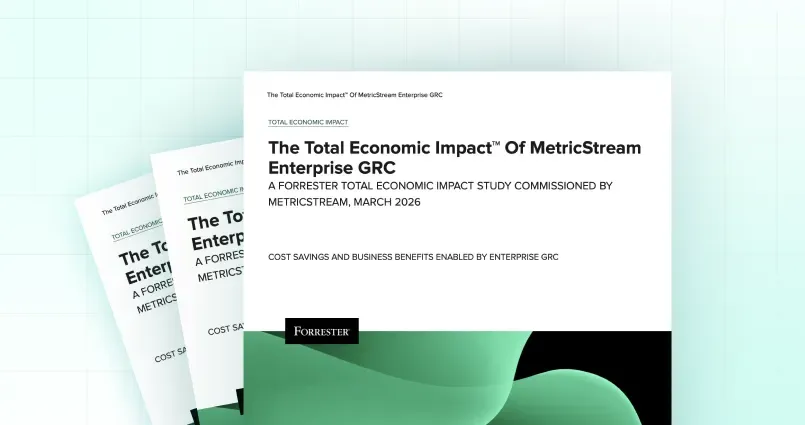
That’s why I’m proud to share the findings of a newly released Forrester Total Economic Impact™ (TEI) study commissioned by MetricStream. This is an independent, rigorous financial analysis based on real interviews with MetricStream customers across financial services, insurance, and healthcare. Forrester built a composite organization from those interviews, ran the numbers, and came back with a result that I think deserves to be heard across every boardroom and risk committee: 133% ROI, with payback in under 6 months.
Let me walk you through what that means — and why it matters beyond the headline.
The Problem: GRC Sprawl Is Costing You More Than You Think
Before implementing MetricStream, the organizations Forrester interviewed shared a strikingly familiar story. Spreadsheets. Siloed tools. Outdated risk registers. Quarterly reports that required hundreds of people working for 2 to 3 weeks. Manual processes that resulted in key-person risk, inconsistency, and limited visibility for leadership.
One interviewee — the head of analytics at a European bank — put it simply: “We had no alignment on what we understood as risks. There were different risk scales, different impact scales, and different likelihood scales.” That’s not a GRC problem. That’s a business problem.
What Forrester found, and this is what we see with our customers every day, is that the cost of fragmented GRC doesn’t show up cleanly on a balance sheet. It shows up in audit findings, regulatory penalties, team burnout, and missed opportunities to use data for strategic decision-making.
The Findings: $8.4M in Benefits Over Three Years
The Forrester study quantified three primary benefit categories for the composite organization:
- $4.2M in labor savings. Enterprise GRC eliminates the duplicative data entry, manual reconciliation, and reporting drag that plague GRC teams working across disparate systems. One insurance organization told Forrester that quarterly reports requiring weeks of manual aggregation are now completed in one to two days. Another saved 1,800 hours annually on universe validation alone through RPA-integrated workflows. These are structural shifts in how GRC teams spend their time, leading to significant improvements.
- $2.3M in technology cost savings. When organizations replace a patchwork of legacy tools with a single, unified platform, the benefits become clear. The composite organization decommissioned multiple GRC-related tools. This saved over $300,000 per tool retired, plus the associated IT administration burden. The healthcare organization Forrester interviewed replaced a legacy GRC solution, an HR policy system, and hundreds of intranet sites with Enterprise GRC.
- $2.0M in reduced risk of fines and reputational damage. This one is harder to quantify, which is exactly why I appreciate Forrester’s methodology. By modeling average regulatory penalties, remediation costs, and conservative estimates of reputational damage, the study shows that proactive, centralized GRC management can reduce the risk of violations by approximately 20%. For a $20B organization with $5M in average annual penalties, that’s a material number.
Beyond the Numbers: The Strategic Shift
There’s also a compelling pattern underneath the numbers. Every quantified benefit flows from one core achievement: a centralized, trusted source of truth for GRC data.
When risks, controls, policies, and assessments live on a single, governed platform, with a consistent taxonomy, real-time visibility, and role-based access, everything downstream improves. Reporting gets faster. Collaboration improves across regions and functions. Regulators get direct, transparent access to audit-ready documentation. And perhaps most excitingly, AI use cases become possible for the first time.
As one compliance leader told Forrester: “Because all our compliance work now follows the same structure in the GRC platform, we finally have the foundation to start experimenting with AI — whether that’s helping people find policy answers faster or suggesting actions based on what’s worked before.”
This is what we mean when we talk about GRC as a system of intelligence and action, not just a system of record. The Forrester study is validation that this vision is not aspirational. It’s already happening.
What This Means for GRC Leaders
If you’re making the case for GRC investment, this study gives you something powerful: an independently validated financial model you can adapt to your own organization’s context. And if you’re already a MetricStream customer, this is a framework for measuring and communicating the value you’re already creating.
The GRC function has long deserved a seat at the strategic table. The numbers are finally there to back it up.
See the proof for yourself. Download the full Forrester TEI Study and discover the benefits MetricStream delivers.
Request a demo to explore what those results could look like for your organization.
The Total Economic Impact™ of MetricStream Enterprise GRC: At a Glance
| Benefit Category | 3-Year Value | Key Example |
|---|---|---|
| Labor savings | $4.2M | Quarterly reports cut from weeks to 1–2 days |
| Technology cost savings | $2.3M | 300K+ saved per legacy tool retired |
| Reduced fines & reputational risk | $2.0M | ~20% reduction in regulatory violation risk |
| Total benefits | $8.4M | |
| ROI | 133% | |
| Payback period | <6 months |
Frequently Asked Questions
Forrester's TEI methodology is an independent, structured framework used to evaluate the full financial impact of a technology investment -- both quantified and unquantified. The TEI study was commissioned by MetricStream and conducted by Forrester Research. It involved in-depth interviews with four MetricStream customers across financial services, insurance, banking, and healthcare. Forrester built a composite organization from those interviews to model costs, benefits, and ROI.
The TEI study is important because it goes beyond simple cost comparisons by modeling the actual benefits, costs, risks, and flexibility a solution delivers, in real dollars. The study provides:
- Independent validation -- Forrester owns editorial control, not MetricStream
- Customer-sourced data -- built from real interviews with enterprise customers
- Credible with tech buyers -- the framework is widely recognized w CISOs, CIOS, CFOs, and Procurement
The study found a 133% ROI with a payback period of under 12 months.
Labor savings ($4.2M), technology cost consolidation ($2.3M), and reduced risk of regulatory fines and reputational damage ($2.0M) — totaling $8.4M in benefits over three years.
The study found savings of over $300,000 per legacy tool retired, plus reduced IT administration costs.
By centralizing GRC data and enabling proactive risk management, MetricStream can reduce the likelihood of regulatory violations by approximately 20%.
When all compliance data follows a consistent structure on one platform, organizations gain the data foundation needed to experiment with AI — such as surfacing policy answers faster or recommending actions based on historical patterns.
Organizations from financial services, insurance, banking, and healthcare sectors were interviewed.
The study provides an independently validated financial model that GRC leaders can adapt to their own organizational context when presenting to CFOs, boards, or procurement committees.