





Introduction
A Risk Appetite Statement (RAS) is a formal document that articulates how much risk an organization is willing to accept across different categories, including financial, operational, compliance, and reputational, in pursuit of its strategic objectives. It establishes boundaries for acceptable risk-taking at the enterprise and business-unit level, guiding consistent decision-making across leadership.
Risk has become faster, interconnected, and far more consequential to everyday business decisions. Leaders are no longer responding to isolated threats but to overlapping pressures that influence strategy, investment, and long-term resilience. Yet organizational readiness has not kept pace. Global research in 2025 shows that fewer than half of organizations (49%) say risk awareness truly permeates their enterprise, revealing a persistent gap between recognizing risk and managing it in a disciplined, enterprise-wide way.
This disconnect creates a governance challenge that boards and executives can no longer ignore. When risk awareness is uneven, decision-making becomes inconsistent and strategic choices may expose the organization to unintended consequences.
A Risk Appetite Statement addresses this gap directly. Rather than treating risk appetite as a static declaration, leading organizations are translating it into measurable limits, decision thresholds, and continuous monitoring that guide real-world actions. A well-defined RAS aligns governance with strategy, enabling organizations to take calculated risks with confidence while maintaining resilience in an increasingly volatile environment.
Key Takeaways
- A Risk Appetite Statement (RAS) defines how much risk an organization is willing to accept in pursuit of its objectives and guides consistent decision-making.
- A clear RAS aligns strategy with risk tolerance, strengthens governance and communication, and sets expectations for risk-taking across the organization.
- Common challenges include vague language, misalignment with business goals, difficulty balancing quantitative and qualitative measures, and keeping the RAS current.
- Effective RAS design requires stakeholder involvement, clear governance, measurable metrics, and regular review to remain relevant and actionable.
What is a Risk Appetite Statement?
A Risk Appetite Statement is a structured framework that articulates an organization's acceptable level of risk exposure across different domains, balancing growth opportunities with risk mitigation strategies.
The RAS provides a clear boundary for risk-taking, serving as a guide for decision-making at all levels of the organization. It includes qualitative and quantitative measures to define acceptable risk levels, ensuring consistency and transparency in managing risk across various departments and functions.
Purpose of a Risk Appetite Statement
A Risk Appetite Statement (RAS) serves as a guiding framework that helps organizations define the level and types of risk they are willing to accept while striving to meet their objectives. It ensures that risk-taking aligns with business goals, regulatory requirements, and stakeholder expectations. By establishing clear boundaries for decision-making, a well-defined RAS helps organizations balance opportunities with risk mitigation strategies. Additionally, it fosters a risk-aware culture, enabling leadership teams to make informed choices, allocate resources effectively, and maintain operational resilience.
It is worth distinguishing a Risk Appetite Statement from a risk policy. The RAS is a strategic, board-approved declaration that defines the level of risk the organization is willing to accept across categories. A risk policy is an operational document that prescribes how specific risks are managed, including processes, controls, escalation procedures, and responsibilities. The RAS sets the boundaries; risk policies define the mechanisms through which the organization stays within them. Effective GRC programs maintain both, with policies designed to implement the appetite boundaries the RAS defines.
Risk Appetite vs Risk Tolerance
These are the risk measures set by an organisation in their strategic decisions; the main differences are below:
| Dimension | Risk Appetite | Risk Tolerance | Risk Capacity |
| Definition | Level of risk willing to accept in pursuit of objectives | Acceptable variation around the appetite | Maximum risk the organization can absorb |
| Set by | Board and senior leadership | Risk function and business units | CRO and CFO based on capital and resources |
| Nature | Strategic — reflects goals and culture | Operational — daily risk limits | Structural — hard financial ceiling |
| Example | "Moderate credit risk aligned with lending strategy" | "NPL ratio within ±10% of target" | "Total risk capital not to exceed 15% of Tier 1" |
| Relationship | Should be below risk capacity | Should be within risk appetite | Upper bound for appetite-setting |
The FSB Risk Appetite Framework
The Financial Stability Board (FSB) published its Risk Appetite Framework guidance for Global Systemically Important Financial Institutions in 2013, establishing the international benchmark for how major financial institutions should articulate and govern risk appetite. The guidance defines the key components of an effective framework, including the Risk Appetite Statement, risk limits, key risk indicators, and governance processes, and forms the basis for most major bank regulators' expectations on risk appetite governance. Organizations outside the financial sector benefit from aligning with FSB guidance as it represents recognized best practice for structured, board-level risk appetite governance.
Key Components of a Risk Appetite Statement
Here are the key components of a risk appetite statement:

- Risk Philosophy Statement – The RAS should open with a declaration of the organization's overall attitude toward risk-taking, articulating the principles that guide how risk is approached across the enterprise.
- Risk Capacity – Before setting appetite, organizations must define the maximum risk they can absorb without compromising their ability to function, typically expressed in financial terms by the CRO and CFO.
- Risk Categories – Organizations face different types of risks, such as financial, operational, strategic, compliance, reputational, and cybersecurity risks. The RAS should classify risks into relevant categories to ensure comprehensive coverage.
- Appetite by Category – Once risk categories are defined, the RAS should articulate a specific appetite position for each domain, distinguishing between areas where the organization accepts higher risk in pursuit of strategic objectives and areas where tolerance is low or zero.
- Risk Tolerance Levels – This defines the acceptable limits of risk exposure for each category. Tolerance levels may vary depending on business objectives, regulatory requirements, and industry standards. Organizations may classify risk tolerance as low, moderate, or high, based on their ability and willingness to absorb potential losses.
- Measurement Metrics – The RAS should include both qualitative and quantitative metrics to evaluate risk exposure effectively. Examples include financial ratios (e.g., debt-to-equity ratio), operational performance indicators (e.g., system downtime thresholds), and regulatory compliance benchmarks (e.g., number of audit violations).
- KRIs and Triggers – The RAS should specify the key risk indicators used to monitor exposure against defined thresholds, with clear escalation triggers that activate when the organization approaches or breaches its tolerance limits.
- Governance Framework – A clear governance structure is essential for implementing and monitoring risk appetite. This includes defining roles and responsibilities for risk management teams, establishing escalation procedures, and ensuring regular risk assessments and reporting.
- Monitoring and Reporting Mechanisms – A strong RAS incorporates processes for continuous monitoring and periodic review of risk levels. This ensures that risk exposure remains within acceptable limits and allows organizations to adapt their risk appetite as business conditions evolve.
- Alignment with Business Strategy – A well-defined RAS ensures that risk-taking aligns with the organization's long-term strategic goals. It helps management make risk-informed decisions that support growth and sustainability while minimizing potential disruptions.
| RAS Component | What It Defines | Example |
| Risk Philosophy Statement | Overall organisational attitude toward risk-taking | "We accept moderate risk in pursuit of growth with zero tolerance for compliance violations" |
| Risk Capacity | Maximum risk the organisation can absorb | "Total risk capital: 15% of Tier 1 capital" |
| Risk Categories | The risk domains covered by the RAS | "Financial, operational, strategic, compliance, reputational, and cybersecurity risks" |
| Appetite by Category | Specific risk appetite for each domain | "Low appetite for operational risk; moderate appetite for strategic risk" |
| Risk Tolerance Levels | Quantitative thresholds triggering review | "Credit NPL ratio not to exceed 3.5%; single-name concentration below 10% of equity" |
| Measurement Metrics | Qualitative and quantitative indicators of risk exposure | "Debt-to-equity ratio; system downtime thresholds; number of audit violations" |
| KRIs and Triggers | Early warning metrics | "Review triggered if operational loss events exceed 120% of budget in any quarter" |
| Governance Framework | Roles, responsibilities, and escalation procedures | "Board approves RAS annually; CRO reviews quarterly; business units report monthly" |
| Monitoring and Reporting | Processes for tracking risk exposure against appetite | "Monthly KRI dashboard reviewed by risk committee; quarterly board risk report" |
| Alignment with Business Strategy | How risk appetite connects to strategic objectives | "Moderate appetite for strategic risk in pursuit of market expansion; low appetite for operational risk" |
Importance of a Clear Risk Appetite Statement
Here are some key benefits of a risk appetite statement:
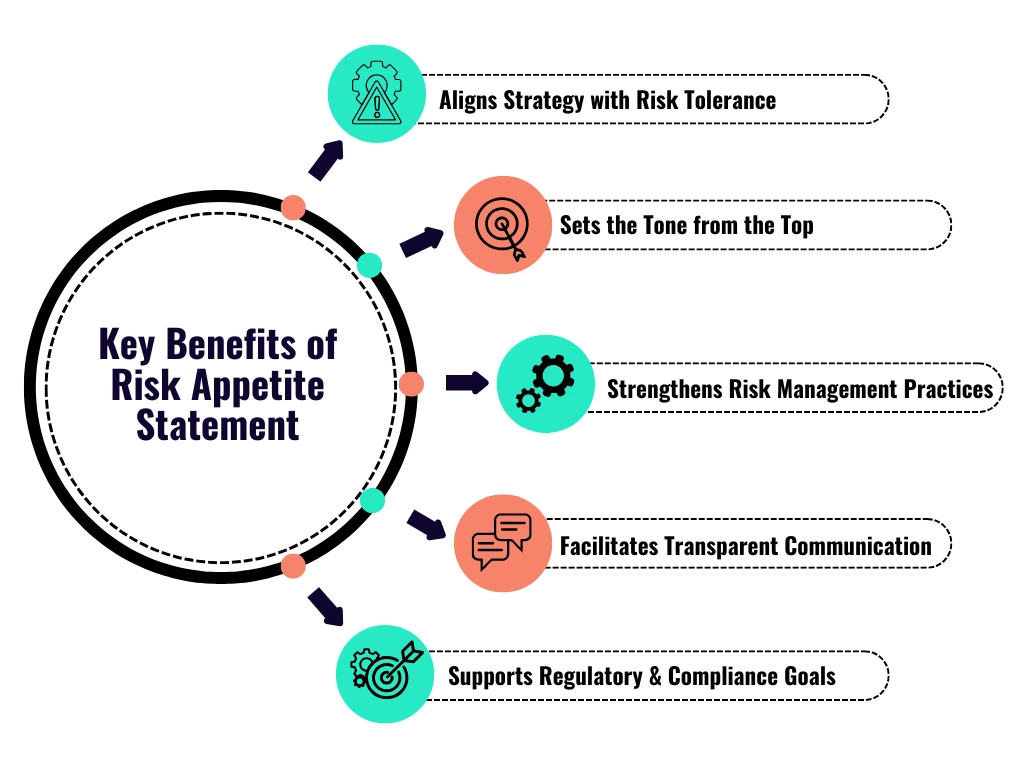
- Aligns Strategy with Risk Tolerance A well-defined risk appetite statement ensures that an organization’s strategic goals align with its risk tolerance. Clarifying how much risk the organization is willing to take, helps in making informed decisions that balance growth opportunities with acceptable levels of uncertainty.
- Sets the Tone from the Top The risk appetite statement communicates the leadership’s stance on risk-taking. It sets expectations across all levels of the organization, ensuring that risk-related decisions are consistent with the company’s overall philosophy and culture.
- Strengthens Risk Management Practices A well-articulated risk appetite statement strengthens risk management by providing a benchmark against which risks can be assessed and controlled. It helps create tailored risk responses and improves the overall risk framework.
- Facilitates Transparent Communication A clear risk appetite statement defines what risks are acceptable and which are not, enabling transparent communication across risk functions in an organization. This, in turn, promotes a shared understanding of risk limits, fostering collaboration and accountability.
- Supports Regulatory and Compliance Goals A clear risk appetite statement demonstrates to regulators and stakeholders that the organization has a structured approach to risk. It helps meet compliance requirements by showing that risks are managed within defined parameters, reducing the chance of legal and regulatory breaches.
Risk Appetite Statement Examples
Examples From Different Industries
Financial Services
In the financial services industry, risk appetite statements often address risks associated with market fluctuations, credit exposure, and regulatory compliance.
Example: Our institution maintains a moderate risk appetite in pursuit of stable and sustainable growth. We are willing to accept moderate credit risk to achieve a balanced portfolio, but we have a low tolerance for operational risks that could disrupt our services. Compliance with regulatory requirements is non-negotiable, and we maintain a very low appetite for any risks that could jeopardize our regulatory standing.
This statement highlights a balanced approach, acknowledging the need for growth while emphasizing the importance of regulatory compliance and operational stability.
Banking
For banking institutions, cyber risk has become as consequential as credit or market risk, requiring explicit appetite boundaries tied to measurable operational thresholds.
Example: Our institution accepts low residual cyber risk. We will not tolerate a major cyber incident that disrupts critical banking services for more than four hours, compromises more than 10,000 customer records, or results in regulatory sanctions. We will invest no less than 12% of our IT operating budget in cybersecurity, conduct annual penetration testing, and maintain continuous monitoring across all critical IT systems.
This statement demonstrates how banking institutions are increasingly required to define cyber risk appetite with the same precision applied to financial risk limits.
Healthcare
In the healthcare industry, risk appetite statements center on patient safety, data privacy, and regulatory accreditation as non-negotiable boundaries, with measured appetite for clinical innovation.
Example: This organization has zero tolerance for patient safety events resulting from preventable errors. All near-miss and adverse events are reported within 24 hours. The organization maintains JCAHO accreditation and full HIPAA compliance at all times.
This statement reflects the healthcare sector's defining characteristic: that certain risks carry consequences severe enough to warrant absolute boundaries rather than managed thresholds.
Technology
For technology companies, the emphasis is frequently on innovation, cybersecurity, and market competition:
Example: We have a high-risk appetite for innovation and new product development to maintain our competitive edge in the market. However, we have a low-risk appetite for cybersecurity threats and data breaches. Our organization is committed to adhering to the highest standards of data protection and privacy regulations.
This statement underscores the company’s willingness to take risks for innovation while maintaining stringent controls over cybersecurity.
Examples Based on Organization Size
Small Enterprises
Smaller organizations may have different risk appetites due to limited resources and different strategic priorities.
Example: As a small enterprise, our risk appetite is generally low across most categories. We prioritize financial stability and customer satisfaction, with minimal tolerance for operational disruptions. While we are open to exploring new market opportunities, we prefer low-risk ventures that align closely with our core competencies.
This reflects the need for smaller organizations to be more conservative, focusing on stability and customer satisfaction.
Medium-Sized Enterprise
Medium-sized enterprises often have more resources to allocate towards risk-taking, enabling moderate risk appetites:
Example: Our medium-sized enterprise adopts a moderate risk appetite, balancing growth and stability. We are willing to accept moderate financial and market risks to expand our product lines and customer base. However, we maintain a low tolerance for risks that could impact our brand reputation and regulatory compliance.
The balance here between moderate growth and a low tolerance for reputational and regulatory risks is key.
Large-Sized Enterprise
Larger organizations often have more complex risk appetites, reflecting their broader operational scope and strategic ambitions:
Example: Our large enterprise maintains a diversified risk appetite. We accept high risks in strategic acquisitions and global market expansions to drive growth. However, we enforce stringent controls to mitigate operational, compliance, and reputational risks.
This statement demonstrates a sophisticated approach, accepting high strategic risks while controlling operational and compliance risks.
Risk Appetite Statements for Specific Risk Categories
Financial Risk Appetite
Financial risks are a primary concern for all organizations and can often be a make-or-break scenario.
Example: Our organization has a moderate appetite for financial risk. We are willing to take calculated financial risks to achieve a targeted return on investment and support our growth objectives. However, we maintain strict limits on leverage and ensure robust financial planning to mitigate potential impacts on our cash flow and solvency.
This statement outlines a measured approach to financial risks, with clear boundaries and mitigations.
Operational Risk Appetite
In terms of operational risks, an organization may focus on business continuity and efficiency.
Example: Our operational risk appetite is low. We focus on maintaining high standards of operational efficiency and reliability. We invest in robust internal controls, employee training, and technology to minimize disruptions. Any risks that could significantly impact our operational continuity or employee safety are unacceptable.
Reputational Risk Appetite
Reputational risks are managed with an uncompromising approach to ethics and transparency.
Example: We maintain a very low appetite for reputational risk. Our brand and customer trust are paramount. We enforce stringent ethical standards, transparent communications, and proactive stakeholder engagement to preserve and enhance our reputation. Any actions that could potentially harm our public image are closely scrutinized and avoided.
Cyber Risk Appetite
Cyber threats are addressed through a strong emphasis on prevention, detection, and operational resilience across digital environments.
Example: We operate with a cautious cyber risk appetite where sensitive information, core infrastructure, or customer services could be affected. Security investments, continuous monitoring, and rapid containment capabilities are prioritised to minimise disruption. Any technology adoption that materially increases cyber exposure without safeguards is carefully evaluated or declined.
Challenges in Developing Risk Appetite Statements
Developing an effective risk appetite statement requires navigating several organizational and technical challenges. Understanding these obstacles is the first step toward addressing them systematically. Here are five common challenges:
The Struggle with Vague Terminology
Organizations often find it challenging to define what constitutes a risk. The terminology can be broad and ambiguous, leading to confusion and misinterpretation. For example, what one department considers a high-risk activity might be seen as moderate by another. This lack of uniformity can hinder the development of a cohesive risk appetite statement. Establishing clear, universally understood definitions is crucial for consistency.
Ensuring Consistency with Organizational Goals
Many organizations fail to integrate their risk appetite statements with their business strategies. This misalignment can result in contradictory directives and goals. For instance, a company focused on rapid expansion might have a risk appetite that discourages high-risk ventures, thus stalling growth. Ensuring that the risk appetite statement aligns seamlessly with strategic objectives is essential for coherent decision-making.
Achieving Consensus Among Diverse Stakeholders
Different stakeholders, from board members to frontline employees, may have varying perspectives and priorities regarding risk. Achieving a consensus that satisfies all parties is often challenging but crucial for the successful implementation of the risk appetite statement. Effective communication and collaboration are key to overcoming this challenge.
Balancing Quantitative and Qualitative Measures
Quantifying risk appetite is a complex task that requires a balanced approach between qualitative and quantitative measures. Some risks can be easily quantified, such as financial risks, while others, like reputational risks, are more subjective. Organizations often struggle to find the right metrics to quantify these risks effectively. Without accurate quantification, it becomes challenging to communicate and enforce the risk appetite.
Adapting to Continuous Changes
The risk landscape is continually evolving, influenced by regulatory changes, market dynamics, and technological advancements. Organizations often face difficulties in keeping their risk appetite statements up-to-date. An outdated risk appetite statement can lead to ineffective risk management, leaving the organization vulnerable to unforeseen threats. Regular reviews and updates are essential to ensure that the risk appetite remains relevant.
How to Write a Risk Appetite Statement Step-by-Step
Here is a breakdown of the process of curating a risk appetite statement:
Anchor the appetite to strategic objectives
Begin with the organisation’s core priorities such as growth, resilience, innovation, and regulatory compliance. The risk appetite should clarify where the organisation is prepared to accept uncertainty and where protection is essential, using measurable outcomes that connect directly to business performance.
Define the organisation’s key risk categories
Establish clear groupings such as strategic, operational, financial, compliance, cyber, and reputational risk. Provide concise definitions so leaders and teams share a consistent understanding of what each category covers and how it influences decision-making.
Select meaningful quantitative and qualitative measures
Translate each risk category into clear metrics, including loss limits, exposure thresholds, downtime tolerance, or compliance variance, supported by qualitative guidance that explains acceptable and unacceptable behaviour. This combination ensures the statement guides both measurement and judgement.
Set tolerances, thresholds, and escalation triggers
Convert high-level appetite into operational guardrails by defining monitoring thresholds, breach points, and required responses. These boundaries enable timely escalation and consistent handling of emerging risk conditions.
Align with regulatory, legal, and contractual obligations
Reflect mandatory requirements from regulators, industry standards, and major contractual commitments within the defined tolerances. Where external obligations impose stricter limits, the appetite must incorporate those constraints as non-negotiable boundaries.
Embed monitoring, reporting, and periodic review
Integrate the approved appetite into planning, performance management, and risk reporting through a focused set of key risk indicators, clear ownership, and defined review cycles. Regular reassessment ensures the statement evolves alongside strategic change, regulatory shifts, and operational learning.
Best Practices for Risk Appetite Statement Development
To maintain an effective risk appetite statement, involve stakeholders, use both quantitative and qualitative metrics, establish clear governance, and regularly review it to stay aligned with evolving risks.
Once you successfully develop a risk appetite statement, practice the following to ensure its longevity and effectiveness:
Engage Stakeholders Early and Often
This collaborative approach ensures that diverse perspectives are considered, leading to a more balanced and realistic risk appetite. Regular consultations and workshops can facilitate a shared understanding of risk and foster a cohesive risk culture across the organization.
Use Quantitative and Qualitative
Metrics Combine both metrics to articulate the risk appetite. Quantitative metrics, such as financial ratios and risk limits, provide clear and measurable benchmarks. Meanwhile, qualitative statements can capture the organization's risk philosophy and cultural attitudes toward risk. This dual approach ensures a comprehensive understanding of risk appetite.
Establish Clear Governance Frameworks
A well-defined governance framework is essential for the effective management and oversight of risk appetite. This includes setting up committees or roles responsible for monitoring adherence to the risk appetite, as well as establishing processes for regular review and update.
Integrate Risk Appetite into Strategic Decision-Making
Incorporate your risk appetite into strategic decisions to harmonize risk and opportunity. By aligning risk tolerance with business goals, you ensure that the organization remains agile and focused without overextending into areas of high risk. This makes risk appetite a guiding principle for long-term success.
Embed Risk Appetite Across the Organization
Embed the risk appetite statement within your company culture by communicating it clearly across all levels. Make it a reference point for employees and teams, ensuring they understand the boundaries and principles that define acceptable risks.
Calibrate Risk Appetite Continuously
Regular reviews help the statement stay relevant amidst changing market dynamics, regulations, or internal growth. This ensures your organization remains resilient and well-prepared to face new risks without exceeding its defined tolerance levels.
Conclusion
An effective risk appetite statement encapsulates the organization's willingness and capacity to take on risk, providing a clear framework that influences various aspects of operations, from strategic planning to day-to-day decision-making.
MetricStream's enterprise risk management and operational risk management software empowers your organization to manage risk effectively, safeguarding your business while driving sustainable growth.
A Risk Appetite Statement (RAS) is a formal document that articulates how much risk an organization is willing to accept across different categories, including financial, operational, compliance, and reputational, in pursuit of its strategic objectives. It establishes boundaries for acceptable risk-taking at the enterprise and business-unit level, guiding consistent decision-making across leadership.
Risk has become faster, interconnected, and far more consequential to everyday business decisions. Leaders are no longer responding to isolated threats but to overlapping pressures that influence strategy, investment, and long-term resilience. Yet organizational readiness has not kept pace. Global research in 2025 shows that fewer than half of organizations (49%) say risk awareness truly permeates their enterprise, revealing a persistent gap between recognizing risk and managing it in a disciplined, enterprise-wide way.
This disconnect creates a governance challenge that boards and executives can no longer ignore. When risk awareness is uneven, decision-making becomes inconsistent and strategic choices may expose the organization to unintended consequences.
A Risk Appetite Statement addresses this gap directly. Rather than treating risk appetite as a static declaration, leading organizations are translating it into measurable limits, decision thresholds, and continuous monitoring that guide real-world actions. A well-defined RAS aligns governance with strategy, enabling organizations to take calculated risks with confidence while maintaining resilience in an increasingly volatile environment.
- A Risk Appetite Statement (RAS) defines how much risk an organization is willing to accept in pursuit of its objectives and guides consistent decision-making.
- A clear RAS aligns strategy with risk tolerance, strengthens governance and communication, and sets expectations for risk-taking across the organization.
- Common challenges include vague language, misalignment with business goals, difficulty balancing quantitative and qualitative measures, and keeping the RAS current.
- Effective RAS design requires stakeholder involvement, clear governance, measurable metrics, and regular review to remain relevant and actionable.
A Risk Appetite Statement is a structured framework that articulates an organization's acceptable level of risk exposure across different domains, balancing growth opportunities with risk mitigation strategies.
The RAS provides a clear boundary for risk-taking, serving as a guide for decision-making at all levels of the organization. It includes qualitative and quantitative measures to define acceptable risk levels, ensuring consistency and transparency in managing risk across various departments and functions.
A Risk Appetite Statement (RAS) serves as a guiding framework that helps organizations define the level and types of risk they are willing to accept while striving to meet their objectives. It ensures that risk-taking aligns with business goals, regulatory requirements, and stakeholder expectations. By establishing clear boundaries for decision-making, a well-defined RAS helps organizations balance opportunities with risk mitigation strategies. Additionally, it fosters a risk-aware culture, enabling leadership teams to make informed choices, allocate resources effectively, and maintain operational resilience.
It is worth distinguishing a Risk Appetite Statement from a risk policy. The RAS is a strategic, board-approved declaration that defines the level of risk the organization is willing to accept across categories. A risk policy is an operational document that prescribes how specific risks are managed, including processes, controls, escalation procedures, and responsibilities. The RAS sets the boundaries; risk policies define the mechanisms through which the organization stays within them. Effective GRC programs maintain both, with policies designed to implement the appetite boundaries the RAS defines.
Risk Appetite vs Risk Tolerance
These are the risk measures set by an organisation in their strategic decisions; the main differences are below:
| Dimension | Risk Appetite | Risk Tolerance | Risk Capacity |
| Definition | Level of risk willing to accept in pursuit of objectives | Acceptable variation around the appetite | Maximum risk the organization can absorb |
| Set by | Board and senior leadership | Risk function and business units | CRO and CFO based on capital and resources |
| Nature | Strategic — reflects goals and culture | Operational — daily risk limits | Structural — hard financial ceiling |
| Example | "Moderate credit risk aligned with lending strategy" | "NPL ratio within ±10% of target" | "Total risk capital not to exceed 15% of Tier 1" |
| Relationship | Should be below risk capacity | Should be within risk appetite | Upper bound for appetite-setting |
The FSB Risk Appetite Framework
The Financial Stability Board (FSB) published its Risk Appetite Framework guidance for Global Systemically Important Financial Institutions in 2013, establishing the international benchmark for how major financial institutions should articulate and govern risk appetite. The guidance defines the key components of an effective framework, including the Risk Appetite Statement, risk limits, key risk indicators, and governance processes, and forms the basis for most major bank regulators' expectations on risk appetite governance. Organizations outside the financial sector benefit from aligning with FSB guidance as it represents recognized best practice for structured, board-level risk appetite governance.
Here are the key components of a risk appetite statement:
- Risk Philosophy Statement – The RAS should open with a declaration of the organization's overall attitude toward risk-taking, articulating the principles that guide how risk is approached across the enterprise.
- Risk Capacity – Before setting appetite, organizations must define the maximum risk they can absorb without compromising their ability to function, typically expressed in financial terms by the CRO and CFO.
- Risk Categories – Organizations face different types of risks, such as financial, operational, strategic, compliance, reputational, and cybersecurity risks. The RAS should classify risks into relevant categories to ensure comprehensive coverage.
- Appetite by Category – Once risk categories are defined, the RAS should articulate a specific appetite position for each domain, distinguishing between areas where the organization accepts higher risk in pursuit of strategic objectives and areas where tolerance is low or zero.
- Risk Tolerance Levels – This defines the acceptable limits of risk exposure for each category. Tolerance levels may vary depending on business objectives, regulatory requirements, and industry standards. Organizations may classify risk tolerance as low, moderate, or high, based on their ability and willingness to absorb potential losses.
- Measurement Metrics – The RAS should include both qualitative and quantitative metrics to evaluate risk exposure effectively. Examples include financial ratios (e.g., debt-to-equity ratio), operational performance indicators (e.g., system downtime thresholds), and regulatory compliance benchmarks (e.g., number of audit violations).
- KRIs and Triggers – The RAS should specify the key risk indicators used to monitor exposure against defined thresholds, with clear escalation triggers that activate when the organization approaches or breaches its tolerance limits.
- Governance Framework – A clear governance structure is essential for implementing and monitoring risk appetite. This includes defining roles and responsibilities for risk management teams, establishing escalation procedures, and ensuring regular risk assessments and reporting.
- Monitoring and Reporting Mechanisms – A strong RAS incorporates processes for continuous monitoring and periodic review of risk levels. This ensures that risk exposure remains within acceptable limits and allows organizations to adapt their risk appetite as business conditions evolve.
- Alignment with Business Strategy – A well-defined RAS ensures that risk-taking aligns with the organization's long-term strategic goals. It helps management make risk-informed decisions that support growth and sustainability while minimizing potential disruptions.
| RAS Component | What It Defines | Example |
| Risk Philosophy Statement | Overall organisational attitude toward risk-taking | "We accept moderate risk in pursuit of growth with zero tolerance for compliance violations" |
| Risk Capacity | Maximum risk the organisation can absorb | "Total risk capital: 15% of Tier 1 capital" |
| Risk Categories | The risk domains covered by the RAS | "Financial, operational, strategic, compliance, reputational, and cybersecurity risks" |
| Appetite by Category | Specific risk appetite for each domain | "Low appetite for operational risk; moderate appetite for strategic risk" |
| Risk Tolerance Levels | Quantitative thresholds triggering review | "Credit NPL ratio not to exceed 3.5%; single-name concentration below 10% of equity" |
| Measurement Metrics | Qualitative and quantitative indicators of risk exposure | "Debt-to-equity ratio; system downtime thresholds; number of audit violations" |
| KRIs and Triggers | Early warning metrics | "Review triggered if operational loss events exceed 120% of budget in any quarter" |
| Governance Framework | Roles, responsibilities, and escalation procedures | "Board approves RAS annually; CRO reviews quarterly; business units report monthly" |
| Monitoring and Reporting | Processes for tracking risk exposure against appetite | "Monthly KRI dashboard reviewed by risk committee; quarterly board risk report" |
| Alignment with Business Strategy | How risk appetite connects to strategic objectives | "Moderate appetite for strategic risk in pursuit of market expansion; low appetite for operational risk" |
Here are some key benefits of a risk appetite statement:
- Aligns Strategy with Risk Tolerance A well-defined risk appetite statement ensures that an organization’s strategic goals align with its risk tolerance. Clarifying how much risk the organization is willing to take, helps in making informed decisions that balance growth opportunities with acceptable levels of uncertainty.
- Sets the Tone from the Top The risk appetite statement communicates the leadership’s stance on risk-taking. It sets expectations across all levels of the organization, ensuring that risk-related decisions are consistent with the company’s overall philosophy and culture.
- Strengthens Risk Management Practices A well-articulated risk appetite statement strengthens risk management by providing a benchmark against which risks can be assessed and controlled. It helps create tailored risk responses and improves the overall risk framework.
- Facilitates Transparent Communication A clear risk appetite statement defines what risks are acceptable and which are not, enabling transparent communication across risk functions in an organization. This, in turn, promotes a shared understanding of risk limits, fostering collaboration and accountability.
- Supports Regulatory and Compliance Goals A clear risk appetite statement demonstrates to regulators and stakeholders that the organization has a structured approach to risk. It helps meet compliance requirements by showing that risks are managed within defined parameters, reducing the chance of legal and regulatory breaches.
Examples From Different Industries
Financial Services
In the financial services industry, risk appetite statements often address risks associated with market fluctuations, credit exposure, and regulatory compliance.
Example: Our institution maintains a moderate risk appetite in pursuit of stable and sustainable growth. We are willing to accept moderate credit risk to achieve a balanced portfolio, but we have a low tolerance for operational risks that could disrupt our services. Compliance with regulatory requirements is non-negotiable, and we maintain a very low appetite for any risks that could jeopardize our regulatory standing.
This statement highlights a balanced approach, acknowledging the need for growth while emphasizing the importance of regulatory compliance and operational stability.
Banking
For banking institutions, cyber risk has become as consequential as credit or market risk, requiring explicit appetite boundaries tied to measurable operational thresholds.
Example: Our institution accepts low residual cyber risk. We will not tolerate a major cyber incident that disrupts critical banking services for more than four hours, compromises more than 10,000 customer records, or results in regulatory sanctions. We will invest no less than 12% of our IT operating budget in cybersecurity, conduct annual penetration testing, and maintain continuous monitoring across all critical IT systems.
This statement demonstrates how banking institutions are increasingly required to define cyber risk appetite with the same precision applied to financial risk limits.
Healthcare
In the healthcare industry, risk appetite statements center on patient safety, data privacy, and regulatory accreditation as non-negotiable boundaries, with measured appetite for clinical innovation.
Example: This organization has zero tolerance for patient safety events resulting from preventable errors. All near-miss and adverse events are reported within 24 hours. The organization maintains JCAHO accreditation and full HIPAA compliance at all times.
This statement reflects the healthcare sector's defining characteristic: that certain risks carry consequences severe enough to warrant absolute boundaries rather than managed thresholds.
Technology
For technology companies, the emphasis is frequently on innovation, cybersecurity, and market competition:
Example: We have a high-risk appetite for innovation and new product development to maintain our competitive edge in the market. However, we have a low-risk appetite for cybersecurity threats and data breaches. Our organization is committed to adhering to the highest standards of data protection and privacy regulations.
This statement underscores the company’s willingness to take risks for innovation while maintaining stringent controls over cybersecurity.
Small Enterprises
Smaller organizations may have different risk appetites due to limited resources and different strategic priorities.
Example: As a small enterprise, our risk appetite is generally low across most categories. We prioritize financial stability and customer satisfaction, with minimal tolerance for operational disruptions. While we are open to exploring new market opportunities, we prefer low-risk ventures that align closely with our core competencies.
This reflects the need for smaller organizations to be more conservative, focusing on stability and customer satisfaction.
Medium-Sized Enterprise
Medium-sized enterprises often have more resources to allocate towards risk-taking, enabling moderate risk appetites:
Example: Our medium-sized enterprise adopts a moderate risk appetite, balancing growth and stability. We are willing to accept moderate financial and market risks to expand our product lines and customer base. However, we maintain a low tolerance for risks that could impact our brand reputation and regulatory compliance.
The balance here between moderate growth and a low tolerance for reputational and regulatory risks is key.
Large-Sized Enterprise
Larger organizations often have more complex risk appetites, reflecting their broader operational scope and strategic ambitions:
Example: Our large enterprise maintains a diversified risk appetite. We accept high risks in strategic acquisitions and global market expansions to drive growth. However, we enforce stringent controls to mitigate operational, compliance, and reputational risks.
This statement demonstrates a sophisticated approach, accepting high strategic risks while controlling operational and compliance risks.
Financial Risk Appetite
Financial risks are a primary concern for all organizations and can often be a make-or-break scenario.
Example: Our organization has a moderate appetite for financial risk. We are willing to take calculated financial risks to achieve a targeted return on investment and support our growth objectives. However, we maintain strict limits on leverage and ensure robust financial planning to mitigate potential impacts on our cash flow and solvency.
This statement outlines a measured approach to financial risks, with clear boundaries and mitigations.
Operational Risk Appetite
In terms of operational risks, an organization may focus on business continuity and efficiency.
Example: Our operational risk appetite is low. We focus on maintaining high standards of operational efficiency and reliability. We invest in robust internal controls, employee training, and technology to minimize disruptions. Any risks that could significantly impact our operational continuity or employee safety are unacceptable.
Reputational Risk Appetite
Reputational risks are managed with an uncompromising approach to ethics and transparency.
Example: We maintain a very low appetite for reputational risk. Our brand and customer trust are paramount. We enforce stringent ethical standards, transparent communications, and proactive stakeholder engagement to preserve and enhance our reputation. Any actions that could potentially harm our public image are closely scrutinized and avoided.
Cyber Risk Appetite
Cyber threats are addressed through a strong emphasis on prevention, detection, and operational resilience across digital environments.
Example: We operate with a cautious cyber risk appetite where sensitive information, core infrastructure, or customer services could be affected. Security investments, continuous monitoring, and rapid containment capabilities are prioritised to minimise disruption. Any technology adoption that materially increases cyber exposure without safeguards is carefully evaluated or declined.
Developing an effective risk appetite statement requires navigating several organizational and technical challenges. Understanding these obstacles is the first step toward addressing them systematically. Here are five common challenges:
The Struggle with Vague Terminology
Organizations often find it challenging to define what constitutes a risk. The terminology can be broad and ambiguous, leading to confusion and misinterpretation. For example, what one department considers a high-risk activity might be seen as moderate by another. This lack of uniformity can hinder the development of a cohesive risk appetite statement. Establishing clear, universally understood definitions is crucial for consistency.
Ensuring Consistency with Organizational Goals
Many organizations fail to integrate their risk appetite statements with their business strategies. This misalignment can result in contradictory directives and goals. For instance, a company focused on rapid expansion might have a risk appetite that discourages high-risk ventures, thus stalling growth. Ensuring that the risk appetite statement aligns seamlessly with strategic objectives is essential for coherent decision-making.
Achieving Consensus Among Diverse Stakeholders
Different stakeholders, from board members to frontline employees, may have varying perspectives and priorities regarding risk. Achieving a consensus that satisfies all parties is often challenging but crucial for the successful implementation of the risk appetite statement. Effective communication and collaboration are key to overcoming this challenge.
Balancing Quantitative and Qualitative Measures
Quantifying risk appetite is a complex task that requires a balanced approach between qualitative and quantitative measures. Some risks can be easily quantified, such as financial risks, while others, like reputational risks, are more subjective. Organizations often struggle to find the right metrics to quantify these risks effectively. Without accurate quantification, it becomes challenging to communicate and enforce the risk appetite.
Adapting to Continuous Changes
The risk landscape is continually evolving, influenced by regulatory changes, market dynamics, and technological advancements. Organizations often face difficulties in keeping their risk appetite statements up-to-date. An outdated risk appetite statement can lead to ineffective risk management, leaving the organization vulnerable to unforeseen threats. Regular reviews and updates are essential to ensure that the risk appetite remains relevant.
Here is a breakdown of the process of curating a risk appetite statement:
Anchor the appetite to strategic objectives
Begin with the organisation’s core priorities such as growth, resilience, innovation, and regulatory compliance. The risk appetite should clarify where the organisation is prepared to accept uncertainty and where protection is essential, using measurable outcomes that connect directly to business performance.
Define the organisation’s key risk categories
Establish clear groupings such as strategic, operational, financial, compliance, cyber, and reputational risk. Provide concise definitions so leaders and teams share a consistent understanding of what each category covers and how it influences decision-making.
Select meaningful quantitative and qualitative measures
Translate each risk category into clear metrics, including loss limits, exposure thresholds, downtime tolerance, or compliance variance, supported by qualitative guidance that explains acceptable and unacceptable behaviour. This combination ensures the statement guides both measurement and judgement.
Set tolerances, thresholds, and escalation triggers
Convert high-level appetite into operational guardrails by defining monitoring thresholds, breach points, and required responses. These boundaries enable timely escalation and consistent handling of emerging risk conditions.
Align with regulatory, legal, and contractual obligations
Reflect mandatory requirements from regulators, industry standards, and major contractual commitments within the defined tolerances. Where external obligations impose stricter limits, the appetite must incorporate those constraints as non-negotiable boundaries.
Embed monitoring, reporting, and periodic review
Integrate the approved appetite into planning, performance management, and risk reporting through a focused set of key risk indicators, clear ownership, and defined review cycles. Regular reassessment ensures the statement evolves alongside strategic change, regulatory shifts, and operational learning.
To maintain an effective risk appetite statement, involve stakeholders, use both quantitative and qualitative metrics, establish clear governance, and regularly review it to stay aligned with evolving risks.
Once you successfully develop a risk appetite statement, practice the following to ensure its longevity and effectiveness:
Engage Stakeholders Early and Often
This collaborative approach ensures that diverse perspectives are considered, leading to a more balanced and realistic risk appetite. Regular consultations and workshops can facilitate a shared understanding of risk and foster a cohesive risk culture across the organization.
Use Quantitative and Qualitative
Metrics Combine both metrics to articulate the risk appetite. Quantitative metrics, such as financial ratios and risk limits, provide clear and measurable benchmarks. Meanwhile, qualitative statements can capture the organization's risk philosophy and cultural attitudes toward risk. This dual approach ensures a comprehensive understanding of risk appetite.
Establish Clear Governance Frameworks
A well-defined governance framework is essential for the effective management and oversight of risk appetite. This includes setting up committees or roles responsible for monitoring adherence to the risk appetite, as well as establishing processes for regular review and update.
Integrate Risk Appetite into Strategic Decision-Making
Incorporate your risk appetite into strategic decisions to harmonize risk and opportunity. By aligning risk tolerance with business goals, you ensure that the organization remains agile and focused without overextending into areas of high risk. This makes risk appetite a guiding principle for long-term success.
Embed Risk Appetite Across the Organization
Embed the risk appetite statement within your company culture by communicating it clearly across all levels. Make it a reference point for employees and teams, ensuring they understand the boundaries and principles that define acceptable risks.
Calibrate Risk Appetite Continuously
Regular reviews help the statement stay relevant amidst changing market dynamics, regulations, or internal growth. This ensures your organization remains resilient and well-prepared to face new risks without exceeding its defined tolerance levels.
An effective risk appetite statement encapsulates the organization's willingness and capacity to take on risk, providing a clear framework that influences various aspects of operations, from strategic planning to day-to-day decision-making.
MetricStream's enterprise risk management and operational risk management software empowers your organization to manage risk effectively, safeguarding your business while driving sustainable growth.
Frequently Asked Questions
A risk appetite statement is a formal, board-approved document that defines how much risk an organization is willing to accept across categories, including financial, operational, compliance, and reputational risk in pursuit of its strategic objectives. It provides measurable boundaries that guide consistent decision-making across leadership and business units.
Risk appetite is the level of risk an organization is willing to accept in pursuit of its objectives, risk tolerance is the acceptable variation around that appetite before corrective action is triggered, and risk capacity is the maximum risk the organization can absorb before its ability to function is compromised. Risk appetite should always be set below risk capacity.
Common pitfalls include being too vague, failing to align with business strategy, and not involving key stakeholders in the process, which can result in ineffective risk management.
Define strategic objectives, assess risk capacity, categorize risks, and establish clear tolerance levels with measurable indicators.
Organizations typically categorize risk appetite as Conservative (low risk tolerance), Moderate (balanced risk approach), or Aggressive (high risk tolerance).
A risk statement should clearly define the risk event, potential impact, likelihood, and any mitigation measures in a structured format.
The Risk and Control Self-Assessment (RCSA) process identifies, evaluates, and mitigates operational risks through self-assessment by business units.
Risk appetite is typically defined by senior leadership and formally approved by the board of directors, with input from the chief risk officer and key business stakeholders to ensure alignment with strategy and operational realities.
A Risk Appetite Statement should be formally reviewed at least annually as part of the strategic planning cycle and approved by the board. Additional reviews are warranted following major acquisitions, regulatory changes, new market entries, or significant risk events.
Many regulators expect organisations, especially in financial services and highly regulated sectors, to maintain a documented and board-approved risk appetite framework as part of sound governance and risk management practices.
Yes. Organisations often accept higher levels of strategic or innovation risk while maintaining very low tolerance for compliance breaches, safety incidents, or customer data exposure, reflecting different business priorities and consequences.
An effective Risk Appetite Statement includes a risk philosophy statement, risk capacity limits, category-specific appetite statements covering financial, operational, compliance, reputational, cyber, and strategic risks, quantitative tolerances and thresholds, and key risk indicators that provide early warning when the organization is approaching its defined limits.
A Risk Appetite Statement should be formally reviewed at least annually as part of the strategic planning cycle and approved by the board. Additional reviews are warranted following major acquisitions, regulatory changes, new market entries, or significant risk events.
A bank might define moderate credit risk appetite with a maximum NPL ratio of 3% and single-name concentration below 10% of equity capital. A healthcare organization might state zero appetite for patient safety violations, while a technology company might accept elevated strategic risk in pursuit of market leadership but maintain low operational risk tolerance to protect service reliability.
The Financial Stability Board published Risk Appetite Framework guidance for Global Systemically Important Financial Institutions in 2013, establishing the international standard for how major banks articulate and govern risk appetite. The guidance defines the key components of an effective framework and forms the basis for most major bank regulators' expectations on risk appetite governance.
A Risk Appetite Statement is a strategic, board-approved declaration that defines how much risk the organization is willing to accept across categories, while a risk policy is an operational document prescribing how specific risks are managed through processes, controls, and escalation procedures. The RAS sets the boundaries; risk policies define the mechanisms for staying within them.
For each risk category, identify two to three measurable indicators that reflect exposure levels, such as NPL ratio for credit risk or incident frequency for cyber risk, then set threshold values aligned with the defined appetite level. These thresholds should be configured as KRIs in your GRC system with automated alerts when limits are approached or breached.
The most common mistakes are using vague language without measurable definitions, building a statement that reflects board intent rather than how the organization actually operates, failing to differentiate appetite across risk categories, and treating the RAS as a compliance exercise rather than a governance tool that actively guides decisions.