





Introduction
Reputational risk is the potential for damage to an organisation's standing, credibility, or public perception arising from actions, events, or associations that conflict with stakeholder expectations of ethical, legal, or responsible behaviour. It applies to all organisations regardless of size or sector, with particular regulatory focus in financial services, where the FCA, PRA, and equivalent authorities treat reputational damage as a supervisory concern linked to conduct, operational, and ESG risk.
Companies operate within a tightly interconnected global environment where information travels at lightning speed across a variety of platforms. This constant exchange and the public's access to information mean that how a business is perceived can drastically change overnight.
Reputational risk is the potential for damage to an organization's standing, credibility, or public perception arising from actions or events that conflict with stakeholder expectations, translating directly into customer loss, share price decline, regulatory action, and talent attrition across all sectors and sizes.
According to Aon's 2025 Global Cyber Risk Report, published June 2025, cyber attack events that escalate into reputational risk incidents cause shareholder value to fall by an average of 27%, with damage to brand or reputation ranking as a top-ten global business risk continuously since 2007. The figure underscores that reputational risk is not a secondary consequence of other risk categories but a material financial exposure in its own right, one that requires dedicated management frameworks rather than treatment as an incidental output of crisis communications.
Reputation, a subtle force, can significantly influence stakeholder trust, consumer behavior, and ultimately, the financial health and operational effectiveness of an organization. Given these dynamics, understanding and managing reputational risk is important for sustaining corporate health and growth.
Key Takeaways
- Reputational risk is the potential harm to an organization's image, which can impact trust, consumer behavior, and financial health.
- Common causes of reputational risk include internal misconduct, product failures, negative customer experiences, social media missteps, and cybersecurity breaches.
- Mitigation strategies include building strong ethics programs, proactive communication, crisis management plans, monitoring online sentiment, and regular risk audits.
- Reputational risk management is crucial because it impacts customer loyalty, attracts negative media attention, affects recruitment and retention, incurs legal and ethical ramifications, and reflects a company's social and environmental responsibility.
What is Reputational Risk?
Reputational risk is the potential harm negative publicity can cause to an organization’s brand, trust, and financial health. It impacts customer confidence, employee retention, stakeholder relations, and market expansion. Damage can lead to revenue loss, higher costs, and long-term challenges in restoring credibility.
Reputational Risk vs. Operational Risk
Reputational risk refers to the potential damage to an organization’s brand, credibility, and stakeholder trust due to negative publicity, ethical lapses, or poor public perception. It can impact customer loyalty, financial performance, and long-term business relationships.
Operational risk, on the other hand, arises from internal failures such as process inefficiencies, system breakdowns, human errors, or external disruptions. It directly affects business continuity, compliance, and financial stability.
Reputational risk intersects with several adjacent risk categories; the table below clarifies the relationship between each.
Reputational Risk vs Related Risk
| Risk Type | Definition | Relationship to Reputational Risk | Examples |
| Conduct Risk | Risk of harm from inappropriate firm or staff behaviour | Conduct failures are among the most direct triggers of reputational damage | Mis-selling; market manipulation; cultural failures |
| Compliance Risk | Risk of regulatory non-compliance | Enforcement actions and regulatory notices generate significant reputational exposure | FCA enforcement notices; SEC charges |
| Operational Risk | Risk from people, processes, systems, and external events | Operational failures including cyber incidents, product failures, and fraud drive reputational harm | Data breaches; product recalls; fraud events |
| ESG Risk | Environmental, social, and governance failure risk | ESG failures are an increasingly significant and visible source of reputational damage | Greenwashing allegations; supply chain labour abuses |
| Strategic Risk | Strategy execution and competitive positioning risk | Strategic missteps damage investor and market confidence in leadership | Failed acquisitions; missed market pivots |
While operational risks often lead to reputational risks if not managed effectively, reputational risks can exist independently and have far-reaching consequences beyond operational failures.
Reputational Risk Examples
The scope of reputational risk is wide-ranging, and understanding its triggers is vital. Here are two real-world examples of events that precipitated reputational harm:
Ethical Misconduct and Compliance Violations:
When an organization or its employees are found bending or breaking legal or ethical boundaries, the fallout can be significant.
In 2015, Volkswagen was found to have installed software in millions of its diesel vehicles to cheat emissions tests, making the cars appear more environmentally friendly than they actually were. This deception was uncovered by the U.S. Environmental Protection Agency (EPA) and led to a series of grave consequences for the company.Volkswagen faced over $30 billion in fines, settlements, and other costs, and its stock price plummeted, reflecting the loss of investor confidence. Additionally, the scandal severely tarnished Volkswagen's brand, which had been synonymous with reliability and trust.
The fallout demonstrated how ethical lapses and legal violations can erode public trust and investor confidence, leading to long-term reputational damage that can take years to rebuild.
Product Failures or Safety Issues:
Companies that produce goods face the constant challenge of ensuring their products are safe and reliable. An example of this is the Samsung Galaxy Note 7 crisis.
In 2016, reports emerged that several Galaxy Note 7 devices had caught fire due to battery defects. The issue was severe enough that Samsung had to recall approximately 2.5 million units initially, and despite attempts to fix the problem, replacement devices continued to exhibit the same dangerous flaw. This led to a second, unprecedented global recall and ultimately the discontinuation of the product.
The financial impact was substantial, costing Samsung an estimated $5.3 billion, but the reputational damage was even more profound. The brand, known for its innovation and quality, faced a significant trust deficit as consumers began to question the safety and reliability of Samsung products.
The ethical standing of an organization forms the bedrock of its relationship with stakeholders. Any crack, no matter how small, can cause a seismic shift in perception, leading to boycotts, sanctions, and a long road to redemption.
The table below maps the principal trigger categories to verified real-world cases and their documented financial consequences:
Reputational Risk Triggers and Real-World Impact
| Trigger Category | Examples | Notable Cases | Financial Impact |
| Regulatory and Legal Failures | Enforcement actions; fines; legal judgements | Deutsche Bank AML failures (170 million euro fine); Wells Fargo fake accounts scandal | Fines; litigation costs; customer attrition; share price decline |
| Ethical and Conduct Failures | Executive misconduct; certification fraud; emissions deception | Boeing 737 MAX (certification fraud); Volkswagen emissions scandal | Market cap decline; regulatory action; recall costs |
| Cybersecurity Incidents | Data breaches; ransomware; customer data exposure | Marks and Spencer ransomware attack (April 2025, approximately 300 million pounds in lost operating profit; over 1 billion pounds wiped from market value) | Trust erosion; regulatory investigation; sustained revenue loss |
| Product and Service Failures | Product recalls; safety incidents; quality failures | Johnson and Johnson talcum powder litigation; Samsung Galaxy Note 7 recall | Recall costs; litigation; long-term market share loss |
| ESG and Sustainability Issues | Environmental damage; supply chain labour abuses; greenwashing | Boohoo supply chain scandal; BP Deepwater Horizon | ESG investor pressure; licence-to-operate risk |
| Social Media and PR Crisis | Viral negative content; CEO controversy; consumer boycotts | Bud Light brand equity decline (2023) | Customer loss; brand equity reduction |
Causes of Reputational Risk
The causes of reputational risks are usually from sudden, severe incidents that occur unexpectedly or from the ongoing nature of an organization’s activities, which can result in prolonged damage over time.
Here’s a broader spectrum of triggers that could tarnish an organization's public image:
- Internal Misconduct:
Whether it's a high-level executive caught in an unethical act or employees mistreating customers, internal wrongdoing can quickly escalate into a reputational crisis. It erodes trust and reflects poorly on a company’s culture and ethics. - Product Failures:
From safety issues to performance disappointments, when a product doesn’t live up to expectations or poses a risk to consumers, the backlash can be swift and severe. It's a stark reminder of the need for stringent quality control and transparent communication. - Negative Customer Experiences:
A single negative review can multiply, and in social media, a dissatisfied customer’s story can go viral, reaching millions overnight. This form of reputational risk emphasizes the importance of excellent customer service and rapid, thoughtful crisis response. - Social Media Missteps:
In today's digitally connected world, a poorly judged tweet or an insensitive ad campaign can spread like wildfire across social media platforms, drawing widespread condemnation. The speed at which information travels online means that social media blunders can explode into major issues in mere hours. - Cybersecurity Breaches:
As businesses become increasingly digital, the potential for damaging cyber incidents rises. A significant data breach, exposing customer information or corporate secrets, can immediately erode trust and signal weaknesses in an organization's defenses.
Why is Reputational Risk Important?
Recognizing the significance of reputational risk is essential for any company, irrespective of its size. It directly influences customer loyalty, sales performance, and resource allocation, while also affecting media perception and talent acquisition.
Below are some points that illustrate the significant impacts reputational risk can have on a company:
Customer Loyalty and Trust:
At its core, a company’s reputation is about trust. When that trust is broken, through poor product quality or negative customer experiences, it can take years to rebuild. Loyal customers may start looking elsewhere, and attracting new ones becomes a herculean task.
Impact on Sales:
Sales numbers are often the first to reflect the impact of a reputational hit. Whether it’s due to product recalls, bad press, or customer boycotts, the bottom line can suffer significantly. Rebuilding sales momentum requires time and investment, often diverting resources from growth initiatives to damage control.
Negative Media Attention:
Once the media latches onto a story, it can spiral beyond the company's control, with every detail dissected and discussed across multiple platforms. This kind of attention can deter potential partners, investors, and customers who are wary of associating with a brand mired in controversy.
Recruitment and Retention Challenges:
A strong reputation not only attracts customers but also with talent. When a company is seen as unethical or a source of negative headlines, top candidates may think twice about applying, and current employees may consider leaving for a more stable and positively viewed organization.
Types of Reputational Risks
Here’s a rundown of some common types of reputational risks that organizations like yours might encounter:
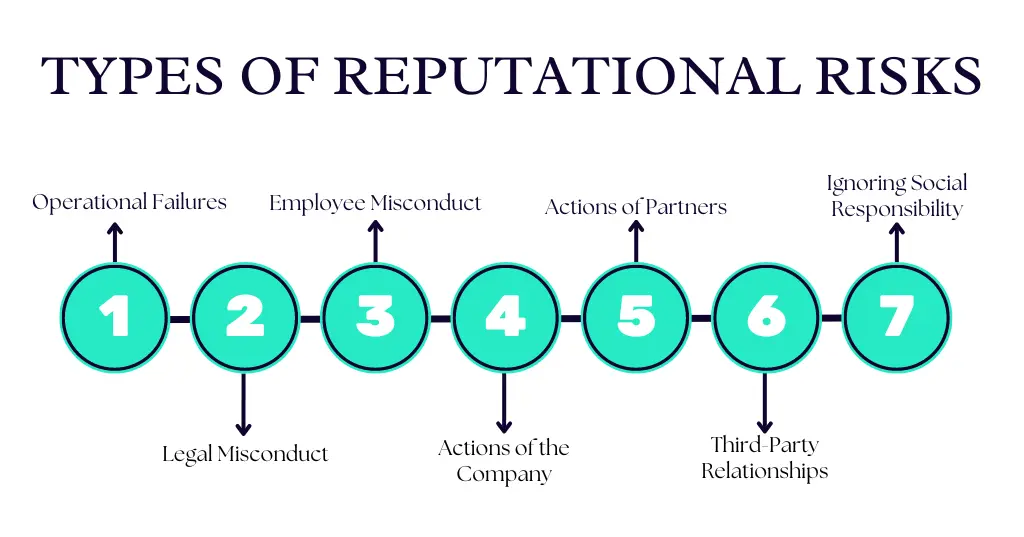
Operational Failures:
These are the cracks in the foundation of your business, where services or products fail to meet the mark. Whether it's a breakdown in quality control, a lapse in delivery times, or a glitch in customer service, these failures can erode trust in the eyes of your clientele.
Legal Misconduct:
Any misstep, be it compliance lapses or regulatory infringements, not only incurs financial penalties but also tarnishes your reputation. This shadow cast by legal misconduct can be long and daunting, affecting stakeholder trust and investor confidence.
Employee Misconduct:
Employees are the face of a brand. When they engage in unethical behavior, discrimination, or harassment, it reflects poorly on the entire organization. The fallout from such incidents can resonate far beyond the immediate aftermath, impacting employee morale and customer perceptions.
Actions of the Company:
Every decision and action a company makes sends a message about its values and ethics. Whether it’s controversial marketing campaigns, poor financial stewardship, or executive decisions that come under fire, these actions can lead to a rapid erosion of reputation.
Actions of Partners:
The actions of a company's partners can also become a reputational burden. Whether it’s suppliers engaging in unethical labor practices or partners embroiled in legal issues, the association can cast a shadow over the brand.
Third-Party Relationships:
Outsourcing and third-party collaborations can boost efficiency but also pose a reputational risk if these entities fail to uphold the standards you've set for your own operations. Any misalignment in ethical practices or operational quality can reflect negatively on your company.
Ignoring Social or Environmental Responsibility:
Companies today are increasingly judged not just by their profits, but by their impact on society and the environment. A perceived indifference or negative impact on these fronts can significantly harm a brand's reputation, as consumers and investors alike demand more responsible corporate behavior.
How To Mitigate Reputational Risk?
To mitigate reputational risk, a company should prioritize transparency, actively monitor online presence, quickly respond to negative feedback, maintain ethical practices, engage with stakeholders, develop a crisis management plan, and consistently communicate authentically with customers, addressing concerns promptly and openly; essentially building trust through actions that align with stated values.
Here are some key strategies to fortify defenses against reputational harm:
Build a Strong Ethics Program:
A culture of integrity and ethical behavior doesn't happen by accident. It’s the product of concerted efforts, including clear ethical guidelines, regular training, and a no-tolerance stance on violations. This culture acts as the first line of defense against reputational damage.
Engage in Proactive Communication:
Don't wait for a crisis to communicate with your stakeholders. Regular, transparent communication about your operations, the challenges you face, and the steps you're taking to address them helps build trust.
Implement a Comprehensive Crisis Management Plan:
Hope for the best but prepare for the worst. Having a well-thought-out crisis management plan allows you to respond quickly and efficiently to issues, minimizing potential damage to your reputation.
Monitor and Respond to Online Sentiment:
Regular monitoring of social media and online forums can help you catch potential issues before they explode into full-blown crises. Responding appropriately to negative sentiments or feedback can also turn potentially damaging situations into opportunities for demonstrating your commitment to customer satisfaction.
Regularly Audit and Assess Risks:
Conducting regular audits and assessments of potential reputational risks helps organizations identify vulnerabilities and areas for improvement. This proactive approach ensures that risk management strategies remain effective and up-to-date with evolving threats.
The framework below structures reputational risk management across six phases, from identification through to recovery:
Reputational Risk Management Framework
| Phase | Activity | Tools and Methods | Responsible Party |
| Identification | Monitor triggers; map stakeholder expectations against organisational behaviour | Social listening; ESG monitoring; regulatory watch | Risk; Communications |
| Assessment | Rate likelihood and impact; integrate findings with the enterprise risk register | ERM risk register; scenario analysis; brand surveys | Risk Management |
| Prevention | Implement controls against reputation-damaging events across all risk categories | Ethics programme; regulatory compliance; ESG strategy | All functions |
| Early Warning | Monitor leading indicators of reputational damage before events escalate | Social sentiment scores; brand tracking; regulator correspondence | Communications; Risk |
| Response | Execute crisis communications; manage media; engage regulators | Crisis PR playbooks; CEO communications; legal guidance | CEO; Communications; Legal |
| Recovery | Rebuild stakeholder trust through transparent, sustained action | Apology and remediation communications; ESG reporting; stakeholder engagement | Board; CEO; Communications |
Conclusion
The implications of reputational damage can be profound, affecting not just financial performance but also long-term strategic goals. This intricate interplay between brand perception and business success underscores the need for a robust, forward-thinking approach to risk management.
MetricStream provides a comprehensive platform that encapsulates the nuanced facets of risk assessment, mitigation, and recovery, serving as an invaluable ally in safeguarding and enhancing reputational integrity.
Reputational risk is the potential for damage to an organisation's standing, credibility, or public perception arising from actions, events, or associations that conflict with stakeholder expectations of ethical, legal, or responsible behaviour. It applies to all organisations regardless of size or sector, with particular regulatory focus in financial services, where the FCA, PRA, and equivalent authorities treat reputational damage as a supervisory concern linked to conduct, operational, and ESG risk.
Companies operate within a tightly interconnected global environment where information travels at lightning speed across a variety of platforms. This constant exchange and the public's access to information mean that how a business is perceived can drastically change overnight.
Reputational risk is the potential for damage to an organization's standing, credibility, or public perception arising from actions or events that conflict with stakeholder expectations, translating directly into customer loss, share price decline, regulatory action, and talent attrition across all sectors and sizes.
According to Aon's 2025 Global Cyber Risk Report, published June 2025, cyber attack events that escalate into reputational risk incidents cause shareholder value to fall by an average of 27%, with damage to brand or reputation ranking as a top-ten global business risk continuously since 2007. The figure underscores that reputational risk is not a secondary consequence of other risk categories but a material financial exposure in its own right, one that requires dedicated management frameworks rather than treatment as an incidental output of crisis communications.
Reputation, a subtle force, can significantly influence stakeholder trust, consumer behavior, and ultimately, the financial health and operational effectiveness of an organization. Given these dynamics, understanding and managing reputational risk is important for sustaining corporate health and growth.
- Reputational risk is the potential harm to an organization's image, which can impact trust, consumer behavior, and financial health.
- Common causes of reputational risk include internal misconduct, product failures, negative customer experiences, social media missteps, and cybersecurity breaches.
- Mitigation strategies include building strong ethics programs, proactive communication, crisis management plans, monitoring online sentiment, and regular risk audits.
- Reputational risk management is crucial because it impacts customer loyalty, attracts negative media attention, affects recruitment and retention, incurs legal and ethical ramifications, and reflects a company's social and environmental responsibility.
Reputational risk is the potential harm negative publicity can cause to an organization’s brand, trust, and financial health. It impacts customer confidence, employee retention, stakeholder relations, and market expansion. Damage can lead to revenue loss, higher costs, and long-term challenges in restoring credibility.
Reputational risk refers to the potential damage to an organization’s brand, credibility, and stakeholder trust due to negative publicity, ethical lapses, or poor public perception. It can impact customer loyalty, financial performance, and long-term business relationships.
Operational risk, on the other hand, arises from internal failures such as process inefficiencies, system breakdowns, human errors, or external disruptions. It directly affects business continuity, compliance, and financial stability.
Reputational risk intersects with several adjacent risk categories; the table below clarifies the relationship between each.
Reputational Risk vs Related Risk
| Risk Type | Definition | Relationship to Reputational Risk | Examples |
| Conduct Risk | Risk of harm from inappropriate firm or staff behaviour | Conduct failures are among the most direct triggers of reputational damage | Mis-selling; market manipulation; cultural failures |
| Compliance Risk | Risk of regulatory non-compliance | Enforcement actions and regulatory notices generate significant reputational exposure | FCA enforcement notices; SEC charges |
| Operational Risk | Risk from people, processes, systems, and external events | Operational failures including cyber incidents, product failures, and fraud drive reputational harm | Data breaches; product recalls; fraud events |
| ESG Risk | Environmental, social, and governance failure risk | ESG failures are an increasingly significant and visible source of reputational damage | Greenwashing allegations; supply chain labour abuses |
| Strategic Risk | Strategy execution and competitive positioning risk | Strategic missteps damage investor and market confidence in leadership | Failed acquisitions; missed market pivots |
While operational risks often lead to reputational risks if not managed effectively, reputational risks can exist independently and have far-reaching consequences beyond operational failures.
The scope of reputational risk is wide-ranging, and understanding its triggers is vital. Here are two real-world examples of events that precipitated reputational harm:
Ethical Misconduct and Compliance Violations:
When an organization or its employees are found bending or breaking legal or ethical boundaries, the fallout can be significant.
In 2015, Volkswagen was found to have installed software in millions of its diesel vehicles to cheat emissions tests, making the cars appear more environmentally friendly than they actually were. This deception was uncovered by the U.S. Environmental Protection Agency (EPA) and led to a series of grave consequences for the company.Volkswagen faced over $30 billion in fines, settlements, and other costs, and its stock price plummeted, reflecting the loss of investor confidence. Additionally, the scandal severely tarnished Volkswagen's brand, which had been synonymous with reliability and trust.
The fallout demonstrated how ethical lapses and legal violations can erode public trust and investor confidence, leading to long-term reputational damage that can take years to rebuild.
Product Failures or Safety Issues:
Companies that produce goods face the constant challenge of ensuring their products are safe and reliable. An example of this is the Samsung Galaxy Note 7 crisis.
In 2016, reports emerged that several Galaxy Note 7 devices had caught fire due to battery defects. The issue was severe enough that Samsung had to recall approximately 2.5 million units initially, and despite attempts to fix the problem, replacement devices continued to exhibit the same dangerous flaw. This led to a second, unprecedented global recall and ultimately the discontinuation of the product.
The financial impact was substantial, costing Samsung an estimated $5.3 billion, but the reputational damage was even more profound. The brand, known for its innovation and quality, faced a significant trust deficit as consumers began to question the safety and reliability of Samsung products.
The ethical standing of an organization forms the bedrock of its relationship with stakeholders. Any crack, no matter how small, can cause a seismic shift in perception, leading to boycotts, sanctions, and a long road to redemption.
The table below maps the principal trigger categories to verified real-world cases and their documented financial consequences:
Reputational Risk Triggers and Real-World Impact
| Trigger Category | Examples | Notable Cases | Financial Impact |
| Regulatory and Legal Failures | Enforcement actions; fines; legal judgements | Deutsche Bank AML failures (170 million euro fine); Wells Fargo fake accounts scandal | Fines; litigation costs; customer attrition; share price decline |
| Ethical and Conduct Failures | Executive misconduct; certification fraud; emissions deception | Boeing 737 MAX (certification fraud); Volkswagen emissions scandal | Market cap decline; regulatory action; recall costs |
| Cybersecurity Incidents | Data breaches; ransomware; customer data exposure | Marks and Spencer ransomware attack (April 2025, approximately 300 million pounds in lost operating profit; over 1 billion pounds wiped from market value) | Trust erosion; regulatory investigation; sustained revenue loss |
| Product and Service Failures | Product recalls; safety incidents; quality failures | Johnson and Johnson talcum powder litigation; Samsung Galaxy Note 7 recall | Recall costs; litigation; long-term market share loss |
| ESG and Sustainability Issues | Environmental damage; supply chain labour abuses; greenwashing | Boohoo supply chain scandal; BP Deepwater Horizon | ESG investor pressure; licence-to-operate risk |
| Social Media and PR Crisis | Viral negative content; CEO controversy; consumer boycotts | Bud Light brand equity decline (2023) | Customer loss; brand equity reduction |
The causes of reputational risks are usually from sudden, severe incidents that occur unexpectedly or from the ongoing nature of an organization’s activities, which can result in prolonged damage over time.
Here’s a broader spectrum of triggers that could tarnish an organization's public image:
- Internal Misconduct:
Whether it's a high-level executive caught in an unethical act or employees mistreating customers, internal wrongdoing can quickly escalate into a reputational crisis. It erodes trust and reflects poorly on a company’s culture and ethics. - Product Failures:
From safety issues to performance disappointments, when a product doesn’t live up to expectations or poses a risk to consumers, the backlash can be swift and severe. It's a stark reminder of the need for stringent quality control and transparent communication. - Negative Customer Experiences:
A single negative review can multiply, and in social media, a dissatisfied customer’s story can go viral, reaching millions overnight. This form of reputational risk emphasizes the importance of excellent customer service and rapid, thoughtful crisis response. - Social Media Missteps:
In today's digitally connected world, a poorly judged tweet or an insensitive ad campaign can spread like wildfire across social media platforms, drawing widespread condemnation. The speed at which information travels online means that social media blunders can explode into major issues in mere hours. - Cybersecurity Breaches:
As businesses become increasingly digital, the potential for damaging cyber incidents rises. A significant data breach, exposing customer information or corporate secrets, can immediately erode trust and signal weaknesses in an organization's defenses.
Recognizing the significance of reputational risk is essential for any company, irrespective of its size. It directly influences customer loyalty, sales performance, and resource allocation, while also affecting media perception and talent acquisition.
Below are some points that illustrate the significant impacts reputational risk can have on a company:
Customer Loyalty and Trust:
At its core, a company’s reputation is about trust. When that trust is broken, through poor product quality or negative customer experiences, it can take years to rebuild. Loyal customers may start looking elsewhere, and attracting new ones becomes a herculean task.
Impact on Sales:
Sales numbers are often the first to reflect the impact of a reputational hit. Whether it’s due to product recalls, bad press, or customer boycotts, the bottom line can suffer significantly. Rebuilding sales momentum requires time and investment, often diverting resources from growth initiatives to damage control.
Negative Media Attention:
Once the media latches onto a story, it can spiral beyond the company's control, with every detail dissected and discussed across multiple platforms. This kind of attention can deter potential partners, investors, and customers who are wary of associating with a brand mired in controversy.
Recruitment and Retention Challenges:
A strong reputation not only attracts customers but also with talent. When a company is seen as unethical or a source of negative headlines, top candidates may think twice about applying, and current employees may consider leaving for a more stable and positively viewed organization.
Here’s a rundown of some common types of reputational risks that organizations like yours might encounter:
Operational Failures:
These are the cracks in the foundation of your business, where services or products fail to meet the mark. Whether it's a breakdown in quality control, a lapse in delivery times, or a glitch in customer service, these failures can erode trust in the eyes of your clientele.
Legal Misconduct:
Any misstep, be it compliance lapses or regulatory infringements, not only incurs financial penalties but also tarnishes your reputation. This shadow cast by legal misconduct can be long and daunting, affecting stakeholder trust and investor confidence.
Employee Misconduct:
Employees are the face of a brand. When they engage in unethical behavior, discrimination, or harassment, it reflects poorly on the entire organization. The fallout from such incidents can resonate far beyond the immediate aftermath, impacting employee morale and customer perceptions.
Actions of the Company:
Every decision and action a company makes sends a message about its values and ethics. Whether it’s controversial marketing campaigns, poor financial stewardship, or executive decisions that come under fire, these actions can lead to a rapid erosion of reputation.
Actions of Partners:
The actions of a company's partners can also become a reputational burden. Whether it’s suppliers engaging in unethical labor practices or partners embroiled in legal issues, the association can cast a shadow over the brand.
Third-Party Relationships:
Outsourcing and third-party collaborations can boost efficiency but also pose a reputational risk if these entities fail to uphold the standards you've set for your own operations. Any misalignment in ethical practices or operational quality can reflect negatively on your company.
Ignoring Social or Environmental Responsibility:
Companies today are increasingly judged not just by their profits, but by their impact on society and the environment. A perceived indifference or negative impact on these fronts can significantly harm a brand's reputation, as consumers and investors alike demand more responsible corporate behavior.
To mitigate reputational risk, a company should prioritize transparency, actively monitor online presence, quickly respond to negative feedback, maintain ethical practices, engage with stakeholders, develop a crisis management plan, and consistently communicate authentically with customers, addressing concerns promptly and openly; essentially building trust through actions that align with stated values.
Here are some key strategies to fortify defenses against reputational harm:
Build a Strong Ethics Program:
A culture of integrity and ethical behavior doesn't happen by accident. It’s the product of concerted efforts, including clear ethical guidelines, regular training, and a no-tolerance stance on violations. This culture acts as the first line of defense against reputational damage.
Engage in Proactive Communication:
Don't wait for a crisis to communicate with your stakeholders. Regular, transparent communication about your operations, the challenges you face, and the steps you're taking to address them helps build trust.
Implement a Comprehensive Crisis Management Plan:
Hope for the best but prepare for the worst. Having a well-thought-out crisis management plan allows you to respond quickly and efficiently to issues, minimizing potential damage to your reputation.
Monitor and Respond to Online Sentiment:
Regular monitoring of social media and online forums can help you catch potential issues before they explode into full-blown crises. Responding appropriately to negative sentiments or feedback can also turn potentially damaging situations into opportunities for demonstrating your commitment to customer satisfaction.
Regularly Audit and Assess Risks:
Conducting regular audits and assessments of potential reputational risks helps organizations identify vulnerabilities and areas for improvement. This proactive approach ensures that risk management strategies remain effective and up-to-date with evolving threats.
The framework below structures reputational risk management across six phases, from identification through to recovery:
Reputational Risk Management Framework
| Phase | Activity | Tools and Methods | Responsible Party |
| Identification | Monitor triggers; map stakeholder expectations against organisational behaviour | Social listening; ESG monitoring; regulatory watch | Risk; Communications |
| Assessment | Rate likelihood and impact; integrate findings with the enterprise risk register | ERM risk register; scenario analysis; brand surveys | Risk Management |
| Prevention | Implement controls against reputation-damaging events across all risk categories | Ethics programme; regulatory compliance; ESG strategy | All functions |
| Early Warning | Monitor leading indicators of reputational damage before events escalate | Social sentiment scores; brand tracking; regulator correspondence | Communications; Risk |
| Response | Execute crisis communications; manage media; engage regulators | Crisis PR playbooks; CEO communications; legal guidance | CEO; Communications; Legal |
| Recovery | Rebuild stakeholder trust through transparent, sustained action | Apology and remediation communications; ESG reporting; stakeholder engagement | Board; CEO; Communications |
The implications of reputational damage can be profound, affecting not just financial performance but also long-term strategic goals. This intricate interplay between brand perception and business success underscores the need for a robust, forward-thinking approach to risk management.
MetricStream provides a comprehensive platform that encapsulates the nuanced facets of risk assessment, mitigation, and recovery, serving as an invaluable ally in safeguarding and enhancing reputational integrity.
Frequently Asked Questions
Reputational risk is the potential for damage to an organisation's standing from actions or events conflicting with stakeholder expectations, where impact is determined by how customers, investors, regulators, and the public respond rather than by the triggering event alone.
The six principal trigger categories are regulatory and legal failures, ethical and conduct failures, cybersecurity incidents, product and service failures, ESG issues, and social media crises, each capable of generating reputational harm independently or in combination with other risk events.
Reputational risk is measured through brand equity surveys, Net Promoter Scores, social media sentiment analysis, ESG ratings from Sustainalytics and MSCI, media tone analysis, employee engagement scores, and event study methodologies estimating share price impact from specific incidents.
Conduct risk refers to harm from inappropriate firm or employee behaviour, while reputational risk covers perception damage from any event including conduct failures, making conduct risk one of the primary drivers of reputational exposure in regulated financial services organisations.
Effective reputational risk management combines trigger identification, prevention through ethics and compliance programmes, early warning systems using social sentiment and regulatory monitoring, pre-built crisis response plans with scenario-tested communications, and structured recovery through transparent stakeholder engagement and remediation reporting.
A crisis response plan should define trigger escalation procedures, decision authority, media response protocols, regulator notification, social media monitoring, CEO and board communication templates, and recovery milestones, with all elements tested through simulation exercises before a crisis occurs.
ESG failures, including greenwashing allegations, supply chain abuses, and governance controversies, are an increasingly significant source of reputational damage, particularly with ESG-sensitive institutional investors, and CSRD disclosure requirements make the consequences of ESG misreporting more acute.
Reputational risk is partially insurable, with some policies covering crisis management costs and limited lost revenue, but share price decline, customer loss, and regulatory action typically fall outside coverage, while D&O liability addresses directors personally for conduct-related reputational claims.
Reputational risk appears in ERM frameworks either as a standalone category or as a consequence dimension applied across all risk categories, with the latter approach preferred as it ensures reputational impact is assessed for every risk event without double-counting.
MetricStream integrates reputational risk into the enterprise risk register, applies AiSPIRE AI to monitor external signals for emerging threats, connects ESG risk to reputational exposure, and tracks reputational incidents through response and remediation via structured issue management workflows.