
Metricstream Logo
×

The Ultimate Guide to Risk Reporting

Introduction

Businesses today have access to large volumes of quality data that can be transformed into actionable risk insights, which can help improve firm-wide risk awareness as well help enable stakeholders to predict risk outcomes more effectively and reliably. It is important to present such risk insights in a well-structured format. Hence, the need for an effective risk reporting system.

According to Deloitte’s 2025 Global Risk Management Survey, over 75 percent of organizations say that improving risk reporting and data driven insights is a top priority for strengthening decision making at the executive level.

Furthermore, with intensifying regulatory scrutiny and rapidly evolving risk landscape, boards and senior management are demanding in-depth visibility into the organizational risk posture for making better-informed business decisions. The onus is on the risk teams and the chief risk officers to provide this risk information.

In this article, we will discuss risk reporting in detail, including its types, importance, key elements of a risk report, and more.

Key Takeaways

  • Risk reporting is the process of documenting and informing the board and the senior management of the top organizational risks in a structured format.
  • The four main types of risk reporting are project risk reporting, program risk reporting, portfolio risk reporting, and business risk reporting.
  • The key elements to be included in a risk report are executive summary, risk profile, risk appetite and tolerance levels, KRIs, and risk management efforts.
  • A comprehensive risk report enables organizations to enhance proactive risk management, risk-aware decision-making, trust and confidence of various stakeholders, and continuous improvement.

What is Risk Reporting? Why is it Important in Risk Management?

Risk reporting is the practice of documenting and informing an enterprise of its key risks at a particular point in time. It helps organizations better understand the overall risk posture, prioritize their risks and mitigation action, and make risk-aware business decisions.

Risks can be reported based on various parameters such as the top risks faced by the organization based on risk assessment and risk analysis, associated controls, the number of open issues for the risk, key risk indicators (KRIs) and trends, etc.

Types of Risk Reporting

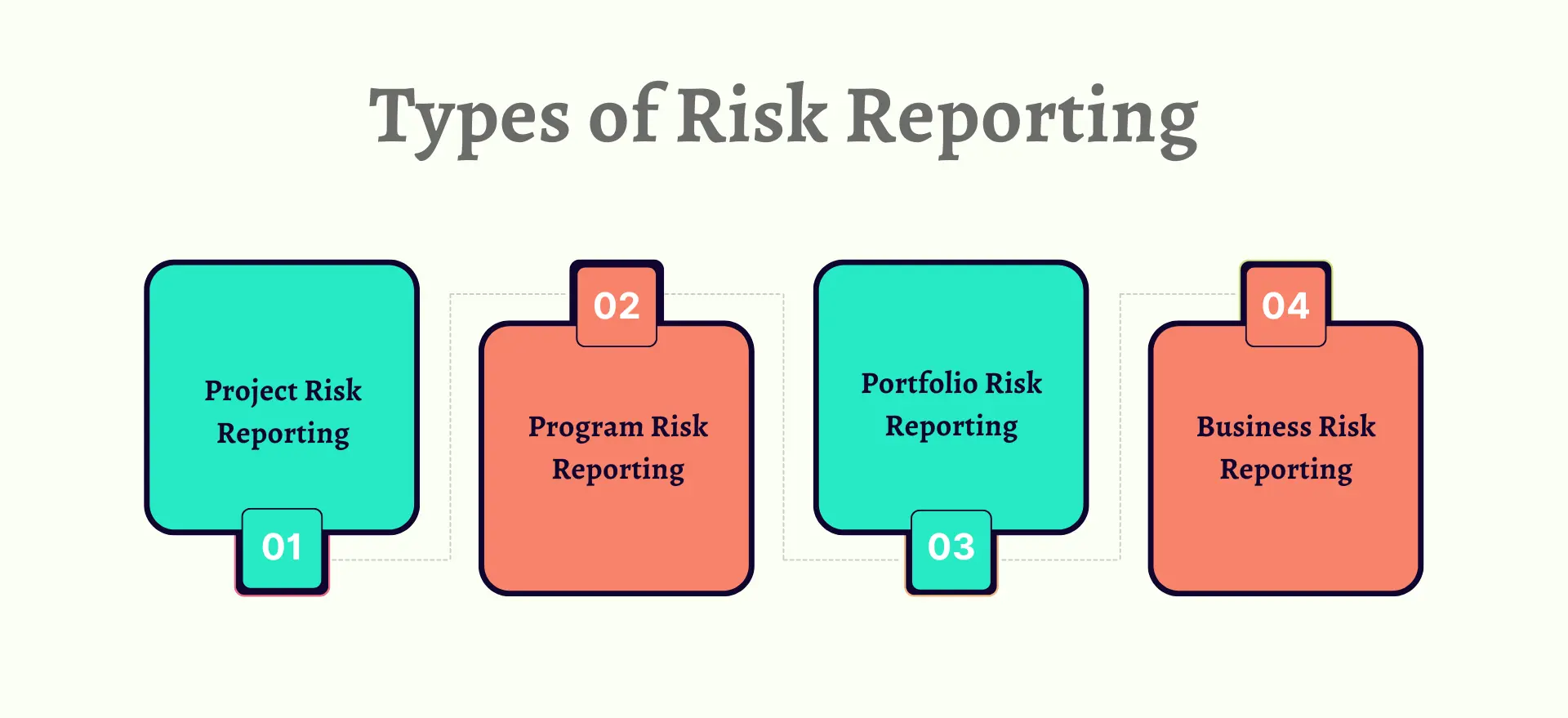
There are 4 major types of risk reporting:
What is Risk Reporting

Project Risk Reporting 

Project risk reporting involves documenting and informing the enterprise of risks associated with a particular project, typically reported by smaller teams and project managers. It falls lowest in the risk reporting hierarchy.

Program Risk Reporting 

Program risk reporting involves documenting and informing the enterprise of risks associated with a program that is composed of multiple projects. Such reporting also covers risk overlap between multiple projects.

Portfolio Risk Reporting 

Portfolio risk reporting involves documenting and informing of all risks associated with all programs that form the portfolio of an enterprise.

Business Risk Reporting 

Business risk reporting involves enterprise-level risk reporting involving risks falling within and outside the portfolio of the organization, typically covering all associated risks that an enterprise needs to address on priority.

How to Build an Effective Risk Report?

A good risk report brings clarity to the organization. It highlights what matters, shows where attention is needed, and supports timely decisions. Here is a breakdown of the process of building an effective risk report: 

  • Identify enterprise risks 

    Begin with risks that are directly linked to business objectives, operations, and regulatory exposure. Inputs from business units help surface real issues that may not appear in standard risk lists. 

  • Assess risk likelihood and impact 

    Evaluate how often a risk may occur and the actual extent of its impact. Use a consistent scoring method so risks can be compared and prioritized across the company. 

  • Define risk appetite thresholds 

    Establish clear boundaries for acceptable risk levels. These thresholds help teams understand when a risk can be monitored and when it requires escalation. 

  • Track key risk indicators 

    Select KRIs that reflect meaningful changes in risk exposure. Regular tracking helps identify patterns and shifts before they develop into larger concerns. 

  • Visualize risk trends through dashboards 

    Present data through simple visuals such as heat maps and trend charts. Clear visuals make it easier for stakeholders to quickly interpret risk levels and priorities. 

  • Communicate insights to leadership 

    Focus on what has changed, what it means for the business, and what actions are required. Clear and direct communication ensures leadership can respond with confidence.

What Should a Risk Report Include?

The risk reporting system should be aligned with other organizational management structures and processes to provide a true view of risk. A well-structured risk report can greatly enhance the risk manager’s ability to gain the necessary insight into the potential risks.

Here are some of the key elements that should be included in a risk report:

Executive Summary: 

This includes a brief of all risks that an enterprise must address on priority.

Risk Profile: 

This is a number or a grade that helps enterprises understand the risks in quantifiable terms. 

Risk Appetite: 

This is a measure of how much risk an organization can take before becoming unsustainable or financially weak.

Tolerance Levels: 

Tolerance level is a measure of risk that an organization is willing to take. This number is typically much lower than risk appetite and helps organizations get a realistic picture of the risk-to-reward ratio.

Key Risk Indicators: 

KRIs are a set of metrics attached to each identified risk, where each indicator has a threshold. Whenever an indicator reaches beyond such a threshold, an organization can understand that a particular risk is beginning to materialize.

Risk Management Measures: 

This section includes information on proactive measures that the organization can take to mitigate or eliminate an identified risk.


ElementPurpose
Executive SummaryProvides a concise overview of major risks, key changes, and areas requiring attention from leadership
Risk ProfilePresents the overall risk exposure across the organization, often using ratings or aggregated risk views
Risk AppetiteDefines the maximum level of risk the organization is willing to accept, helping contextualize risk levels
Key Risk Indicators (KRIs)Tracks measurable signals that indicate changes in risk exposure or emerging issues
Risk TrendsShows how risks are evolving over time, helping identify patterns and areas of increasing concern
Mitigation PlansOutlines actions being taken to reduce or manage identified risks, along with progress updates
Exceptions and BreachesHighlights risks that exceed defined thresholds and require escalation or intervention

Real-World Risk Reporting Examples 

  • Cybersecurity Risk Reporting Security incidents are captured in real time and reflected in centralized dashboards. These dashboards show affected systems, severity levels, and current exposure. They also track remediation progress, open vulnerabilities, and response timelines. This gives security teams and leadership a clear view of where action is needed and how quickly issues are being resolved. 
  • Operational Risk Reporting In industries such as manufacturing, system failures or production outages trigger detailed operational risk reports. These reports quantify the impact in terms of downtime, revenue loss, and process disruption. They also highlight root causes and corrective actions, helping teams prevent similar incidents in the future. 
  • Regulatory Risk Reporting Compliance teams prepare structured reports that outline regulatory risks, control gaps, and ongoing remediation efforts. These reports are shared with senior management, boards, and in some cases regulators. They provide visibility into compliance status, emerging risks, and areas that require immediate attention. 

Challenges in Risk Reporting

  • Too much data, not enough clarity 

    Many reports try to include everything, which makes it harder to spot what matters. Important risks may get buried under excessive detail. 

  • Inconsistent data across teams 

    Different departments often use their own methods and definitions, leading to reports that are difficult to compare or consolidate. 

  • Delayed or outdated information 

    If risk data is not updated regularly, reports can reflect a past state rather than the current situation. This weakens their usefulness for decision making. 

  • Lack of clear ownership 

    When it is unclear who is responsible for updating or validating risk information, reports can become incomplete or inaccurate, and therefore not usable in the long run. 

  • Overly complex presentation 

    Dense reports filled with technical jargon or complicated visuals can make it difficult for leadership to quickly understand key issues, causing imminent lag. 

  • Weak connection to action 

    Some reports highlight risks but do not clearly outline what needs to be done next, leaving stakeholders without a clear path forward.

What are the Best Practices for Building an Effective Risk Report?

Here are some of the best practices for building a comprehensive and effective risk report:

Relevant Reporting

A risk report must be relevant to the organization. It is common to see teams preparing reports based on information taken from the World Economic Forum and other forums’ risk reports. Although these forums do make astute observations and accurate risk reports, these tend to be much more generic and wide-ranging than needed.

Risk reports for an organization must be narrow and focused on risks that directly affect them. As an organization can identify risks relevant to their domain and business, they can prepare dedicated strategies to mitigate them, against generic risks which might or might not affect them.

Visual Representations

A risk report should include lush use of visuals such as graphs, charts, and images. Research has proven that people are more likely to retain information for longer durations of time when acquired through visual mediums.

Further, information acquired with the help of visual cues helps executives understand the importance and relevance of different types of risks. Cues such as color schemes and shapes can be used to attach priority to a particular risk.

Sunrise and Sunset points

The sunrise and sunset points of identified risks are one of the most important parts of a risk report to help establish a timeline for the organization. A sunrise point is an event that helps understand when risk begins to materialize, and a sunset point is the event that helps understand when an identified risk is no longer considered a risk for the organization.

Sunrise and sunset points help organizations understand when to act and when to cease acting on risk. A sunrise point is a reference to deploy measures to counteract the ill effects of risk, mitigate the risk, and manage the risk. On the other hand, a sunset point is a reference to ceasing deployed measures as the identified risk is no longer considered a risk for the organization.

Risk Statement for Identified Risks

In a risk report, a clear and concise risk statement is indispensable for ensuring the risk and the threats that it poses are clearly understood by the organization. The risk statement must elaborate on the identified risk, the indicators that mark it as a risk, and additional material to make the risk more intelligible wherever required.

Measures in Place

In events where an organization has already deployed certain measures that can mitigate identified risks, the measures in place must be included in the risk report. This allows organizations to understand their preparedness and identify any flaws in existing strategies that may cause leakage. Measures in place also help organizations prioritize risks and focus on the risks against which the organization has no safeguards in place.

Risk Management Strategies

Finally, the risk report must include risk management strategies. The ultimate goal of a risk report is to understand ways in which the organization can prevent lasting damage. Therefore, along with a list of identified risks, the report must include measures and strategies available to mitigate such risks, their timeline, and possible backups in case the strategies fail to deliver. Including risk management strategies in the risk report also help organizations prepare budgets and prepare contingency plans to protect their assets in the event of the failure of risk management measures.

Why is Risk Reporting Important?

An effective risk reporting practice is essential to an organization since it allows management to make informed decisions and resolve more pressing risks by establishing an order of priority.

Here are the key reasons why effective risk reporting is essential for organizations:

Proactive Risk Management

Risk reporting helps organizations proactively identify and prioritize top risks and pressing issues to address them in a timely manner.

Risk-Aware Decision-Making

 A comprehensive risk report enables decision makers understand the organization’s risk posture, its risk appetite and tolerance levels, and incorporate this information while making strategic business decisions, such as entering new markets or geographies, pricing strategies, etc. 

Stakeholder Assurance

Risk reports not just help keep the boards and the top management informed of the organizational risk posture but also other key stakeholders, including regulators and investors. It helps strengthen trust and confidence with these stakeholders that the organization has effective risk management practices in place.

Continuous Improvement

 A comprehensive risk report helps risk officers communicate the risk exposures in a transparent and effective manner. It highlights gaps and weaknesses in the organization’s risk management strategy, thereby enabling continuous improvement.

How MetricStream Can Help

MetricStream provides comprehensive tools and capabilities to create powerful dashboards, reports, and heat maps that offer quick and real-time access to information on risk management across the enterprise. Through graphical charts, organizations can capture and track details on risk profiles, risk-control assessments, control ownership, status of issue remediation, successes, failures, and trends.

To learn how MetricStream can help you streamline your risk reporting process, request a personalized demo today.

How MetricStream Can Help

  • What is risk reporting in enterprise risk management?

    Risk reporting in enterprise risk management is the process of communicating information about risks, controls, and risk exposure to leadership and stakeholders. It helps decision makers understand the organization’s risk profile and take appropriate action.

  • What should a risk report include?

    A risk report typically includes key risks, risk ratings, trends over time, key risk indicators, control effectiveness, mitigation actions, and any risks that exceed approved thresholds.

  • Who is responsible for risk reporting?

    Risk reporting is usually coordinated by the risk management or ERM team, while risk owners provide updates on their respective risks. Senior leadership and risk committees review the reports for oversight and decision making.

  • How often should risk reports be generated?

    Risk reports are commonly generated quarterly for executive and board level review. High priority risks may be monitored and reported more frequently depending on their impact and volatility.

  • What tools are used for risk reporting?

    Organizations use spreadsheets, business intelligence dashboards, and dedicated GRC platforms to collect risk data, track indicators, and generate structured risk reports.

  • Why is risk reporting important for organizations?

    Risk reporting provides visibility into emerging threats, supports informed decision making, and helps ensure that risks are managed within the organization’s defined risk appetite.

  • What are key risk indicators in risk reporting?

    Key risk indicators are measurable metrics that signal changes in risk exposure. They help organizations track trends, identify potential issues early, and determine whether risks remain within acceptable limits.

  • Who are the main audiences for risk reports?

    Risk reports are typically prepared for senior management, risk committees, and the board of directors. Operational teams may also receive targeted reports to monitor risks within their areas of responsibility.

  • How do you document controls and link them to risks?

    Risk reports are typically prepared for senior management, risk committees, and the board of directors. Operational teams may also receive targeted reports to monitor risks within their areas of responsibility.

  • What are common formats used in risk reporting?

    Risk reports often use dashboards, heat maps, trend charts, and summary tables to present risk data clearly. These formats help stakeholders quickly understand risk levels and emerging issues.

  • How do risk reports support strategic decision making?

    Risk reports provide leadership with a clear view of risk exposure and potential threats to business objectives. This insight helps executives evaluate tradeoffs, prioritize resources, and make informed strategic decisions.

  • What are common challenges in risk reporting?

    Common challenges include inconsistent risk data, lack of clear metrics, delayed updates from risk owners, and reports that contain too much detail without highlighting the most critical risks.

Businesses today have access to large volumes of quality data that can be transformed into actionable risk insights, which can help improve firm-wide risk awareness as well help enable stakeholders to predict risk outcomes more effectively and reliably. It is important to present such risk insights in a well-structured format. Hence, the need for an effective risk reporting system.

According to Deloitte’s 2025 Global Risk Management Survey, over 75 percent of organizations say that improving risk reporting and data driven insights is a top priority for strengthening decision making at the executive level.

Furthermore, with intensifying regulatory scrutiny and rapidly evolving risk landscape, boards and senior management are demanding in-depth visibility into the organizational risk posture for making better-informed business decisions. The onus is on the risk teams and the chief risk officers to provide this risk information.

In this article, we will discuss risk reporting in detail, including its types, importance, key elements of a risk report, and more.

  • Risk reporting is the process of documenting and informing the board and the senior management of the top organizational risks in a structured format.
  • The four main types of risk reporting are project risk reporting, program risk reporting, portfolio risk reporting, and business risk reporting.
  • The key elements to be included in a risk report are executive summary, risk profile, risk appetite and tolerance levels, KRIs, and risk management efforts.
  • A comprehensive risk report enables organizations to enhance proactive risk management, risk-aware decision-making, trust and confidence of various stakeholders, and continuous improvement.

Risk reporting is the practice of documenting and informing an enterprise of its key risks at a particular point in time. It helps organizations better understand the overall risk posture, prioritize their risks and mitigation action, and make risk-aware business decisions.

Risks can be reported based on various parameters such as the top risks faced by the organization based on risk assessment and risk analysis, associated controls, the number of open issues for the risk, key risk indicators (KRIs) and trends, etc.

There are 4 major types of risk reporting:

What is Risk Reporting

Project Risk Reporting 

Project risk reporting involves documenting and informing the enterprise of risks associated with a particular project, typically reported by smaller teams and project managers. It falls lowest in the risk reporting hierarchy.

Program Risk Reporting 

Program risk reporting involves documenting and informing the enterprise of risks associated with a program that is composed of multiple projects. Such reporting also covers risk overlap between multiple projects.

Portfolio Risk Reporting 

Portfolio risk reporting involves documenting and informing of all risks associated with all programs that form the portfolio of an enterprise.

Business Risk Reporting 

Business risk reporting involves enterprise-level risk reporting involving risks falling within and outside the portfolio of the organization, typically covering all associated risks that an enterprise needs to address on priority.

How to Build an Effective Risk Report?

A good risk report brings clarity to the organization. It highlights what matters, shows where attention is needed, and supports timely decisions. Here is a breakdown of the process of building an effective risk report: 

  • Identify enterprise risks 

    Begin with risks that are directly linked to business objectives, operations, and regulatory exposure. Inputs from business units help surface real issues that may not appear in standard risk lists. 

  • Assess risk likelihood and impact 

    Evaluate how often a risk may occur and the actual extent of its impact. Use a consistent scoring method so risks can be compared and prioritized across the company. 

  • Define risk appetite thresholds 

    Establish clear boundaries for acceptable risk levels. These thresholds help teams understand when a risk can be monitored and when it requires escalation. 

  • Track key risk indicators 

    Select KRIs that reflect meaningful changes in risk exposure. Regular tracking helps identify patterns and shifts before they develop into larger concerns. 

  • Visualize risk trends through dashboards 

    Present data through simple visuals such as heat maps and trend charts. Clear visuals make it easier for stakeholders to quickly interpret risk levels and priorities. 

  • Communicate insights to leadership 

    Focus on what has changed, what it means for the business, and what actions are required. Clear and direct communication ensures leadership can respond with confidence.

The risk reporting system should be aligned with other organizational management structures and processes to provide a true view of risk. A well-structured risk report can greatly enhance the risk manager’s ability to gain the necessary insight into the potential risks.

Here are some of the key elements that should be included in a risk report:

Executive Summary: 

This includes a brief of all risks that an enterprise must address on priority.

Risk Profile: 

This is a number or a grade that helps enterprises understand the risks in quantifiable terms. 

Risk Appetite: 

This is a measure of how much risk an organization can take before becoming unsustainable or financially weak.

Tolerance Levels: 

Tolerance level is a measure of risk that an organization is willing to take. This number is typically much lower than risk appetite and helps organizations get a realistic picture of the risk-to-reward ratio.

Key Risk Indicators: 

KRIs are a set of metrics attached to each identified risk, where each indicator has a threshold. Whenever an indicator reaches beyond such a threshold, an organization can understand that a particular risk is beginning to materialize.

Risk Management Measures: 

This section includes information on proactive measures that the organization can take to mitigate or eliminate an identified risk.


ElementPurpose
Executive SummaryProvides a concise overview of major risks, key changes, and areas requiring attention from leadership
Risk ProfilePresents the overall risk exposure across the organization, often using ratings or aggregated risk views
Risk AppetiteDefines the maximum level of risk the organization is willing to accept, helping contextualize risk levels
Key Risk Indicators (KRIs)Tracks measurable signals that indicate changes in risk exposure or emerging issues
Risk TrendsShows how risks are evolving over time, helping identify patterns and areas of increasing concern
Mitigation PlansOutlines actions being taken to reduce or manage identified risks, along with progress updates
Exceptions and BreachesHighlights risks that exceed defined thresholds and require escalation or intervention

Real-World Risk Reporting Examples 

  • Cybersecurity Risk Reporting Security incidents are captured in real time and reflected in centralized dashboards. These dashboards show affected systems, severity levels, and current exposure. They also track remediation progress, open vulnerabilities, and response timelines. This gives security teams and leadership a clear view of where action is needed and how quickly issues are being resolved. 
  • Operational Risk Reporting In industries such as manufacturing, system failures or production outages trigger detailed operational risk reports. These reports quantify the impact in terms of downtime, revenue loss, and process disruption. They also highlight root causes and corrective actions, helping teams prevent similar incidents in the future. 
  • Regulatory Risk Reporting Compliance teams prepare structured reports that outline regulatory risks, control gaps, and ongoing remediation efforts. These reports are shared with senior management, boards, and in some cases regulators. They provide visibility into compliance status, emerging risks, and areas that require immediate attention. 

Challenges in Risk Reporting

  • Too much data, not enough clarity 

    Many reports try to include everything, which makes it harder to spot what matters. Important risks may get buried under excessive detail. 

  • Inconsistent data across teams 

    Different departments often use their own methods and definitions, leading to reports that are difficult to compare or consolidate. 

  • Delayed or outdated information 

    If risk data is not updated regularly, reports can reflect a past state rather than the current situation. This weakens their usefulness for decision making. 

  • Lack of clear ownership 

    When it is unclear who is responsible for updating or validating risk information, reports can become incomplete or inaccurate, and therefore not usable in the long run. 

  • Overly complex presentation 

    Dense reports filled with technical jargon or complicated visuals can make it difficult for leadership to quickly understand key issues, causing imminent lag. 

  • Weak connection to action 

    Some reports highlight risks but do not clearly outline what needs to be done next, leaving stakeholders without a clear path forward.

Here are some of the best practices for building a comprehensive and effective risk report:

Relevant Reporting

A risk report must be relevant to the organization. It is common to see teams preparing reports based on information taken from the World Economic Forum and other forums’ risk reports. Although these forums do make astute observations and accurate risk reports, these tend to be much more generic and wide-ranging than needed.

Risk reports for an organization must be narrow and focused on risks that directly affect them. As an organization can identify risks relevant to their domain and business, they can prepare dedicated strategies to mitigate them, against generic risks which might or might not affect them.

Visual Representations

A risk report should include lush use of visuals such as graphs, charts, and images. Research has proven that people are more likely to retain information for longer durations of time when acquired through visual mediums.

Further, information acquired with the help of visual cues helps executives understand the importance and relevance of different types of risks. Cues such as color schemes and shapes can be used to attach priority to a particular risk.

Sunrise and Sunset points

The sunrise and sunset points of identified risks are one of the most important parts of a risk report to help establish a timeline for the organization. A sunrise point is an event that helps understand when risk begins to materialize, and a sunset point is the event that helps understand when an identified risk is no longer considered a risk for the organization.

Sunrise and sunset points help organizations understand when to act and when to cease acting on risk. A sunrise point is a reference to deploy measures to counteract the ill effects of risk, mitigate the risk, and manage the risk. On the other hand, a sunset point is a reference to ceasing deployed measures as the identified risk is no longer considered a risk for the organization.

Risk Statement for Identified Risks

In a risk report, a clear and concise risk statement is indispensable for ensuring the risk and the threats that it poses are clearly understood by the organization. The risk statement must elaborate on the identified risk, the indicators that mark it as a risk, and additional material to make the risk more intelligible wherever required.

Measures in Place

In events where an organization has already deployed certain measures that can mitigate identified risks, the measures in place must be included in the risk report. This allows organizations to understand their preparedness and identify any flaws in existing strategies that may cause leakage. Measures in place also help organizations prioritize risks and focus on the risks against which the organization has no safeguards in place.

Risk Management Strategies

Finally, the risk report must include risk management strategies. The ultimate goal of a risk report is to understand ways in which the organization can prevent lasting damage. Therefore, along with a list of identified risks, the report must include measures and strategies available to mitigate such risks, their timeline, and possible backups in case the strategies fail to deliver. Including risk management strategies in the risk report also help organizations prepare budgets and prepare contingency plans to protect their assets in the event of the failure of risk management measures.

An effective risk reporting practice is essential to an organization since it allows management to make informed decisions and resolve more pressing risks by establishing an order of priority.

Here are the key reasons why effective risk reporting is essential for organizations:

Proactive Risk Management

Risk reporting helps organizations proactively identify and prioritize top risks and pressing issues to address them in a timely manner.

Risk-Aware Decision-Making

 A comprehensive risk report enables decision makers understand the organization’s risk posture, its risk appetite and tolerance levels, and incorporate this information while making strategic business decisions, such as entering new markets or geographies, pricing strategies, etc. 

Stakeholder Assurance

Risk reports not just help keep the boards and the top management informed of the organizational risk posture but also other key stakeholders, including regulators and investors. It helps strengthen trust and confidence with these stakeholders that the organization has effective risk management practices in place.

Continuous Improvement

 A comprehensive risk report helps risk officers communicate the risk exposures in a transparent and effective manner. It highlights gaps and weaknesses in the organization’s risk management strategy, thereby enabling continuous improvement.

MetricStream provides comprehensive tools and capabilities to create powerful dashboards, reports, and heat maps that offer quick and real-time access to information on risk management across the enterprise. Through graphical charts, organizations can capture and track details on risk profiles, risk-control assessments, control ownership, status of issue remediation, successes, failures, and trends.

To learn how MetricStream can help you streamline your risk reporting process, request a personalized demo today.

  • What is risk reporting in enterprise risk management?

    Risk reporting in enterprise risk management is the process of communicating information about risks, controls, and risk exposure to leadership and stakeholders. It helps decision makers understand the organization’s risk profile and take appropriate action.

  • What should a risk report include?

    A risk report typically includes key risks, risk ratings, trends over time, key risk indicators, control effectiveness, mitigation actions, and any risks that exceed approved thresholds.

  • Who is responsible for risk reporting?

    Risk reporting is usually coordinated by the risk management or ERM team, while risk owners provide updates on their respective risks. Senior leadership and risk committees review the reports for oversight and decision making.

  • How often should risk reports be generated?

    Risk reports are commonly generated quarterly for executive and board level review. High priority risks may be monitored and reported more frequently depending on their impact and volatility.

  • What tools are used for risk reporting?

    Organizations use spreadsheets, business intelligence dashboards, and dedicated GRC platforms to collect risk data, track indicators, and generate structured risk reports.

  • Why is risk reporting important for organizations?

    Risk reporting provides visibility into emerging threats, supports informed decision making, and helps ensure that risks are managed within the organization’s defined risk appetite.

  • What are key risk indicators in risk reporting?

    Key risk indicators are measurable metrics that signal changes in risk exposure. They help organizations track trends, identify potential issues early, and determine whether risks remain within acceptable limits.

  • Who are the main audiences for risk reports?

    Risk reports are typically prepared for senior management, risk committees, and the board of directors. Operational teams may also receive targeted reports to monitor risks within their areas of responsibility.

  • How do you document controls and link them to risks?

    Risk reports are typically prepared for senior management, risk committees, and the board of directors. Operational teams may also receive targeted reports to monitor risks within their areas of responsibility.

  • What are common formats used in risk reporting?

    Risk reports often use dashboards, heat maps, trend charts, and summary tables to present risk data clearly. These formats help stakeholders quickly understand risk levels and emerging issues.

  • How do risk reports support strategic decision making?

    Risk reports provide leadership with a clear view of risk exposure and potential threats to business objectives. This insight helps executives evaluate tradeoffs, prioritize resources, and make informed strategic decisions.

  • What are common challenges in risk reporting?

    Common challenges include inconsistent risk data, lack of clear metrics, delayed updates from risk owners, and reports that contain too much detail without highlighting the most critical risks.

lets-talk-img

Ready to get started?

Speak to our GRC experts Let’s talk