

Introduction
2025 will be remembered as a defining year in cyber history. Cyberattacks increasingly moved beyond data theft and network outages to cause real-world disruption, and no industry was spared. From airports to automakers, organizations across verticals felt the impact as cyber incidents brought critical operations to a halt.
The September 2025 Jaguar Land Rover attack halted production for five weeks, triggering supply chain disruptions. The economic losses amounted to nearly £1.9 billion, and is now being classified as the costliest cyber attack in UK history. The Marks & Spencer 2025 cyber attack led to losses across multiple critical areas, including financial, operational, and reputational, with M&S's market value falling by over £700 million.
We also saw customer experience platforms and cloud ecosystems being targeted at unprecedented scale, exposing systemic dependencies across the digital economy. By compromising the integration between Drift (acquired by Salesloft) and Salesforce, malicious threat actors gained access to unlocked sensitive Salesforce CRM data from 700+ organizations.
The message is clear. Cyber GRC is no longer a siloed technology issue but has evolved into a material business risk with board-level consequences. Organizations are being held accountable not just for breaches, but for how effectively cyber risk is governed, monitored, and reported.
Against this reality, MetricStream’s 2026 Cyber GRC Trends highlight the most significant shifts that leaders must prioritize to build resilience, accountability, and confidence in the face of accelerating cyber risk. You can read all about the trends here – and here’s a look at the top 5 below.
1. AI-First Cyber GRC Will Redefine Risk Management
Cyber GRC is rapidly becoming AI-first. Organizations are embedding AI across risk identification, assessment, and response to move beyond manual processes and backward-looking analysis.
In 2026, predictive intelligence, automated controls testing, and real-time risk insights will allow security and risk teams to anticipate threats before they materialize. AI-first solutions, including AI cyber agents, will correlate signals across vulnerabilities, incidents, threat intelligence, and business context, enabling faster prioritization and more informed decision-making. Human expertise remains central to this model: risk leaders provide oversight, validate AI-driven recommendations, and apply judgment to ensure decisions align with business priorities, regulatory expectations, and ethical considerations.
This marks a fundamental transition for organizations: from reacting to cyber incidents to building proactive cyber resilience at scale.
As IT and OT environments converge, cyber risk increasingly extends into physical operations. Manufacturing plants, energy grids, transportation systems, and healthcare infrastructure now face threats that can disrupt safety, production, and national infrastructure, not just data. In the World Economic Forum’s (WEF) Global Cybersecurity Outlook 2026, 42% of organizations name the convergence of IT/OT/IoT/ robotics as a top factor influencing their overall cyber risk mitigation strategy.
In 2026, organizations operating in critical infrastructure will need unified Cyber GRC strategies that span both digital and physical domains. This requires consistent risk frameworks, shared controls, and integrated visibility across IT and OT systems.
Siloed approaches are no longer viable. Cyber risk management must evolve to address the full operational impact of cyber events.
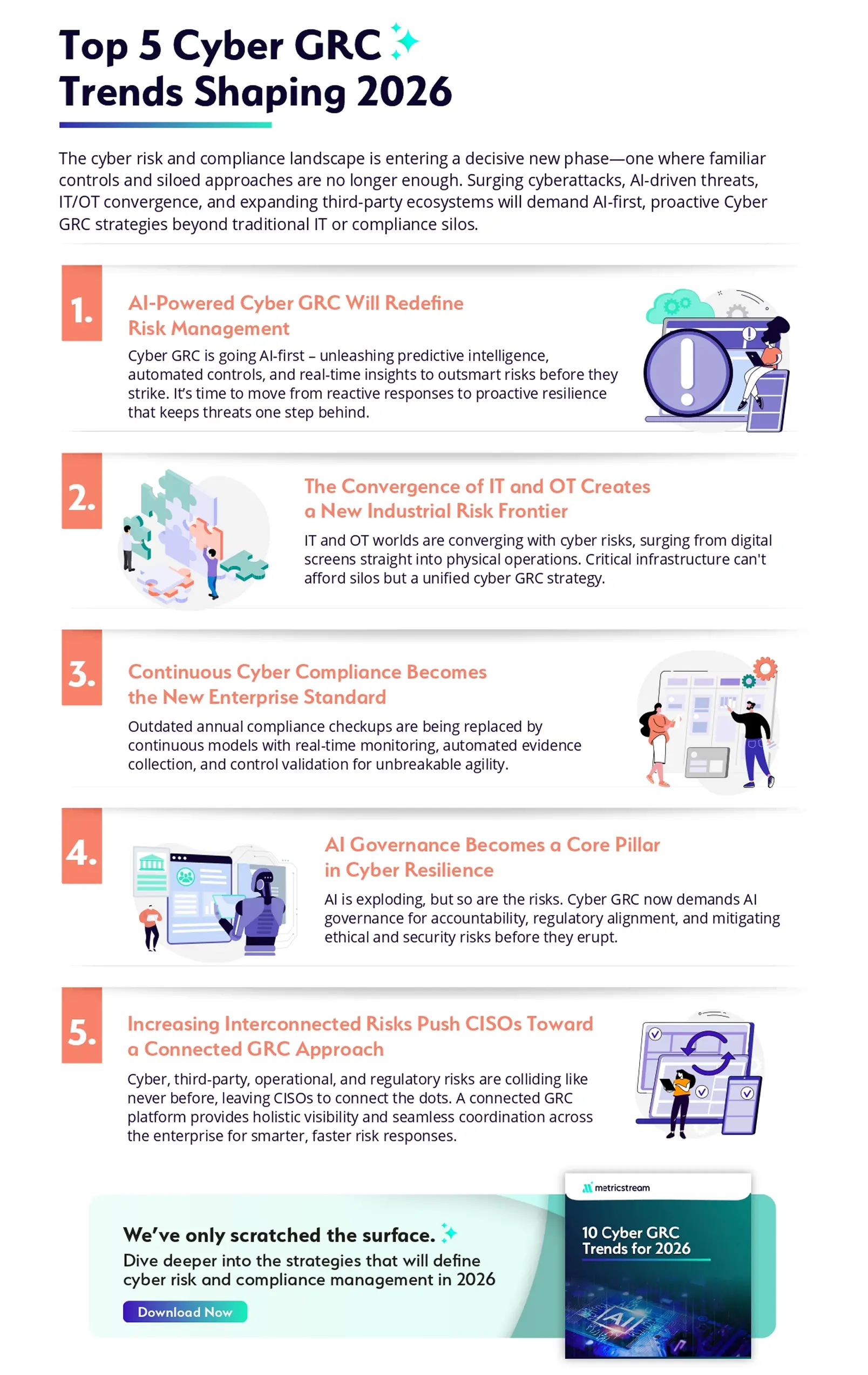
3. Continuous Cyber Compliance Becomes the New Enterprise Standard
Point-in-time compliance assessments are quickly becoming obsolete. In a world of constant change, new threats, evolving regulations, and dynamic cloud environments, compliance must be continuous.
By 2026, leading organizations will rely on real-time monitoring, automated evidence collection, and ongoing controls validation to maintain compliance readiness at all times. Continuous cyber compliance not only reduces audit fatigue but also strengthens security posture by detecting gaps as they emerge.
Compliance will no longer be a periodic exercise. It will be an always-on capability embedded into daily operations.
4. AI Governance Becomes a Core Pillar of Cyber Resilience
The WEF Global Cybersecurity Outlook 2026 report also highlighted that 87% of respondents identified AI-related vulnerabilities as the fastest-growing cyber risk over the course of 2025. As enterprises accelerate AI adoption, AI systems themselves are becoming a major source of cyber and operational risk. Issues around data integrity, model security, bias, explainability, and regulatory compliance are now front and center.
In 2026, AI governance will be a core Cyber GRC priority. Organizations will need clear accountability structures, risk assessments for AI use cases, and controls aligned to emerging regulations and ethical standards.
Without robust governance, AI can amplify risk faster than traditional systems. With it, AI becomes a powerful enabler of secure, resilient, and responsible innovation.
5. Interconnected Risks Drive CISOs Towards a Connected GRC Approach
Cyber risk no longer exists in isolation. It is deeply interconnected with third-party risk, operational risk, regulatory risk, and enterprise resilience.
In response, CISOs are increasingly adopting connected GRC platforms that provide holistic visibility across risk domains. In 2026, this connected approach will be essential for understanding how risks cascade across the organization and for coordinating response efforts across security, risk, compliance, and the business.
Connected GRC enables better prioritization, faster response, and stronger alignment between cyber risk management and business objectives.
Join the Conversation and Get Your Cyber Risk Questions Answered
Join me for a live webinar on Wednesday, February 18, 2026, where I’ll discuss the top cyber risk management trends shaping 2026, and what they mean for organizations navigating an increasingly complex threat and regulatory landscape. I’ll dive deep into how AI-powered Cyber GRC is redefining risk management, the critical role of AI governance in cyber resilience, the convergence of IT and OT risk, and why continuous compliance has become mission-critical. Register now.
Want the complete picture? Download the eBook for a deeper dive into the complete list of Cyber GRC trends for 2026.
Stay Ahead in 2026 with MetricStream’s Cyber GRC
In 2026, organizations need more than point solutions to effectively manage cyber risk and compliance. They require a connected, intelligence-driven approach to Cyber GRC.
MetricStream’s Cyber GRC, built on the AI-First Connected GRC platform, brings together controls, compliance, risk, and third-party oversight in a single system of record. By unifying control libraries, automating evidence collection and testing, and integrating vendor risk, it enables teams to move faster while giving leadership clear, defensible insight into cyber risk posture.
Key capabilities include:
- Framework and control mapping across regulations, standards, and internal requirements
- Policy governance and attestations to ensure accountability and alignment
- Control testing and automated evidence management for continuous assurance
- Issues and remediation workflows to accelerate risk resolution
- Third-party cyber risk oversight to manage extended enterprise exposure
- Dashboards and executive reporting that surface trends in control health, issues, and risk exposure
- Cyber risk quantification to prioritize actions based on business impact
Want to see how MetricStream’s Cyber GRC can meet your unique needs? Request a demo now. And I hope to see you on the 18th for our trends webinar!