




Top 5 Governance, Risk, and Compliance (GRC) Tools and Solutions for 2026
- GRC
- 05 February 26


The Best GRC Tools and Solutions in 2026
Choosing the right Governance, Risk, and Compliance (GRC) tool is one of the most consequential decisions a risk or compliance leader will make. The wrong choice means years of rework, expensive customizations, and gaps in coverage when regulators come knocking. The right choice gives your team a platform that grows with your organization, connects risk data across silos, and turns compliance from a cost center into a strategic advantage.
We've evaluated the leading GRC platforms available in 2026, from purpose-built systems for large enterprises to tools designed for high-growth SMBs and mid-market teams. Here's what you need to know.
Quick Comparison: The Top 5 GRC Solutions at a Glance
| GRC Tool | Best For | AI Capabilities | Analyst Recognition | Ideal Org Size |
|---|---|---|---|---|
| MetricStream | Large enterprises, regulated industries, Customized Programs, AI-driven capabilities | Advanced | Gartner, Forrester, IDC, Chartis | Large & global enterprises, including Fortune 500 companies |
| ServiceNow GRC | Organizations already on ServiceNow platform | Moderate | Gartner | Mid-to-large enterprises |
| AuditBoard | Internal audit & SOX compliance | Moderate | Gartner | Mid-market to enterprise |
| LogicGate | Midmarket and growing organizations | Basic | Gartner | Mid-market organizations |
| Archer (RSA) | Complex enterprises with large resources | Limited | Gartner | Large enterprises |
1. MetricStream - Best for Large Enterprises, Regulated Industries, and Customized Programs
MetricStream is the leading AI-first GRC platform for enterprises operating in complex, highly regulated environments. With more than two decades of dedicated GRC expertise, MetricStream has built its platform specifically for organizations where risk and compliance matter most, including global banks, insurance carriers, healthcare systems, energy companies, and Fortune 500 corporations across every major industry.
The platform's AI-driven capabilities continuously unify risk signals across regulations, controls, incidents, and vendors, enabling organizations to see risk as it emerges, act on connected insights, and close compliance loops faster. Backed by 24/7 global support, MetricStream serves its worldwide client base with the continuity and responsiveness that regulated industries demand.
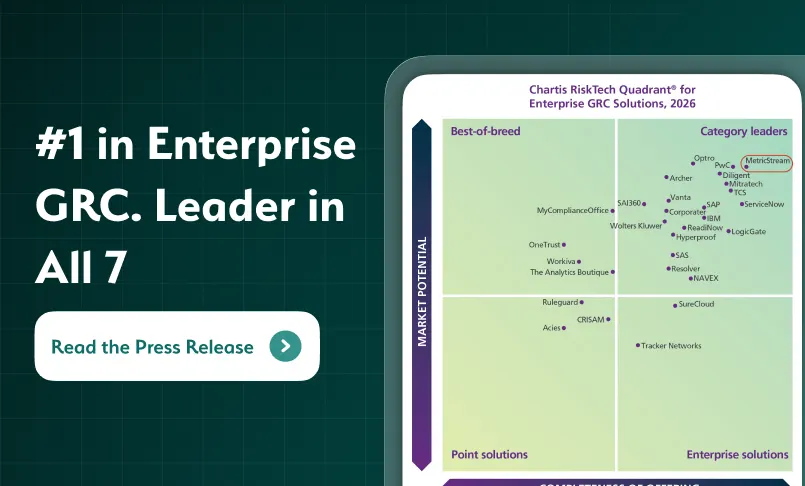
MetricStream's market leader position has been vetted by leading analysts like Forrester, Gartner, Chartis, and IDC MarketScape. The most recent recognition is as a Leader in the IDC MarketScape Worldwide Governance, Risk, and Compliance Software 2026 Vendor Assessment report. The IDC MarketScape report emphasizes MetricStream’s core strengths, stating: “MetricStream has a strong strategic direction and roadmap that will consistently deliver value to customers. The company's AI capability will see an accelerated increase in customer productivity and outcomes, further enhancing the ROI of the platform.”
A Forrester Total Economic Impact study found that MetricStream customers achieved 133% ROI and $8.4 million in total benefits. This figure reflects not just cost savings, but the strategic value of having a connected, real-time view of enterprise risk.
Key Features
MetricStream stands out for embedding AI directly into GRC workflows rather than bolting it on as a separate layer. Here's a look at what makes it a strong contender.
AI-First Platform Built into Every GRC Workflow: MetricStream builds AI into the core of how risk and compliance teams work every day. Across risk management, compliance, audit, policy, and third-party risk, AI capabilities are embedded directly in the workflows where users spend their time, reducing manual effort and accelerating decision-making at scale.
Listed below are a few of MetricStream’s AI capabilities.
- MetricStream Assistant is an AI-powered in-app assistant that helps users navigate the platform, understand field requirements, and complete GRC forms faster. Users can type where they want to go and be taken there instantly, ask questions about any field or workflow in plain language and get cited answers, or describe a risk, issue, or audit finding and have the Assistant suggest field values for review. For large enterprises where GRC adoption and speed of data capture matter, this directly reduces training burden and support dependency.
- MetricStream Policy Assistant is a specialized AI agent embedded within Policy Management. Employees can ask questions in plain language about leave entitlements, data retention obligations, gift policies, or incident reporting procedures and get answers grounded in approved policies, complete with source citations. Policy teams spend less time fielding queries, and employees receive consistent, accurate guidance without having to manually go through lengthy documents.
- AI Survey and Questionnaire Autofill Teams across Regulatory Compliance, IT & Cyber Compliance, Third-Party Risk Management, and Internal Audit can proactively re-answer the same questions using information that already lives in evidence files and prior submissions. AI Survey Autofill lets users upload supporting documents (PDFs, DOCX, XLSX, or PPTX) and generate draft survey responses automatically. Users review AI-generated answers alongside confidence scores and citations before accepting them, individually or in bulk. The result is faster assessment completion, more consistent responses, and a clear audit trail distinguishing AI-generated from manually entered answers.
- AI-Powered Control Description Refinement automatically rewrites control descriptions using proven industry frameworks — 5Ws, STAR, SCQA, and PEEL — in the user's preferred tone (professional, formal, or detailed). Compliance teams get audit-ready control narratives across their entire control library without the manual rewriting effort.
- AI-Generated Regulatory Alert Summarization and Applicability Assessment generates concise summaries of every regulatory alert and its linked documents — whether ingested via RSS feed, email, or manually. It also classifies each alert as applicable, not applicable, or uncertain based on the organization's parameters, and explains every classification decision in plain language. Compliance teams dramatically reduce alert triage time and focus attention on the regulatory changes that actually matter to them.
- AI-Powered Content Refinement for Audit enables audit teams to use AI to improve narrative fields directly within audit workpaper forms, including Purpose/Rationale on the Audit Form and Work Done fields across control, checklist, and other workpaper types. This reduces the manual editing cycle, improves documentation consistency, and enables faster review-ready audit narratives.
- Connected GRC Architecture: MetricStream's Connected GRC platform unifies Risk Management (Enterprise Risk, Operational Risk, Third-Party Risk), Compliance Management, Policy Management, Audit Management, IT & Cyber Risk, Case Management, and ESG Risk in a single platform. That integration isn't cosmetic. The architecture is built so that data flows across functions. So, for example, GRC teams can monitor a regulatory change that automatically triggers a compliance impact assessment, which in turn highlights affected controls and risks.
- Regulatory Change Management: AI-powered horizon scanning, regulatory alerts, and automated impact analysis ensure that large compliance teams don't miss changes in the regulatory landscape. NLP-driven policy search helps frontline employees quickly find the right guidance, reducing the gap between policy and practice.
- Risk Quantification: MetricStream translates IT and enterprise risk exposures into monetary terms, giving boards and executives the financial context they need to prioritize risk investments, a capability particularly valued by Chief Risk Officers and CFOs.
- Low-Code / No-Code Customization: Enterprise GRC programs are never one-size-fits-all. MetricStream's low-code/no-code allows organizations to configure workflows, forms, and dashboards to fit their specific operational model, without requiring expensive development resources.
Who Should Choose MetricStream
MetricStream is the right platform for large enterprises and organizations in highly regulated industries. This includes banking and financial services, insurance, healthcare, life sciences, energy, and utilities, all of which need a proven, integrated GRC platform capable of scaling across complex, multi-jurisdictional risk environments.
If your organization manages a complex GRC program across multiple business units, geographies, or regulatory frameworks, you will need a platform that connects risk, compliance, audit, and cyber functions into a single source of truth. In this case, MetricStream is built for you.
MetricStream is also the right choice for organizations that need enterprise-grade security, deep analyst-validated capabilities, and a vendor with the long-term stability to be a true strategic partner.
2. ServiceNow GRC - Best for Organizations Already on the ServiceNow Platform
ServiceNow is a broad enterprise workflow platform that has extended its capabilities into GRC. Its governance and risk modules are built on the same Now Platform architecture that powers IT service management, HR, and customer workflows across large organizations.
Key Features
ServiceNow GRC offers policy and compliance management, risk assessment workflows, audit management, and vendor risk capabilities. It is important to note that all are tightly integrated with the broader ServiceNow ecosystem. For organizations already running ServiceNow for ITSM or other functions, GRC modules can extend existing workflows without adding a separate vendor relationship.
The platform's strength is its integration depth within the ServiceNow ecosystem. Its noted limitation is that GRC is one product line among many, rather than a dedicated specialization.
Who Should Consider ServiceNow GRC
ServiceNow GRC is a practical fit for organizations already deeply invested in the ServiceNow platform that want to extend risk and compliance workflows into an existing technology environment. It's less suited to organizations seeking a dedicated, deep-capability GRC platform or those outside the ServiceNow ecosystem.
3. AuditBoard – Best for Audit-Led GRC Programs
AuditBoard serves as a companion for auditors and compliance officers, offering intuitive functionalities that address the complexities of managing audits and regulatory requirements. AuditBoard is designed around the workflows of audit and compliance teams. making it a choice for organizations where internal audit drives the GRC program.
Key Features
AuditBoard prioritizes usability with a clean and intuitive interface, allowing users to easily navigate complex processes. The tool facilitates collaboration among different lines of defense (first, second, and third lines) by enabling centralized communication, document sharing, and task management. This collaborative approach strengthens internal controls and ensures alignment across risk management functions. It offers automated workflows for audit planning, execution, and reporting, reducing manual efforts and enhancing productivity.
Who Should Consider AuditBoard
AuditBoard can be considered a choice for organizations where internal audit is the primary driver of the GRC program, particularly those that need structured, auditor-friendly workflows. It is less suited to organizations seeking a platform with equal depth across enterprise risk management or vendor risk.
4. LogicGate
By providing a flexible, user-centric design, LogicGate can help organizations in their risk management activities by enabling tailored workflows that reflect unique risk profiles and appetites. Rather than offering a fixed GRC framework, it allows organizations to design and modify workflows that reflect their specific risk profiles, regulatory requirements, and internal processes
Key Features
The platform automates compliance processes, streamlining compliance management and reducing manual effort. One of LogicGate's standout features is its intuitive drag-and-drop interface, which allows non-technical users to create and modify workflows effortlessly. It provides advanced analytics and reporting capabilities, allowing organizations to gain actionable insights into their risk landscape and compliance status. LogicGate includes robust IT security risk management capabilities, enabling organizations to identify and eliminate IT vulnerabilities.
Who Should Consider LogicGate
LogicGate may be suited for the needs of organizations with non-standard or evolving risk and compliance processes that require a platform they can shape to fit, rather than adapting their operations to a rigid tool. It is less suited to organizations seeking deep, pre-built GRC frameworks or extensive native integrations with enterprise systems.
5. RSA Archer — For Highly Customized Legacy Enterprise Programs
RSA Archer is an enterprise GRC platforms, with a long history in risk management, compliance, and audit. It has been through several ownership transitions and maintains an installed base among organizations that have built deeply customized GRC programs on its framework over many years.
Key Features
Archer offers extensive configurability and a large library of pre-built use case packages covering operational risk, business continuity, policy management, and regulatory compliance. Its depth of customization has historically been both its strength and its complexity challenge.
Who Should Consider RSA Archer
RSA Archer is most relevant for existing Archer customers assessing upgrade or migration paths. For organizations evaluating GRC platforms fresh, the platform's modernization trajectory, AI capabilities, and total cost of ownership relative to newer platforms are important factors to weigh carefully. Organizations prioritizing AI-first capabilities and modern user experience are likely to find more compelling options in today's market.
What Are GRC Tools?
A GRC (Governance, Risk, and Compliance) tool is a software application that businesses use to manage, assess risks, analyze policies, adhere to regulatory changes, and streamline operations. A GRC tool can help automate various aspects of a GRC framework.
GRC tools play a pivotal role in enabling businesses to assess, monitor, and mitigate risks, establish robust internal controls, ensure adherence to regulatory requirements, and uphold organizational policies. By consolidating disparate functions into integrated platforms, GRC tools provide a holistic view of risk exposure, facilitate data-driven decision-making, and enhance overall governance effectiveness.
The Growing Need for GRC Tools
Regulatory complexity has grown significantly over the past two decades. The 2008 financial crisis exposed the consequences of inadequate oversight and accelerated a wave of regulation across financial services, healthcare, technology, and other sectors. Today, organizations face overlapping obligations across frameworks, including GDPR, DORA, SOX, HIPAA, NIST, ISO 27001, and many others simultaneously.
At the same time, cyber threats have grown in sophistication and frequency, third-party ecosystems have expanded, and boards have elevated risk oversight to a boardroom priority. Manual, spreadsheet-based compliance tracking can't keep pace with this environment. GRC tools give organizations the structure, automation, and visibility they need to manage risk proactively, not reactively.
How GRC Tools Have Evolved
GRC technology has come a long way from spreadsheets and point solutions. What began as a way to check compliance boxes has evolved into a strategic capability powered by AI. Advanced GRC platforms connect risk data across the enterprise, automate what used to take weeks, and increasingly use AI to anticipate problems before they surface. Understanding where the market has been helps organizations make smarter decisions about where they need to go.
Point compliance tools
Designed to address a single requirement or regulation (such as SOX, GDPR, or ISO). While useful for narrow use cases, they often create silos and increase manual effort as regulatory complexity grows.
Integrated GRC platforms
Provide a unified view of risk, compliance, audit, and controls across the organization. These platforms reduce duplication, improve consistency, and support cross-functional collaboration at scale.
AI-powered and continuous GRC platforms
Go beyond periodic assessments by using automation, analytics, and AI to continuously monitor risks, controls, and compliance posture. This enables faster detection of issues, predictive insights, and more resilient, real-time GRC programs.
How to Choose the Best GRC Tools
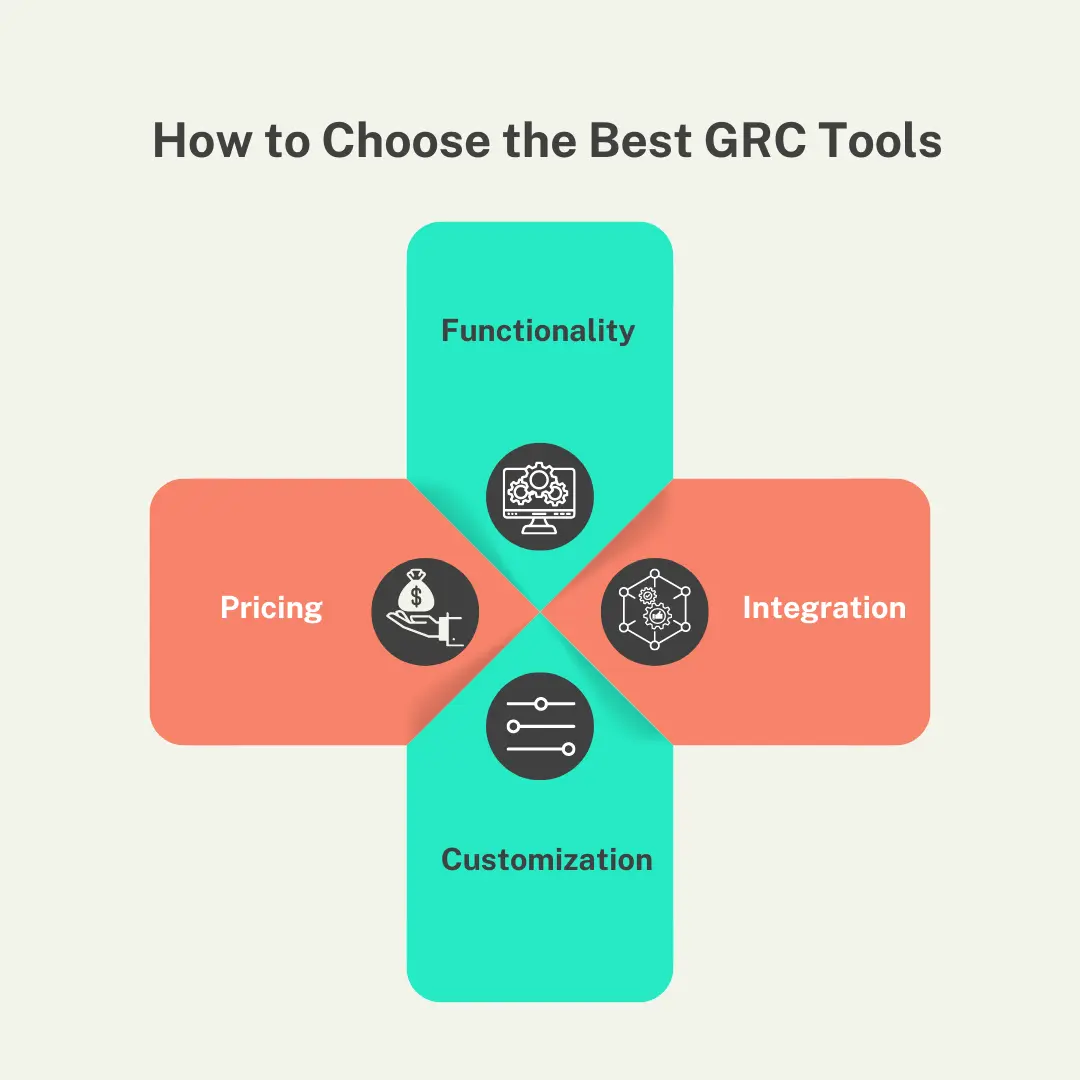
For enterprises considering buying a GRC tool to enhance their GRC processes, there are a few key aspects to consider. Here’s a practical framework.
Functionality:
First, think about what core functions you need. Do you want an all-in-one solution to handle everything from risk assessments to policy management? Or are you looking for something more specialized, like a dedicated risk management tool? The range can be overwhelming, so determine must-have features before you go ahead.
Integration:
Consider how well the platform integrates with your existing systems. If you already use tools for project management or document control, you'll want a GRC solution that integrates without issues. Seamless integration means easy transfer of data between systems and a consistent user experience.
Configurability:
Look for platforms that can be tailored to your requirements. Things like customizable dashboards, flexible workflow automation, and the ability to define custom fields are important. Choose a tool you can mold to fit your processes, not the other way around.
User-Friendly:
Choose tools and software solutions that are intuitive and easy to use. This is essential to ensure smooth user adoption and encourage frontline engagement in GRC. User-friendly tools with logical sequencing of tasks make it easier for frontline executives to report any observation, issue, or anomaly, which can then be analyzed by the second line.
Organizational size and complexity:
Enterprise organizations with global operations, multiple business units, and complex regulatory obligations need platforms built for that scope. Mid-market companies and startups have different requirements and the right vendor for one is rarely the right vendor for the other.
AI and automation depth:
Surface-level automation isn't the same as genuine AI capability. Look for platforms with proven, production-ready AI features and not just roadmap promises.
Analyst validation:
Recognition from Gartner, Forrester, or IDC signals vendor stability, product depth, and willingness to subject capabilities to rigorous third-party scrutiny.
Pricing:
Finally, compare costs. GRC software is available at a range of price points, from free, open-source options to enterprise-level subscriptions. Consider how many users you need and whether you want cloud-based or on-prem deployment.
Benefits of GRC Tools
A well-implemented GRC platform delivers measurable value across the organization:
Risk visibility:
A unified view of risk across business units, geographies, and functions — replacing fragmented spreadsheets and disconnected point solutions.
Compliance efficiency:
Automated evidence collection, control testing, and regulatory change tracking reduce manual effort and the risk of gaps.
Audit readiness:
Continuous monitoring means organizations are always ready for internal and external audits — not scrambling to prepare.
Strategic decision-making:
When risk data is connected and current, leadership can make informed decisions about risk appetite, investment priorities, and operational resilience.
Quantifiable ROI:
The Forrester TEI study for MetricStream found $8.4 million in total benefits — from reduced audit effort, improved compliance efficiency, and avoided regulatory penalties.
Benefits of Implementing a GRC Tool
A robust GRC platform provides executives with a unified view of risks, controls, and compliance data, enabling informed decision-making. It automates compliance monitoring and risk detection to address policy breaches proactively. Enhanced accountability and transparency are achieved through streamlined workflows, optimizing resource allocation, and reducing operational redundancies.
Several significant benefits come with implementing a GRC tool, including:
Refined Decision-Making Capabilities:
A GRC platform gives executives and stakeholders a bird's eye view of risks, controls, and compliance issues. With all of this information in one place, leaders can make fully informed decisions based on data rather than assumptions.
Enhanced Compliance and Reduced Risk:
An effective GRC tool automates compliance monitoring and reporting. It provides alerts to potential policy violations and risks, allowing you to address issues before they become violations.
Augmented Accountability and Transparency:
These tools enhance accountability by giving each employee visibility into relevant risks, controls, and compliance issues. Everyone will understand their responsibilities, have guidance on how to fulfill them, and demonstrate compliance via automated reporting.
Optimized Processes and Resource Efficiency:
Integrating them into workflows streamlines processes by providing a centralized platform for managing risk and compliance activities. This centralization eliminates the need for disparate systems and manual processes, reducing duplication of efforts and saving valuable time and resources
Common Challenges in GRC Tool Implementation
Navigating the implementation of GRC tools involves overcoming potential roadblocks; here are some challenges organizations may face:
- Resistance to Change: One common obstacle in implementing GRC tools is resistance to change from employees accustomed to existing processes. Overcoming this resistance requires effective change management strategies, clear communication, and training programs to ensure organizational buy-in and adoption.
- Integration Challenges: Integration challenges with existing systems and processes are another obstacle. GRC tools may need to interface with various platforms and databases, requiring careful planning and execution to ensure seamless integration without disrupting ongoing operations.
- Resource Constraints: Limited resources, including budgetary constraints and inadequate staffing, can hinder the successful implementation of GRC tools. Organizations must allocate sufficient resources and prioritize GRC initiatives to overcome these constraints and achieve successful implementation.
- Complexity of Regulations: Regulatory requirements pose a significant challenge for organizations implementing GRC tools. Ensuring that GRC tools adequately address regulatory compliance requirements and adapt to evolving regulations requires careful planning, expertise, and ongoing monitoring and updates.
Real-World Successes with GRC Tools
Here are some real-life examples of GRC software successfully implemented in organizations' operational workflows.
Zurich Insurance
Zurich Insurance, a leading, multi-line global insurer with about 56,000 employees, provides a wide range of property, casualty, and life insurance products and services in more than 210 countries and territories. The company leveraged MetricStream's AI-first Connected GRC products to modernize and streamline its compliance, policies, and enterprise risk management processes and manage a broad range of compliance requirements in an integrated manner.
The company has realized significant benefits, including:
- Better insights on compliance with a single source of truth
- Improved compliance efficiency with automated, standardized workflows
- Greater policy awareness in the frontline
- More confident decision-making with real-time visibility into compliance risks
- Faster responsiveness to regulatory changes and updates
Conclusion
The world of GRC is not static, and the solutions we choose to navigate it shouldn't be either. The continuous evolution of threats and regulatory requirements calls for solutions that not only respond to the present but anticipate the future and thrive on risk.
In this context, the highlighted tools, with their distinct capabilities, present compelling choices for organizations of all sizes and sectors. And amidst the contenders, MetricStream emerges as a partner for the forward-thinking enterprise—thoughtful in its approach, comprehensive in its coverage, and compassionate in its client engagement.
MetricStream offers a range of GRC solutions for organizations seeking to navigate complex risk landscapes with confidence and agility.
Frequently Asked Questions
A GRC (Governance, Risk & Compliance) tool is software that centralises policy, control, risk, audit, and compliance activities into a unified platform. It works by mapping regulations and internal standards to controls, automating workflows such as control testing, issue tracking, and evidence collection, and providing dashboards that help leadership monitor status and make informed decisions.
GRC tools eliminate silos across risk and compliance data, reduce manual effort and human error, streamline audit preparation, and improve visibility into governance and control effectiveness. They help organizations stay ahead of evolving regulations while reducing regulatory, operational, and reputational risks.
A modern GRC solution should include centralised risk and control libraries, automated workflows and task management, real-time dashboards with analytics, regulatory change tracking, audit lifecycle support, and integrations with other enterprise systems. Flexibility and scalability across multiple frameworks and business units are also critical.
Implementation timelines vary depending on organizational size and complexity. Simple deployments may take a few weeks, while enterprise-scale rollouts can span several months. Factors influencing timelines include integration requirements, number of frameworks, business unit readiness, and change management efforts.
A good GRC tool is intuitive, flexible, and capable of mapping multiple frameworks and controls. It delivers transparency, automates key tasks, assigns clear ownership, and provides interactive reporting. Most importantly, it supports scalability across risks, audits, and compliance requirements while enabling continuous improvement.
There is no one-size-fits-all GRC tool. The best solution depends on an organisation’s size, industry, regulatory environment, and maturity level. Large enterprises with complex risk landscapes often choose platforms like MetricStream, IBM OpenPages, or ServiceNow, while smaller organisations may opt for lightweight solutions with faster onboarding and lower total cost.
Audit-focused GRC tools support collaboration through workflow coordination, task assignments, notifications, remediation tracking, and integrated audit management modules. Features such as evidence repositories, discussion threads, root-cause analysis, and role-based dashboards enable efficient teamwork, accountability, and effective audit execution.
GRC tools are generally priced using a subscription-based model, with costs influenced by the number of users, modules, risk domains, and integrations required. Enterprise GRC platforms often use modular pricing, while mid-market tools may offer bundled plans. Pricing usually reflects scale, complexity, and regulatory coverage rather than simple seat count.
Organizations with complex risk profiles, multiple regulatory obligations, or distributed operations benefit most from GRC tools. This includes large enterprises, banking and financial services firms, healthcare and energy organizations, and growing technology companies preparing for regulatory audits. GRC tools are especially valuable where manual risk and compliance processes are not able to scale effectively.
Most GRC tools support a wide range of global regulatory and standards frameworks, including SOX, ISO 27001, SOC 1 and SOC 2, GDPR, PCI DSS, HIPAA, and industry-specific regulations. Enterprise platforms often allow organizations to map multiple frameworks to a common control set, reducing duplication and audit effort.
Modern GRC tools integrate with enterprise systems such as SIEM, ERP, HRIS, IAM, and ITSM platforms through APIs and pre-built connectors. These integrations enable automated data ingestion, continuous control monitoring, and real-time risk visibility, reducing manual updates and improving accuracy across risk and compliance workflows.
Yes, advanced GRC platforms support continuous monitoring by automatically collecting data from integrated systems and evaluating control performance in near real time. AI and analytics capabilities help identify emerging risks, control failures, and compliance gaps faster than traditional periodic assessments, enabling more proactive risk management.
GRC tools are available in both cloud-based (SaaS) and on-premise deployment models. Cloud-based GRC platforms are more common today due to faster deployment, scalability, and lower infrastructure overhead, while on-premise options are typically chosen by organizations with strict data residency or security requirements.
Many GRC vendors offer role-based training, product certifications, and enablement programs for administrators and end users. In addition, professionals often pursue industry certifications such as CRISC, CISA, CGEIT, or ISO Lead Implementer credentials to strengthen their GRC expertise and align tool usage with best practices.
The best GRC tool for large enterprises is one that supports enterprise-wide risk visibility, complex regulatory environments, and scalable workflows. Large organizations typically require integrated GRC platforms with strong automation, analytics, and AI capabilities to manage risk, compliance, audit, and cyber risk across regions and business units.
No, GRC tools are not limited to regulated industries. While heavily regulated sectors were early adopters, organizations in technology, manufacturing, retail, and services increasingly use GRC tools to manage operational risk, third-party risk, cybersecurity, and internal controls as business complexity and stakeholder expectations grow.
Yes, modern GRC platforms can support DORA and NIS2 compliance by mapping regulatory requirements to controls, automating risk assessments, and enabling ongoing monitoring of ICT, cyber, and third-party risks. Integrated reporting and audit-ready documentation also help organizations demonstrate compliance to regulators more efficiently.
Compliance software focuses primarily on meeting specific regulatory or standards requirements, often in isolation. GRC software takes a broader approach by integrating governance, risk management, compliance, and audit into a single framework, enabling organizations to understand how risks and controls impact business objectives holistically.
Point compliance tools address a single regulation or requirement. A GRC platform integrates risk, compliance, audit, and controls across the organization, providing a holistic view and enabling cross-functional collaboration. For most mid-to-large organizations, point tools create silos and increase total compliance costs over time.
Start with your organization's specific requirements: regulatory environment, scale, existing technology, and risk maturity. Then assess vendors on product depth, AI capabilities, analyst recognition, implementation track record, and total cost of ownership.
ROI depends on your current state and the scope of deployment. A Forrester Total Economic Impact study on MetricStream found 133% ROI and $8.4 million in total benefits, driven by audit efficiency, compliance cost reduction, and risk avoidance.