

Introduction
As we close 2025, it’s time for our annual tradition of looking back on the year – and most important, predicting what will be most important in GRC for the year ahead. For many Governance, Risk and Compliance (GRC) leaders, 2025 was a year that felt unusually intense. Regulatory expectations intensified, cyber risks escalated, and AI adoption accelerated, often simultaneously.
In Europe, landmark regulations are now in effect. The EU AI Act moved toward phased enforcement, the EU’s Digital Operational Resilience Act (DORA) entered into effect for financial institutions, and NIS2 deadlines drove tighter cyber and critical infrastructure requirements across Europe. In parallel, regulators in the U.S. and UK clarified expectations on AI governance, third-party risk, and operational resilience through updated supervisory statements and guidance.
The risk environment continued to evolve as well. A recent study found that ransomware attacks against critical sectors, including manufacturing, healthcare, energy, transportation, and financial services, increased by 34% year-over-year in 2025. These attacks highlighted systemic vulnerabilities at a time when enterprises were expanding the use of AI and GenAI across core business functions.
Together, these shifts indicate a more complex operating environment, one characterized by rapid technological change, persistent cyber threats, geopolitical uncertainty, and heightened regulatory scrutiny. In this context, GRC as a function becomes increasingly central to how organizations build resilience, manage uncertainty, and support sustainable growth.
Our annual GRC trends forecast for 2026 looks ahead to what this means for leaders. Informed by deep industry analysis and customer successes, it highlights the changes reshaping GRC programs, including AI-first platforms, stronger data foundations, and closer alignment with boards and executive teams. As volatility becomes a constant, connected GRC will be a defining capability for organizations that want to stay ahead.
Read on to see what’s ahead for GRC leaders in the year to come.
Agentic GRC, with Human Governance, will Take Hold
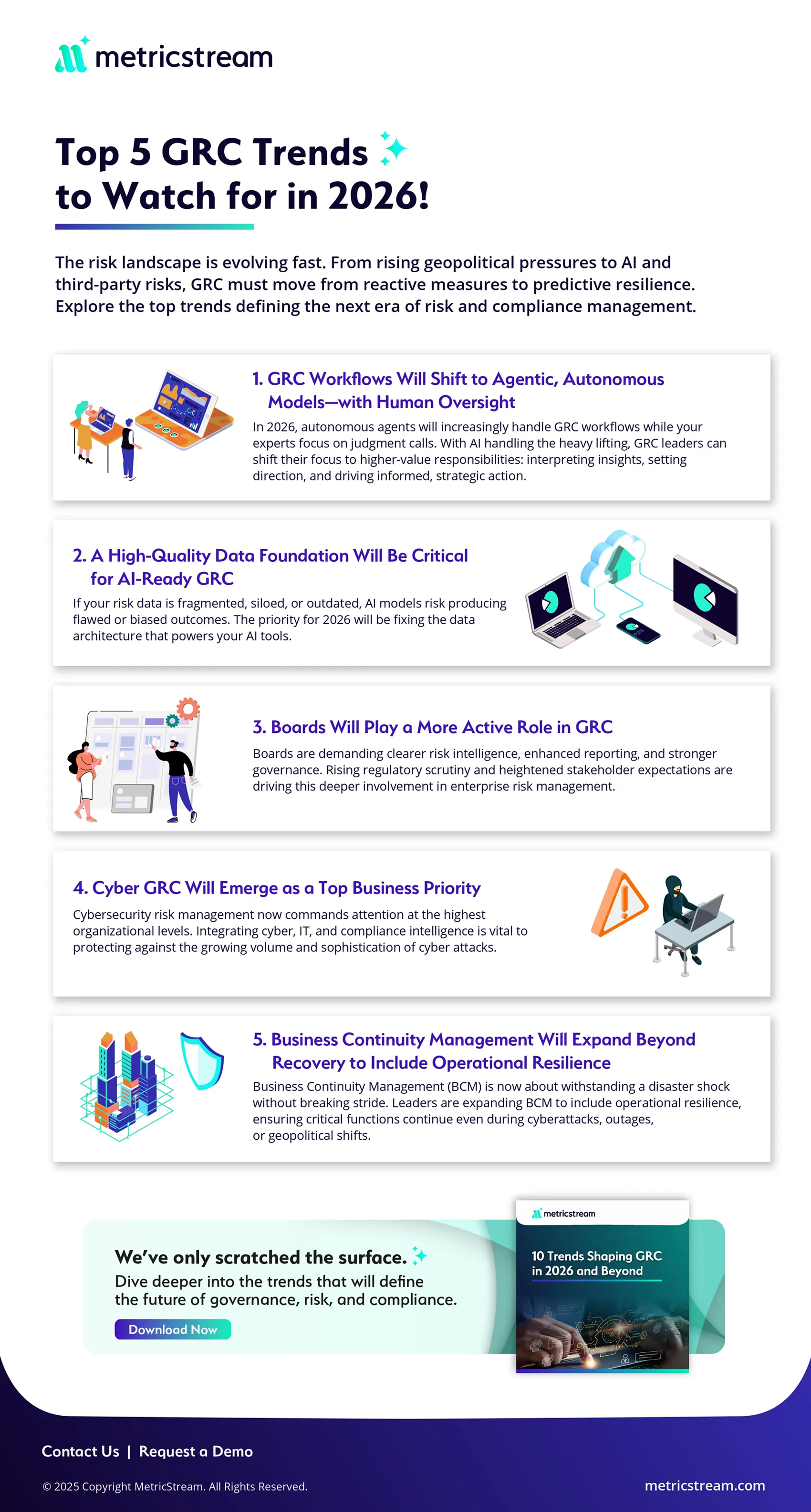
Autonomous, agentic AI systems capable of reasoning, planning, and executing tasks are revolutionizing GRC workflows. In 2026, GRC teams will be able to use intelligent agents for continuous risk monitoring, predictive alerting, and automated decision support. With AI handling the heavy lifting, GRC leaders can shift their focus to higher-value responsibilities, such as interpreting insights, setting direction, and driving informed, strategic action.
However, human governance will continue to serve as the guardrails. Executives will oversee agentic outputs via explainable AI dashboards, ensuring alignment with organizational values and regulations, such as the EU AI Act. While AI will drive value, it won’t do so in isolation. Humans + AI will remain the power equation.
Data Quality Will Become the New GRC Differentiator
A high-quality data foundation will be critical for AI-ready GRC. If your risk data is fragmented, siloed, or outdated, AI models will produce flawed or biased outcomes.
Fixing the data architecture that powers AI tools is a key priority for GRC teams in 2026. Fragmented silos across ERM, compliance, and audit functions breed inaccuracies, eroding trust in AI insights. Leading organizations will invest in data fabric architecture that ingests, cleanses, and governs information from diverse sources, enabling seamless integration and management of data across the organization.
The key here is transparency, as traceable data lineages will enable audits of AI decisions and compliance with emerging standards. Forward-thinking teams will prioritize metadata management and AI governance councils to enforce standards.
The payoff? Reliable predictive analytics and AI for risk quantification, bias-free compliance scoring, and stakeholder confidence.
Business Continuity Will Expand to Include Operational Resilience
For years, organizations have relied on business continuity management (BCM) plans to withstand and recover from disruptions. But simply reacting to a disruption after it occurs is no longer enough in a world of relentless shocks and prolonged uncertainty. Organizations need to be operationally resilient, able to proactively anticipate, detect, and adapt to disruptions in real time.
Regulators are driving this shift, as seen in the example of DORA in Europe and FDIC guidelines in the US, which require annual stress tests and "no-fail" tolerances for vital services. The focus on operational resilience embeds adaptability into corporate DNA, ensuring critical functions continue even during cyberattacks, outages, or geopolitical shifts.
Cyber GRC Rises to the Top of the Enterprise Agenda
Cyber threats have now evolved faster than ever, especially with AI-fueled ransomware and deepfake phishing. The financial repercussions of oversight are too high, with cybercrime predicted to cost the world $12.2 trillion annually by 2031, according to Cybersecurity Magazine.
In 2026, cyber GRC will move firmly onto the C-suite agenda, bringing together cyber, IT, and compliance functions through a unified, connected view of risk. As the cost and impact of breaches continue to rise, organizations shifting from fragmented oversight to proactive cyber GRC programs will gain the benefits of resilience and enable secure innovation as digital transformation accelerates.
Boards Deepen Their Engagement in GRC
In 2026 and beyond, boards will be expected to do more than define risk appetite. They will play a more active role in ensuring risk considerations are embedded into strategic decision-making across the organization. While boards will not manage risk on a day-to-day basis, they will seek greater visibility into emerging risks and take stronger oversight of risk response plans and recovery strategies.
For GRC leaders, this means rethinking how risk and compliance efforts are communicated to the board. Real-time insights will be crucial to helping boards understand not just what the most significant risks are, but how they impact business performance. Increasingly, these insights will be communicated through risk quantification models, visualization tools, and automated reporting.
Join the Conversation: Hear Live from GRC 20/20 analyst Michael Rasmussen
We will be discussing these and more GRC trends shaping 2026 with GRC 20/20 analyst Michael Rasmussen. Join us on January 21, 2026, for a live webinar featuring in-depth trend analysis and practical implementation roadmaps you can apply immediately. Register now to strengthen and future-proof your GRC program.
Want the complete picture? Download the eBook for a deeper dive into the full set of GRC trends for 2026.
Stay Ahead in 2026 with MetricStream’s Connected GRC
MetricStream’s AI-first Connected GRC products are built to simplify your GRC work, amplify your outcomes, enable orchestration across domains, and give you the clarity, speed, and resilience that modern risk and compliance management demands. We are integrating purpose-built AI capabilities and agents across the GRC lifecycle, enabling you to:
- Harness AI-first GRC software to automate the heavy-lifting in your GRC programs – be it form-filling, evidence collection, or risk assessments
- Lay the foundation for AI-ready GRC by unifying, mapping, and rationalizing GRC data at scale
- Leverage AI to predict risks before they materialize, while also automating control testing and monitoring
- Strengthen third-party risk management with AI-powered third-party onboarding, risk assessments, and continuous monitoring
- Boost operational resilience by automatically forecasting disruptions and simulating the impact of different risk events on business continuity
- Keep cyber risks in check with consolidated threat intelligence, AI-driven anomaly detection, and automated threat responses
- Gain better visibility and control over the GRC universe by replacing multiple, disparate GRC systems with a single, integrated platform and AI-powered self-service reporting
- Empower boards with real-time reports, visualization tools, and risk quantification mechanisms that deliver actionable risk insights
Together, these innovations make GRC simpler, faster, and smarter. Want to learn more? Request a demo now.