
Introduction
The intricacies of the global economy, along with the rise of digital transformation, have significantly increased the scope and scale of risks faced by organizations. Implementing robust frameworks to manage these risks effectively is the need of the hour.
This heightened risk environment is reflected in recent findings. According to the World Economic Forum’s Global Risks Report 2025, cyber insecurity, misinformation, and extreme weather events rank among the top global risks by both likelihood and impact, highlighting how interconnected and unpredictable today’s risk landscape has become. At the same time, regulatory complexity continues to grow across jurisdictions, placing additional pressure on organizations to maintain consistent oversight and control.
Enterprise risk management (ERM) and governance, risk, and compliance (GRC) frameworks are integral to the operational and strategic fiber of modern organizations.
Key Takeaways
- Enterprise Risk Management (ERM) is the management of all the risks faced by an organization, encompassing strategic, financial, operational, and compliance risks. It takes a holistic approach, integrating risk management into strategic planning and decision-making.
- Governance, risk, and compliance (GRC) is the integrated approach to managing organizational risks, ensuring adherence to laws and regulations, and aligning operations with strategic goals.
- ERM focuses on managing organizational risks in a manner that is aligned with strategic business goals and objectives while GRC is a broader concept that not only includes risk management but also compliance, assurance, sustainability, and other programs.
What is ERM?
Enterprise Risk Management (ERM) is a comprehensive and structured approach that enables an organization to identify, assess, manage, and monitor risks that could potentially hinder its objectives and capitalization on opportunities. It encompasses various risk categories, including strategic, financial, operational, and compliance risks, and ensures that these are managed in a cohesive and consistent manner.
ERM transcends traditional risk management by embedding risk management and awareness into the company’s strategic planning and decision-making processes. It aligns risk appetite and strategy, enhances risk response decisions, and minimizes operational surprises and losses.
Unlike earlier risk management practices that often operated in silos, ERM advocates for a holistic view of risk across the entire organization. This integrated approach helps in understanding how different risks relate to each other and their cumulative impact on organizational objectives.
What is GRC?
Governance, risk, and compliance (GRC) is an integrated and comprehensive approach to managing organizational risks, compliance, and governance activities. It encapsulates the trio of governance, managing risk (similar to ERM), and compliance with applicable laws and regulations.
- Governance in the GRC context refers to the set of policies, processes, and behaviors that ensure an organization is effectively and efficiently directed, controlled, and accountable. It involves setting the strategic direction and establishing objectives to achieve those objectives.
- Risk management within GRC focuses on identifying, evaluating, and mitigating risks that could impede organizational goals. In this sense, ERM is a component of GRC.
- Compliance is about adhering to the laws, regulations, guidelines, and specifications relevant to an organization's business processes. It helps identify and manage regulatory change, reduce the risk of non-compliance, and avoid penalties and fines.
Key Differences Between ERM and GRC
Let’s delve into the key differences between these two critical aspects of organizational strategy:
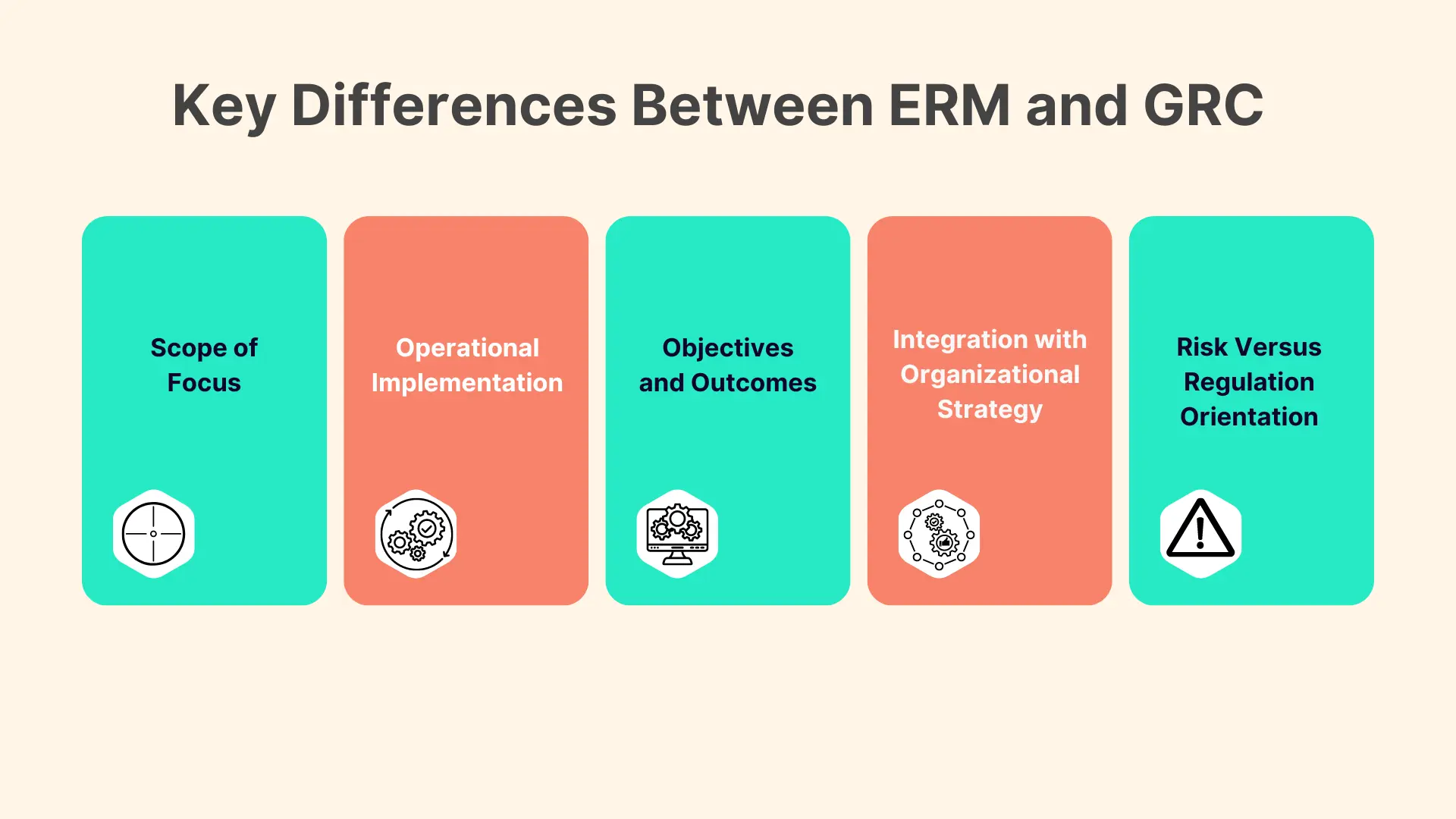
Scope of Focus
The first notable distinction lies in the scope of focus that ERM and GRC each possess. ERM focuses on all-encompassing risks that affect an organization’s ability to achieve its objectives. It includes strategic, financial, operational, and compliance risks. On the other hand, GRC places a strong emphasis not only on managing risks but also on ensuring compliance with laws, regulations, and standards, alongside governance processes that ensure the organization is managed ethically and efficiently.
Operational Implementation
ERM approaches risk with a holistic lens, aiming to embed risk awareness and management across all levels of the organization to drive risk-aware decision-making. It seeks to ensure that every department and employee is involved in identifying and managing risks relevant to their areas of responsibility. Whereas, GRC is often driven by specific requirements for compliance and governance, which means its operations are closely tied to meeting external and internal standards and policies.
Objectives and Outcomes
The main objective of ERM is to equip the organization with the foresight to anticipate potential risks and integrate risk-related decision-making into its strategic planning processes. ERM seeks to optimize risk management, aiming to enhance value for stakeholders by balancing risks and opportunities. On the other hand, GRC focuses on creating a synchronized framework to meet governance, risk, and compliance objectives. The aim here is to not only manage risk but also to ensure that organizational processes are aligned with established standards and regulations, thus reducing legal penalties and improving operational effectiveness.
Integration with Organizational Strategy
ERM is deeply integrated into an organization's strategic planning process. It requires the identification of external and internal risks to strategic objectives and incorporates risk management directly into strategic decision-making processes. GRC, while supportive of strategic goals, is more closely aligned with operational processes and the management of day-to-day risk, compliance, and governance activities.
GRC strategies are developed to support the organization's overall strategy but focus more on the operationalization of practices that ensure the organization meets its regulatory obligations and governance standards.Risk Versus Regulation Orientation
ERM is fundamentally risk-oriented. It seeks to provide a comprehensive view of all risks facing the organization, prioritize them based on their potential impact, and implement strategies to manage or mitigate these risks. GRC, while also concerned with risk, has a significant orientation towards regulations and compliance. The framework focuses on identifying all applicable regulations, ensuring that policies and procedures are in place to meet these requirements, and regularly monitoring and reporting on compliance status.
ERM vs GRC
| Parameter | Enterprise Risk Management (ERM) | Governance, Risk, and Compliance (GRC) |
| Primary Focus | Focuses on identifying and managing risks that could impact strategic objectives and overall business performance. | Focuses on aligning governance, risk, and compliance activities to ensure the organization operates within defined policies and regulations. |
| Scope | Enterprise-wide and strategic, covering all types of risks including financial, operational, and emerging risks. | Cross-functional and integrated, connecting governance structures, compliance requirements, and risk management processes. |
| Objective | Helps organizations anticipate uncertainty and make informed strategic decisions while maintaining resilience. | Ensures consistent adherence to regulatory requirements, internal policies, and control frameworks across the organization. |
| Approach | Risk-centric, with emphasis on identifying, assessing, and prioritizing risks based on their potential impact. | Process-driven, integrating risk management with compliance workflows, policy enforcement, and control monitoring. |
| Decision-Making Role | Supports leadership in evaluating risk-reward trade-offs in strategic initiatives and long-term planning. | Supports operational and compliance decisions by providing structure, visibility, and accountability across functions. |
What Role Does Technology Play in the Implementation of ERM and GRC?
As risk environments become more dynamic and interconnected, managing ERM and GRC through manual processes or siloed tools is no longer sustainable. Technology is playing a central role in bringing structure and consistency to how organizations manage risk, governance, and compliance across the enterprise.
Key capabilities shaping this shift include:
Centralized risk management platforms
Modern platforms bring risk data, controls, policies, and assessments into a single environment. This eliminates fragmentation across spreadsheets and standalone tools, allowing teams to work from a shared source of truth. It also makes it easier to standardize risk methodologies and maintain consistency across business units.
Integrated governance dashboards
Leadership teams require a consolidated view of risk and compliance posture. Integrated dashboards provide real-time insights into key risk indicators, control effectiveness, and compliance status, enabling faster and more informed decision-making without relying on manual reporting cycles.
Automated compliance monitoring
Instead of periodic checks, organizations can continuously monitor compliance through automated workflows and rule-based alerts. This allows teams to detect deviations early, respond more quickly to regulatory changes, and reduce the effort required to maintain ongoing compliance.
Predictive risk analytics
Advanced analytics and modeling techniques are enabling organizations to move beyond reactive risk management. By analyzing historical data, trends, and external signals, predictive capabilities help identify emerging risks, assess potential impact, and support proactive planning.
Challenges in Aligning ERM and GRC
Some of the most common challenges include:
Fragmented governance structures
Governance responsibilities are often distributed across multiple functions such as risk, compliance, legal, and internal audit. Without a unified structure, decision-making can become fragmented, with overlapping roles or gaps in accountability that slow down execution.
Inconsistent risk reporting
Different teams may use varying methodologies, metrics, and formats to assess and report risk. This makes it difficult to consolidate information into a single, reliable view, limiting leadership’s ability to compare risks or prioritize actions effectively.
Regulatory complexity across jurisdictions
Organizations operating across regions must navigate diverse and frequently changing regulatory requirements. Aligning these obligations within a single framework requires careful interpretation and coordination, which can strain both resources and processes.
Limited cross-department collaboration
ERM and GRC rely on input from multiple business units, yet collaboration is often informal or inconsistent. Without structured communication channels and shared workflows, critical insights may not flow between teams in time to influence decisions.
Disconnect between strategy and execution
Risk insights generated at an enterprise level do not always translate into actionable steps at the operational level. This gap can lead to well-defined risk strategies that are not fully embedded into day-to-day processes.
Conclusion
Understanding and differentiating between ERM and GRC is fundamental for organizations aiming to achieve a sustainable, risk-aware, and compliant operational model.
With MetricStream, you can unlock the full potential of your ERM and GRC efforts and embark on a path to operational and strategic excellence. Check out MetricStream Enterprise Risk Management software and the MetricStream GRC solution to understand how they can help you navigate today’s fast-moving business environment efficiently.
Choosing MetricStream means opting for a partner who understands the intricacies of risk and compliance management deeply. Let's team up to build a future that is secure, compliant, and resilient.
The intricacies of the global economy, along with the rise of digital transformation, have significantly increased the scope and scale of risks faced by organizations. Implementing robust frameworks to manage these risks effectively is the need of the hour.
This heightened risk environment is reflected in recent findings. According to the World Economic Forum’s Global Risks Report 2025, cyber insecurity, misinformation, and extreme weather events rank among the top global risks by both likelihood and impact, highlighting how interconnected and unpredictable today’s risk landscape has become. At the same time, regulatory complexity continues to grow across jurisdictions, placing additional pressure on organizations to maintain consistent oversight and control.
Enterprise risk management (ERM) and governance, risk, and compliance (GRC) frameworks are integral to the operational and strategic fiber of modern organizations.
- Enterprise Risk Management (ERM) is the management of all the risks faced by an organization, encompassing strategic, financial, operational, and compliance risks. It takes a holistic approach, integrating risk management into strategic planning and decision-making.
- Governance, risk, and compliance (GRC) is the integrated approach to managing organizational risks, ensuring adherence to laws and regulations, and aligning operations with strategic goals.
- ERM focuses on managing organizational risks in a manner that is aligned with strategic business goals and objectives while GRC is a broader concept that not only includes risk management but also compliance, assurance, sustainability, and other programs.
Enterprise Risk Management (ERM) is a comprehensive and structured approach that enables an organization to identify, assess, manage, and monitor risks that could potentially hinder its objectives and capitalization on opportunities. It encompasses various risk categories, including strategic, financial, operational, and compliance risks, and ensures that these are managed in a cohesive and consistent manner.
ERM transcends traditional risk management by embedding risk management and awareness into the company’s strategic planning and decision-making processes. It aligns risk appetite and strategy, enhances risk response decisions, and minimizes operational surprises and losses.
Unlike earlier risk management practices that often operated in silos, ERM advocates for a holistic view of risk across the entire organization. This integrated approach helps in understanding how different risks relate to each other and their cumulative impact on organizational objectives.
Governance, risk, and compliance (GRC) is an integrated and comprehensive approach to managing organizational risks, compliance, and governance activities. It encapsulates the trio of governance, managing risk (similar to ERM), and compliance with applicable laws and regulations.
- Governance in the GRC context refers to the set of policies, processes, and behaviors that ensure an organization is effectively and efficiently directed, controlled, and accountable. It involves setting the strategic direction and establishing objectives to achieve those objectives.
- Risk management within GRC focuses on identifying, evaluating, and mitigating risks that could impede organizational goals. In this sense, ERM is a component of GRC.
- Compliance is about adhering to the laws, regulations, guidelines, and specifications relevant to an organization's business processes. It helps identify and manage regulatory change, reduce the risk of non-compliance, and avoid penalties and fines.
Let’s delve into the key differences between these two critical aspects of organizational strategy:

Scope of Focus
The first notable distinction lies in the scope of focus that ERM and GRC each possess. ERM focuses on all-encompassing risks that affect an organization’s ability to achieve its objectives. It includes strategic, financial, operational, and compliance risks. On the other hand, GRC places a strong emphasis not only on managing risks but also on ensuring compliance with laws, regulations, and standards, alongside governance processes that ensure the organization is managed ethically and efficiently.
Operational Implementation
ERM approaches risk with a holistic lens, aiming to embed risk awareness and management across all levels of the organization to drive risk-aware decision-making. It seeks to ensure that every department and employee is involved in identifying and managing risks relevant to their areas of responsibility. Whereas, GRC is often driven by specific requirements for compliance and governance, which means its operations are closely tied to meeting external and internal standards and policies.
Objectives and Outcomes
The main objective of ERM is to equip the organization with the foresight to anticipate potential risks and integrate risk-related decision-making into its strategic planning processes. ERM seeks to optimize risk management, aiming to enhance value for stakeholders by balancing risks and opportunities. On the other hand, GRC focuses on creating a synchronized framework to meet governance, risk, and compliance objectives. The aim here is to not only manage risk but also to ensure that organizational processes are aligned with established standards and regulations, thus reducing legal penalties and improving operational effectiveness.
Integration with Organizational Strategy
ERM is deeply integrated into an organization's strategic planning process. It requires the identification of external and internal risks to strategic objectives and incorporates risk management directly into strategic decision-making processes. GRC, while supportive of strategic goals, is more closely aligned with operational processes and the management of day-to-day risk, compliance, and governance activities.
GRC strategies are developed to support the organization's overall strategy but focus more on the operationalization of practices that ensure the organization meets its regulatory obligations and governance standards.Risk Versus Regulation Orientation
ERM is fundamentally risk-oriented. It seeks to provide a comprehensive view of all risks facing the organization, prioritize them based on their potential impact, and implement strategies to manage or mitigate these risks. GRC, while also concerned with risk, has a significant orientation towards regulations and compliance. The framework focuses on identifying all applicable regulations, ensuring that policies and procedures are in place to meet these requirements, and regularly monitoring and reporting on compliance status.
ERM vs GRC
| Parameter | Enterprise Risk Management (ERM) | Governance, Risk, and Compliance (GRC) |
| Primary Focus | Focuses on identifying and managing risks that could impact strategic objectives and overall business performance. | Focuses on aligning governance, risk, and compliance activities to ensure the organization operates within defined policies and regulations. |
| Scope | Enterprise-wide and strategic, covering all types of risks including financial, operational, and emerging risks. | Cross-functional and integrated, connecting governance structures, compliance requirements, and risk management processes. |
| Objective | Helps organizations anticipate uncertainty and make informed strategic decisions while maintaining resilience. | Ensures consistent adherence to regulatory requirements, internal policies, and control frameworks across the organization. |
| Approach | Risk-centric, with emphasis on identifying, assessing, and prioritizing risks based on their potential impact. | Process-driven, integrating risk management with compliance workflows, policy enforcement, and control monitoring. |
| Decision-Making Role | Supports leadership in evaluating risk-reward trade-offs in strategic initiatives and long-term planning. | Supports operational and compliance decisions by providing structure, visibility, and accountability across functions. |
What Role Does Technology Play in the Implementation of ERM and GRC?
As risk environments become more dynamic and interconnected, managing ERM and GRC through manual processes or siloed tools is no longer sustainable. Technology is playing a central role in bringing structure and consistency to how organizations manage risk, governance, and compliance across the enterprise.
Key capabilities shaping this shift include:
Centralized risk management platforms
Modern platforms bring risk data, controls, policies, and assessments into a single environment. This eliminates fragmentation across spreadsheets and standalone tools, allowing teams to work from a shared source of truth. It also makes it easier to standardize risk methodologies and maintain consistency across business units.
Integrated governance dashboards
Leadership teams require a consolidated view of risk and compliance posture. Integrated dashboards provide real-time insights into key risk indicators, control effectiveness, and compliance status, enabling faster and more informed decision-making without relying on manual reporting cycles.
Automated compliance monitoring
Instead of periodic checks, organizations can continuously monitor compliance through automated workflows and rule-based alerts. This allows teams to detect deviations early, respond more quickly to regulatory changes, and reduce the effort required to maintain ongoing compliance.
Predictive risk analytics
Advanced analytics and modeling techniques are enabling organizations to move beyond reactive risk management. By analyzing historical data, trends, and external signals, predictive capabilities help identify emerging risks, assess potential impact, and support proactive planning.
Challenges in Aligning ERM and GRC
Some of the most common challenges include:
Fragmented governance structures
Governance responsibilities are often distributed across multiple functions such as risk, compliance, legal, and internal audit. Without a unified structure, decision-making can become fragmented, with overlapping roles or gaps in accountability that slow down execution.
Inconsistent risk reporting
Different teams may use varying methodologies, metrics, and formats to assess and report risk. This makes it difficult to consolidate information into a single, reliable view, limiting leadership’s ability to compare risks or prioritize actions effectively.
Regulatory complexity across jurisdictions
Organizations operating across regions must navigate diverse and frequently changing regulatory requirements. Aligning these obligations within a single framework requires careful interpretation and coordination, which can strain both resources and processes.
Limited cross-department collaboration
ERM and GRC rely on input from multiple business units, yet collaboration is often informal or inconsistent. Without structured communication channels and shared workflows, critical insights may not flow between teams in time to influence decisions.
Disconnect between strategy and execution
Risk insights generated at an enterprise level do not always translate into actionable steps at the operational level. This gap can lead to well-defined risk strategies that are not fully embedded into day-to-day processes.
Understanding and differentiating between ERM and GRC is fundamental for organizations aiming to achieve a sustainable, risk-aware, and compliant operational model.
With MetricStream, you can unlock the full potential of your ERM and GRC efforts and embark on a path to operational and strategic excellence. Check out MetricStream Enterprise Risk Management software and the MetricStream GRC solution to understand how they can help you navigate today’s fast-moving business environment efficiently.
Choosing MetricStream means opting for a partner who understands the intricacies of risk and compliance management deeply. Let's team up to build a future that is secure, compliant, and resilient.
Frequently Asked Questions
ERM focuses on managing risks across the entire organization, addressing strategic, operational, financial, and compliance risks. GRC, on the other hand, integrates governance, risk management, and compliance activities within a structured framework to ensure alignment with organizational goals and regulatory requirements.
ERM is a subset of GRC. It provides the overarching framework for identifying, assessing, and managing risks, while GRC ensures that these risk management activities are integrated with governance structures and compliance efforts.
Common challenges include resistance to change, lack of senior management support, siloed organizational structures, inadequate resources, complex regulatory environments, and difficulty in integrating disparate systems and data sources.
Enterprise Risk Management is a structured approach used to identify, evaluate, and manage risks across the entire organization. It helps leadership understand potential threats and opportunities that could affect strategic and operational goals.
GRC is an integrated approach that aligns governance structures, risk management practices, and compliance requirements. It helps organizations manage risks effectively while ensuring adherence to laws, regulations, and internal policies.
Key components typically include risk identification, risk assessment, risk response strategies, risk monitoring, governance oversight, and reporting mechanisms that provide visibility into enterprise risks.
Organizations integrate ERM and GRC to gain a unified view of risks, reduce duplication across risk and compliance efforts, improve decision making, and ensure that governance and regulatory requirements are addressed consistently.
Many industries rely on ERM and GRC frameworks, including financial services, healthcare, energy, technology, manufacturing, government, and telecommunications.
Technology platforms help centralize risk and compliance data, automate workflows, track controls, monitor risk indicators, and generate reports that support governance and oversight.
Best practices include establishing clear governance structures, defining risk management processes, aligning risk management with business strategy, maintaining strong documentation, and using technology to improve visibility and coordination.


