





Future-Proofing Cyber Risk Management: Top Cyber GRC Trends Shaping 2025
- IT & Cyber Compliance
- 04 December 24


Introduction
I enjoy cliches not just because they’re a little bit homespun, but also because they’re true. One of my favorites is “risk never sleeps.” If it’s cybersecurity risk, not only does it not sleep, it multiplies and accelerates instead of sleeping!
Already, organizations are experiencing an average of 1,968 cyberattacks per week, a 70% increase since 2023, according to Check Point's Cyber Security Report 2026, as attackers leverage automation and AI to move faster and operate across multiple attack surfaces simultaneously. Organizations are under tremendous pressure to protect their data and systems from breaches and cyber-attacks, all while keeping pace with new and evolving cyber regulations. AI is a powerful new weapon in the fight against hacks – but malicious actors are also using Artificial Intelligence (AI) to launch sophisticated and stealthy attacks. And the vast third-party ecosystem that most modern organizations work within leaves businesses exposed to threats arising from vulnerabilities within partner or vendor organizations.
As we wrap up 2025 and enter a brand-new year, it is important to understand the key trends shaping Cyber GRC in 2026. But before that, here is a quick dive into the top developments that shaped this year.
2024, A Year in Review
2024 was marked by escalating geopolitical tensions, humanitarian crises, and political instability on one hand and increasing adoption and use of AI on the other. Consequently, cyber security regulatory focus has been ensuring cyber resilience as well as regulating AI development and innovation.
US federal cybersecurity policy shifted significantly in early 2026 when the Trump administration released a new national cyber strategy focused on deploying offensive and defensive cyber capabilities, streamlining cybersecurity regulation to reduce compliance burdens, and enlisting private sector support for critical infrastructure protection. Organizations with US regulatory exposure should monitor current guidance from CISA and relevant sector-specific agencies, as the regulatory posture differs materially from the previous administration's framework.
The EU's NIS2 Directive has been in effect since October 2024, with 22 of 27 Member States having adopted transposing legislation as of mid-2026; five member states, including France, Ireland, and Spain, remain in legislative procedure, creating uneven compliance obligations for organizations operating across EU borders. Meanwhile, Singapore rolled out the Operational Technology Cybersecurity Masterplan 2024 to strengthen cybersecurity measures around operational technology that powers public-facing digital equipment such as traffic light controllers, fuel station pumps, and energy grid control systems.
On the AI front, the European Union was the first to enact a law to regulate AI development with the Artificial Intelligence Act in August 2024. The EU Artificial Intelligence Act entered into force in August 2024 and is now in phased enforcement: prohibitions on unacceptable-risk AI systems applied from February 2025, obligations for general-purpose AI models from August 2025, and full applicability across high-risk AI systems is scheduled for August 2026. Other nations are also working on their AI regulations and this trend will continue for the foreseeable future. There was also an increased focus on managing third-party risks with 44 percent of businesses experiencing third-party data breaches in the last year. 2024 also saw organizations increasing cyber security investments and deploying automated continuous GRC tools to ensure error-free compliance in an increasingly fraught cyber risk environment.
Top Cyber GRC Trends for 2025
So what will 2025 look like?
All of the trends above point to a cyber risk landscape that’s likely to become more sophisticated and interconnected. In this environment, CISOs will need to be equipped with the key trends that will impact Cyber GRC in the next year to build cyber resilience and ensure robust cyber risk management strategies.
AI Comes of Age - AI continued to drive innovation, productivity, as well as risks throughout 2024. Organizations are accelerating the adoption of Gen AI to transform operations, improve productivity, and shape cyber risk management strategies by leveraging AI’s ability to analyze huge volumes of data. 65 percent of companies are already using generative AI regularly, while 18 percent have it fully integrated across their organization, marking a 5-point increase in just 6 months. But malicious actors also have equal access to the technology, using it to launch increasingly sophisticated attacks across industries. Cyber teams have to relook at their strategies to manage these risks. Proper AI security measures coupled with effective AI-driven cybersecurity policies will be critical as more companies adopt the technology in the future.
Regulatory Focus on Cyber Resilience– Regulatory action has increased significantly, to keep pace with the rapidly escalating risk landscape. Over 170 new cybersecurity regulations were drafted across 150 countries in just the last two years. And most key regulations - US SEC’s cybersecurity rules, the EU’s Cyber Resilience Act (CRA), the Digital Operational Resilience Act (DORA), and the UK’s proposed Cyber Security and Resilience Bill - focus on proactive measures for identifying, managing, mitigating and reporting cybersecurity risks. The spotlight now is on cyber resilience and organizational ability to resume business as usual after a cyber incident. Organizations have to reshape their cybersecurity and compliance strategies to align with evolving regulations and address the need for cyber resilience.
The Changing Role of the CISO– Cyber risks are significant business risks. A cyber incident can disrupt business, expose confidential customer and operational data, and cause severe damage to reputation and customer trust in the brand. As a result, cyber security is now a top priority leadership concern, and the modern CISO now has a seat in the boardroom. CISOs are no longer only concerned with the technical and operational management of cybersecurity, and have a larger, more strategic role to play in aligning cyber strategy with business objectives.
Third-Party Risk – Today, almost all organizations work within a complex ecosystem of partners and vendors. A single vulnerability in a vendor’s infrastructure can result in major data breaches, non-compliance risks, and financial losses. In 2024, two major data breaches at American Express and Fidelity Investments resulted from attacks on third-party systems. Organizations are now focussing on continuous monitoring of third-party vendors and demanding strict adherence to security standards and encryption protocols across the vendor ecosystem. Robust incident response strategies and regular audits and testing of third-party systems will be a key priority for CISOs in 2025, and regulations will increasingly include third-party risk management as well.
Continuous Risk and Control Monitoring - Cyber risks are continuously evolving, necessitating round-the-clock monitoring and assessment. Security teams need continuous risk monitoring tools to detect and address threats in real-time. Continuous monitoring delivers vital insights into network, application, and cloud activity. Automated data collection processes and AI-driven continuous monitoring mechanisms can help security teams quickly identify threats.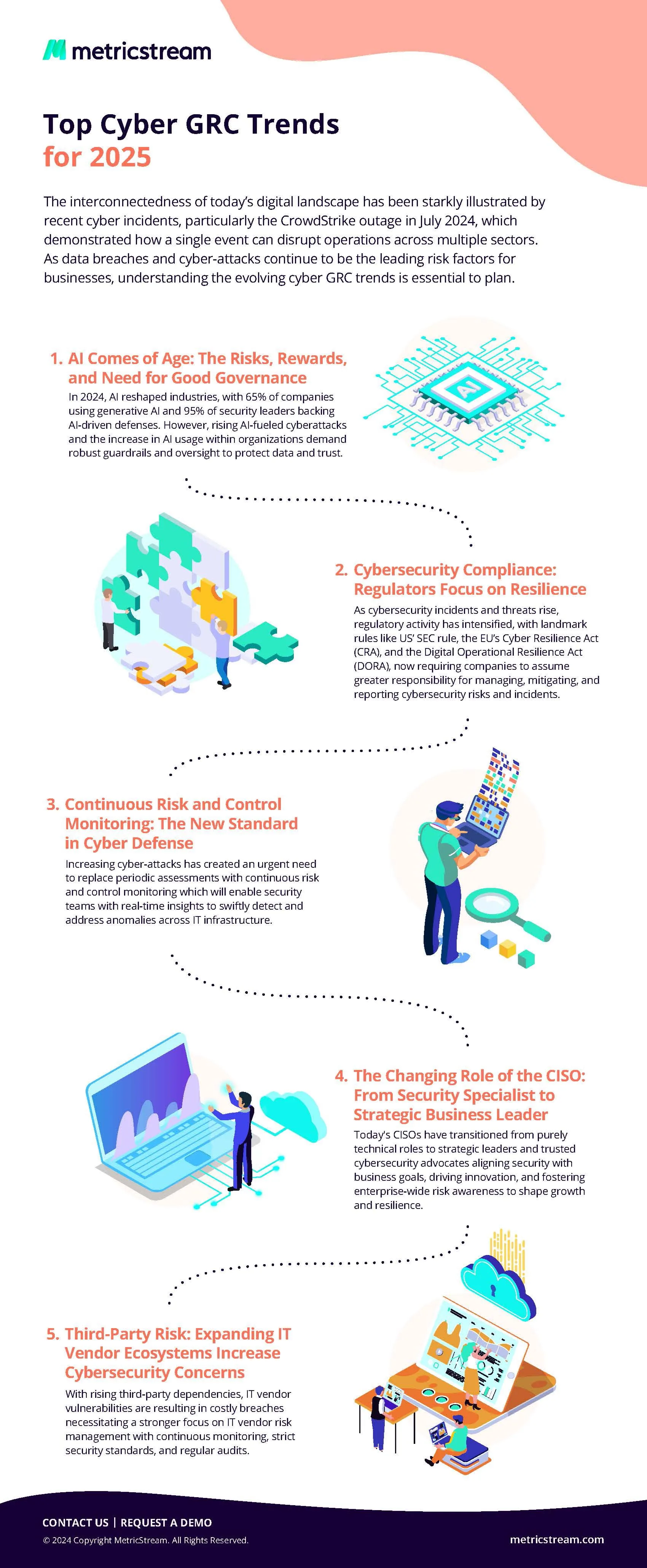
Stay Ahead with MetricStream Cyber GRC
The cyber risk landscape is not showing any signs of de-escalation, and organizations need to know the key trends impacting cyber risk management to anticipate and manage risks effectively. We have identified the top 10 cyber risk trends to watch out and prepare for in 2025.
Our eBook also offers insights on how MetricStream CyberGRC can safeguard your business. Built as an interconnected, intuitive, and intelligent GRC product set, CyberGRC empowers enterprises to connect cyber risk data from across the enterprise, including third and fourth-party vendors, and then use the actionable business intelligence to make data-driven decisions to build cyber resilience.
With MetricStream CyberGRC, you can:
- Protect cloud assets with automated continuous monitoring of controls
- Document, investigate, and resolve IT compliance and control issues in a systematic, automated manner with AI-powered intelligent issue and remediation
- Quantify cyber risks in monetary terms to assess cyber risks more accurately, communicate the risk more effectively, and make better-informed cyber investment decisions
- Strengthen visibility into the overall IT compliance profile with intuitive dashboards and real-time reports
- Harmonize controls across multiple IT regulations and frameworks, improving compliance and saving effort and costs
See how MetricStream CyberGRC can help you stay ahead of these trends – and identify new risks as they emerge. Request your personalized demo today!
Frequently Asked Questions
Global ransomware attacks reached roughly 7,419 in 2025, up 32% year over year. The average global cost of a data breach standing at USD 4.44 million in 2025, according to IBM's Cost of a Data Breach Report 2025, even as breach costs in the United States reached a record high of USD 10.22 million. These figures establish a dual reality for 2026: attack volumes are rising even as AI adoption is reducing per-incident costs for organizations that have invested in security automation.
The EU's NIS2 Directive, which came into effect in October 2024, strengthens cybersecurity requirements across critical infrastructure including energy, healthcare, transportation, and financial services, with organizations subject to mandatory incident reporting, board-level accountability for cybersecurity, and stricter penalties for non-compliance. In 2026, with member state transposition ongoing, organizations should verify the specific national implementation rules that apply to their jurisdiction in addition to the directive's baseline obligations.
Defenders use AI for threat detection, anomaly identification, automated incident response, and predictive risk analysis, enabling faster responses than human teams could achieve alone, while malicious actors are using AI to craft sophisticated phishing campaigns, automate vulnerability scanning, and generate convincing social engineering content. IBM's 2025 report found that 13% of organizations reported breaches of AI models or applications, with 97% of those compromised reporting no AI access controls in place.
The top Cyber GRC priorities in 2026 include implementing AI governance frameworks as AI systems expand the attack surface, meeting tightened regulatory requirements under DORA and NIS2, managing third-party cyber risk obligations, and deploying continuous control monitoring to replace periodic assessments. Board-level demand for cyber risk reporting aligned with business impact has also intensified, making clear communication of cyber exposure a governance requirement rather than a technical exercise.
DORA requires financial institutions to demonstrate that their digital operations, including those dependent on third-party ICT providers, can withstand and recover from disruptions, meaning cybersecurity programs must conduct ICT risk assessments, run scenario-based resilience tests, maintain detailed registers of third-party ICT dependencies, and meet specific incident notification timelines. DORA elevates cybersecurity from a technical discipline to a boardroom governance issue with direct regulatory accountability.
Multiple major regulatory frameworks, including DORA, NIS2, and sector-specific regulations in banking and healthcare, now require documented third-party cyber risk assessments, ongoing monitoring, and contractual controls, moving supplier cyber oversight from a recommended practice to a mandatory obligation. Organizations relying on informal vendor relationships or infrequent assessments face both direct cyber exposure and regulatory non-compliance risk across multiple jurisdictions simultaneously.
The EU AI Act, which entered phased implementation in 2025, introduced a risk-based classification framework for AI systems, with tools used in cybersecurity contexts involving critical infrastructure potentially classified as high-risk and subject to rigorous documentation, testing, and oversight requirements. Organizations deploying AI in security operations must assess whether those tools trigger AI Act obligations and maintain the governance records the regulation requires.
Continuous control monitoring in Cyber GRC involves automated, real-time testing of security controls such as access controls, endpoint protection, and network monitoring configurations, rather than relying on annual or quarterly assessments that leave gaps between review cycles. It identifies control failures as they occur, enabling rapid remediation before vulnerabilities are exploited, and regulators increasingly treat it as evidence of a mature cybersecurity posture.
Cyber GRC should feed into enterprise risk management by translating technical cyber metrics into business risk language, quantifying the financial and operational impact of potential breaches, connecting cyber control failures to enterprise risk registers, and ensuring cyber risk is represented in board-level reporting. This alignment allows organizations to prioritize cyber investments based on business impact rather than technical severity alone.
Organizations should prioritize AI-powered threat detection, continuous monitoring, third-party cyber risk platforms aligned to DORA and NIS2, AI governance frameworks, and board-level reporting tools that express cyber exposure in financial terms. IBM's 2025 Cost of a Data Breach Report found that use of AI security tools saved an average of USD 1.9 million per breach for organizations.