





Introduction
With the rapid pace of digital transformation at organizations, exposure to IT and cyber risks is also growing exponentially. From data breaches and ransomware to cloud security, to risks from third parties and IT vendors, to state-sponsored attacks, and beyond, organizations today have to tackle cyber risks from multiple dimensions. A minor lapse in the cyber security defense mechanism can result in financial losses, lack of stakeholder trust, operational disruptions, and more. The scale of the challenge is reflected in where organizations are directing investment: Gartner forecasts worldwide end-user spending on information security will reach $213 billion in 2025, with regulatory compliance identified as the primary driver of security budget growth across sectors.
At the same time, IT and cyber compliance requirements are also growing at a remarkable pace with heightened focus on all things cyber in recent years. So, organizations have to ensure the robustness of their cyber infrastructure while ensuring compliance with multiple standards, requirements, and regulations. Given the ever-evolving cyber risk landscape, a proactive and strategic approach to IT and cyber risk and compliance management is essential – one that improves cyber risk visibility and foresight, helps to accurately understand cyber risk exposure, and enables keeping up with evolving compliance requirements. Executing on that strategy requires cyber governance, risk, and compliance (GRC) best practices, frameworks, and software. This guide is designed to help you understand what Cyber GRC means, what kinds of solutions are out there to meet your risk management needs, and how to select one that works for you.
What is Cyber GRC?
Cyber GRC is an integrated approach to managing all cyber-related governance, risk management, and compliance (GRC) processes.
For security and risk management professionals, integrated Cyber GRC software provides a unified, holistic view of their cyber risk and compliance posture. The valuable insights provided by such software, supported by data and automated workflows, drive better-informed and agile business decisions.
Key Capabilities of a Best Practice Cyber GRC Solution 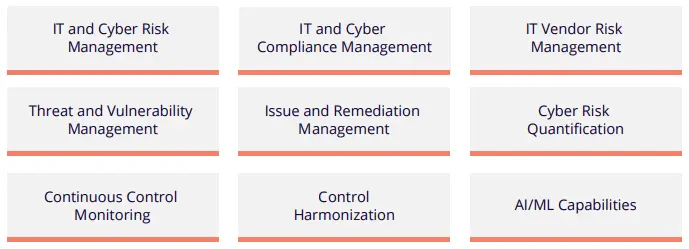
Cyber GRC vs. IT GRC vs. Enterprise GRC
| If Your Primary Need Is... | The Right Platform Category Is... | Typical Buyer Profile |
| Cybersecurity-specific risk management, control testing, and compliance across frameworks such as NIST CSF, ISO 27001, DORA, and SEC Cybersecurity Rules | Cyber GRC | A CISO or Head of IT Risk managing a cybersecurity program that must satisfy regulators and board-level reporting requirements simultaneously |
| Full IT governance including IT General Controls, SOX ITGC automation, and all IT risk domains beyond cybersecurity | IT GRC | An IT Risk Manager or Head of Internal Audit responsible for IT-related financial controls as well as broader technology risk governance |
| Enterprise-wide risk, compliance, audit, and policy management across all business domains including operational risk, third-party risk, and ESG | Enterprise GRC (Business GRC) | A Chief Risk Officer or Chief Compliance Officer managing the full organizational risk and compliance program |
| Both cybersecurity-specific and enterprise-wide GRC managed from a single platform with shared data and unified reporting | Combined Cyber GRC and Business GRC platform | A large financial institution or regulated multinational that requires deep cyber capability without maintaining two separate, disconnected systems |
Why Do I Need a Cyber GRC Software Solution?
Cyber risk is everywhere. A minor lapse in your cyber defense mechanism or a blind spot can result in catastrophic repercussions – including loss of sensitive data, loss of reputation, loss of stakeholder trust, and operational disruptions. In extreme circumstances, it could also lead to the closure of a business.
At the same time, IT compliance is becoming an increasingly demanding business function with the growing number of IT and cyber requirements, frameworks, and frequent regulatory updates.
Last but not least, consider your IT vendor ecosystem. With the amplified digital dependencies between organizations, you need end-to-end visibility on your extended enterprise as a minor slip at the vendor’s end could lead to a major supply chain attack, compromising multiple connected organizations.
Today, with the amplified digital interconnectedness of people, processes, and organizations, the points of intersection of risks – cyber, third-party, compliance, etc. – are also multiplying. To thrive in this rapidly evolving landscape, speed of execution and agility are critical.
An integrated, best-practice driven Cyber GRC solution will enable you to link and map different functions together to see the big picture. You will get a 360-degree view of how a risk is linked to various organizational assets, processes, controls, etc.
Advanced cyber risk quantification capabilities will enable you to associate a monetary value to risks and facilitate prioritization and executive communication of risk.
Real-time analytics, reporting, and technological capabilities like AI, machine learning, and automation will empower you to stay abreast of risks and regulatory changes, boosting agility in decision-making.
Case in Point
The cost of siloed operations; when risk, compliance, and security teams operate with separate tools and inconsistent terminology, data cannot be aggregated or analysed at the enterprise level. An integrated Cyber GRC platform establishes common taxonomy across functions, eliminates duplicate effort, and provides a single view of cyber risk posture that supports consistent, evidence-based decision-making across the organization.
Which Software Should I Choose for Cyber GRC?
Organizations at different stages of compliance maturity and operational scale have different requirements, and the right tool category depends on the scope of what needs to be managed rather than on brand recognition or feature lists alone. The three broad categories below represent the realistic options most organizations are choosing between, with their respective limitations and appropriate use cases:
Office productivity software, such as spreadsheets, is manual in nature and prone to errors. The challenges are exacerbated if risk, compliance, and security teams operate in siloes, making data aggregation extremely difficult and time-consuming. It is also almost impossible to gain real-time insights, which could lead to blind spots in the cyber defense mechanism.
Point solutions help organizations automate workflows and can provide real-time insights. If you only have a single need – say, third party risk management – in one business unit, they may be the right choice. However, they fail to provide comprehensive risk and compliance visibility, with each business unit having their own point solutions without communication or collaboration among them.
An integrated, connected solution provides all the valuable insights in one place for efficient decision-making. It cuts across organizational siloes and facilitates collaboration and harmonization across business units. Real-time insights, supported by visualization tools and graphics, help CISOs, CTOs, and CSOs to quickly view the problem areas, analyze trends, and make data-driven and risk-aware decisions.
Cyber GRC Platform Evaluation Criteria
| Criterion | What to Look For | Questions to Ask the Vendor |
| Multi-Framework Compliance | Pre-mapped regulatory content covering NIST CSF, ISO 27001, DORA, NIS2, PCI DSS, and SEC Cybersecurity Rules, with an update mechanism that reflects regulatory changes without requiring manual rework across the control library | How many frameworks are pre-mapped in the platform? When a regulation is updated, how are control mappings refreshed, and what is the typical lag between a regulatory change being published and the platform reflecting it? |
| Cyber Risk Management | Structured IT and cyber risk assessment workflows, threat and vulnerability data ingestion, and support for both qualitative scoring and quantitative methods such as FAIR-based monetary risk modelling | Does the platform ingest data from vulnerability scanners, threat intelligence feeds, or SIEMs? Can it produce a monetised risk exposure figure that can be presented to a board without requiring translation by a technical team? |
| ITGC Testing | Automated IT General Controls testing workflows with SOX-specific control libraries, continuous control monitoring, and evidence collection tied to audit cycles | What SOX-specific features does the platform include? Can ITGC testing be automated, and does the platform generate audit-ready evidence packages? |
| Third-Party Cyber Risk | Vendor cyber risk scoring, supply chain risk assessment workflows, and integration with external cyber rating services to provide continuous visibility into third-party risk posture | Does the platform integrate with SecurityScorecard, BitSight, or equivalent external cyber rating providers? How does it handle fourth-party risk? |
| Incident Management | Cyber incident tracking with regulatory notification workflows configured for DORA's four-hour initial and 72-hour intermediate reporting timelines, NIS2's 24-hour early warning requirement, and SEC's four-day material disclosure obligation | Does the platform generate the specific report formats required by DORA and NIS2 regulators? Can notification timelines be tracked with automated escalation alerts? |
| AI and Automation | AI-powered anomaly detection, predictive risk signals, automated control testing triggers, and regulatory change management that surfaces new obligations and maps them to existing controls | Request a live demonstration of the AI capability on real compliance data. What specific signals does the AI detect, and what does it do when it identifies an anomaly? |
| Integration | Native connectors or documented API integrations with SIEM, SOAR, vulnerability management platforms, identity and access management systems, and cloud security tools | What native integrations exist with the security tools already in your environment? What is the implementation effort for integrations that are not pre-built? |
What Questions Should I Ask Before Buying a Cyber GRC Solution?
Today, businesses have a multitude of cyber risk management software solutions to choose from. However, not all are designed to address the real, day-to-day challenges faced by security professionals. So, what are the key questions that CISOs, CSOs, and CTOs must ask when making this decision?
As a starting point, we recommend starting with your existing challenges and building from there.
An excellent place to begin is this report from Gartner, titled “Ten Cyber and IT Risk Fundamentals You Must Get Right.” It recommends organizations to adopt an approach that best fits their needs, requirements, objectives, and culture, and allows risk to inform all business decisions — particularly cyber and IT risk decisions. The report delves into the fundamental cyber and IT Risk management processes and lists the key considerations for ensuring long-term success.
The questions below are designed to move the evaluation beyond feature checklists and into the operational and architectural details that determine whether a platform will actually perform under the compliance workload it is being purchased to manage. Vendors with mature, genuinely integrated solutions can answer all of them specifically and with demonstrated evidence. The following questions should be put to every Cyber GRC vendor under evaluation:
- How can the software improve my visibility into cyber risks and associated controls?
- Is the software scalable and flexible enough to handle unforeseen changes in the business?
- Would I be able to view the assets, processes, functions, etc. impacted due to a particular risk?
- Does the software help in performing cyber risk assessments? Are both qualitative and quantitative assessments supported?
- Would I be able to prioritize the risks?
- What about the risks from IT vendors? Does the software support IT vendor and third-party risk management?
- Does the software help in ensuring compliance with industry best practices and frameworks, such as NIST, HIPAA, PCI DSS, etc.?
- How can the software help me stay on top of IT regulatory changes?
- Can I automate the process of updating corporate policies as frameworks and requirements change?
- I have a lot of duplicate controls to comply with various frameworks and regulations. Does the software help me eliminate duplication?
- Does the software help in verifying the effectiveness of controls? Is it automatic?
- What about any identified issues? How can the software help me streamline issue and remediation management?
- I need cyber risk reports, trend charts, and graphics to present to the top management and board. How can the software help?
Cyber GRC Regulatory Quick Reference
| Regulation | Jurisdiction | Key Requirements Relevant to Cyber GRC |
| DORA | EU | Formal ICT risk management framework covering identification, protection, detection, response, and recovery; multi-stage incident reporting with a four-hour initial notification, 72-hour intermediate report, and one-month final report; digital resilience testing including Threat-Led Penetration Testing for significant entities; comprehensive third-party ICT risk management with prescribed contractual provisions |
| NIS2 | EU | Board-level accountability for cybersecurity governance; documented risk management measures across network and information systems; supply chain and third-party security requirements; incident reporting with a 24-hour early warning and 72-hour detailed notification; penalties up to €10 million or 2% of global annual turnover for essential entities |
| SEC Cybersecurity Rules | USA | Disclosure of material cybersecurity incidents within four business days of a materiality determination; annual disclosure of cybersecurity risk management program, strategy, and governance in Form 10-K |
| NY DFS Part 500 | USA (New York) | Annual penetration testing; mandatory multi-factor authentication for all systems; designated CISO; 72-hour regulatory notification for cybersecurity events |
| ISO 27001:2022 | Global | 93 Annex A controls organized across four themes; formal Information Security Management System with documented scope, risk assessment, and Statement of Applicability; third-party certification |
| NIST CSF 2.0 | USA (voluntary) | Six function framework: Govern, Identify, Protect, Detect, Respond, Recover; voluntary but widely adopted as the de facto standard for US federal agencies and private sector organizations |
| PCI DSS v4.0 | Global | 12 core requirements covering network security, access control, data encryption, vulnerability management, monitoring, and testing; applies to all entities storing, processing, or transmitting cardholder data |
Getting Buy-In from the Decision-Makers
Managing cyber risks and compliance processes is not just a tick-the-box exercise. It is essential that your board and C-suite executives understand the importance of an integrated Cyber GRC solution, the role it plays in driving business value, and the risk of not adopting a unified approach.
It's tempting to focus on software features, capabilities, time and cost savings, etc. However, the conversations with the top management and board must be centered around the value it brings to the business.
Getting buy-in from top management is also important to set the tone across the enterprise. Purchasing and implementing an integrated solution is one side of the coin; the other side is nurturing a risk-aware culture across the organizational hierarchy – from the top-level executives down to the frontline employees.
MetricStream Cyber GRC
MetricStream Cyber GRC helps you actively manage cyber risk through an IT and Cyber Risk and Compliance Framework that aligns with established security standards so you can pass IT audits more efficiently and get buy-in from top management. It provides comprehensive visibility into the overall IT risk posture and cybersecurity investment priorities. It helps you get your IT and Cyber Risk Compliance program up and running quickly with pre-packaged content and industry frameworks such as ISO 27001, NIST CSF, and NIST SP800-53, and map policies to IT controls and policy exceptions. The solution will empower you to strengthen your organization’s cyber resilience with built-in industry best practices, insightful reporting, and risk quantification capabilities.
Business Value
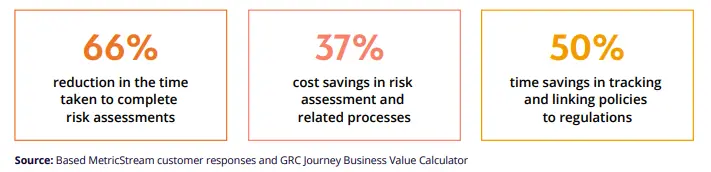
With MetricStream Cyber GRC, you can: 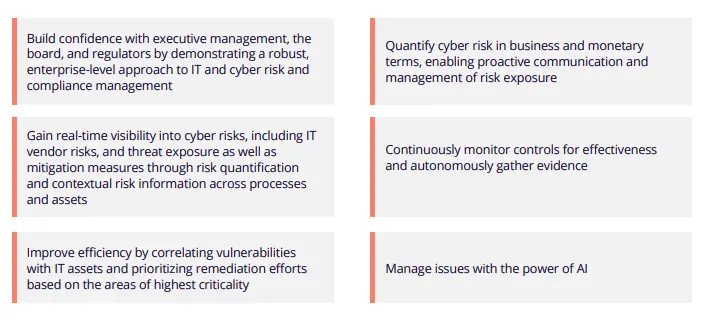
Here are some of our customer case studies that provide insights into how an integrated solution has helped some leading companies improve their efficiency and cyber resilience.
Global Retailer Keeps Cybersecurity Risks in Check Through an Integrated Approach
With a gold mine of sensitive, confidential, and personally identifiable information (PII), a global retailer had to maintain stringent security controls in compliance with requirements such as the Payment Card Industry Data Security Standard (PCI-DSS). In addition, real-time, integrated visibility into cyber risks became increasingly essential for the senior leadership team to understand the organization’s risk profile and to respond proactively to emerging threats.
Their key objectives were to identify priority risks across the organization while ensuring that the business was meeting various compliance objectives and strategic goals. They also needed to determine if sufficient policies and standard operating procedures (SOPs) were available from a governance perspective.
With MetricStream Cyber GRC, the retailer has been able to implement a systematic and integrated approach to IT and cyber risk documentation, risk assessments, control management, and issue detection, as well as risk/ threat analysis and reporting. The solution has enabled the senior-most leadership, C-suite members, board members, and external stakeholders to prioritize and align IT and cyber risks to business risks. Advanced reports and dashboards provide a real-time view of the risks, enabling senior stakeholders to make well-informed decisions.
The retailer can also efficiently manage all compliance requirements related to PCI-DSS and the Sarbanes Oxley Act (SOX). It supports the process of harmonizing control sets across multiple IT regulations. It also helps in scheduling assessments and performing control tests.
As cybersecurity evolved into a top 3 business risk, boards and leadership teams wanted more insights than what a traditional risk heat map provided: “What is the financial impact of a potential data breach?”, “How much is the cost of remediating the risk vs accepting it?”, “Are our cybersecurity investments proportionate to our risk exposure?”
The only way to answer these questions was to quantify the company’s cyber risks in monetary terms. Today, MetricStream Cyber Risk Quantification is helping the company transform cyber risk data into a single risk score that’s quantified in terms of dollar impact. These actionable insights have accelerated decision-making time by 60%.
How MetricStream Can Help
Managing cyber risk and regulatory compliance from a collection of point solutions and manual processes is viable only up to a point. As the number of applicable frameworks grows and the overlap between them becomes harder to track, the operational cost of maintaining separate workflows for DORA, NIS2, ISO 27001, NIST CSF, and the SEC Cybersecurity Rules simultaneously becomes prohibitive. The structural problem is not a lack of compliance intent; it is the absence of a platform that holds all of those obligations, the controls mapped to them, and the evidence of their operation in one governed environment.
MetricStream Cyber GRC provides that environment. Pre-mapped regulatory content covering DORA, NIS2, NIST CSF 2.0, ISO 27001:2022, PCI DSS v4.0, and more than 100 additional frameworks means organizations do not build their control libraries from scratch for each new regulation. Controls are mapped once and tested once, with results feeding compliance status across all applicable frameworks simultaneously. MetricStream's AI-powered risk intelligence capability, detects anomalies in control performance and surfaces predictive risk signals before they become incidents, giving compliance and security teams the foresight that reactive monitoring cannot provide.
For organizations that require both deep cyber capability and enterprise-wide GRC coverage, MetricStream Cyber GRC integrates natively with Connected GRC, consolidating cyber risk, operational risk, audit, policy, and third-party risk management into a single platform without requiring a separate integration project. Board and regulatory reporting draws from the same underlying data as operational monitoring, ensuring that what leadership sees reflects actual program performance rather than a separately assembled summary.
With the rapid pace of digital transformation at organizations, exposure to IT and cyber risks is also growing exponentially. From data breaches and ransomware to cloud security, to risks from third parties and IT vendors, to state-sponsored attacks, and beyond, organizations today have to tackle cyber risks from multiple dimensions. A minor lapse in the cyber security defense mechanism can result in financial losses, lack of stakeholder trust, operational disruptions, and more. The scale of the challenge is reflected in where organizations are directing investment: Gartner forecasts worldwide end-user spending on information security will reach $213 billion in 2025, with regulatory compliance identified as the primary driver of security budget growth across sectors.
At the same time, IT and cyber compliance requirements are also growing at a remarkable pace with heightened focus on all things cyber in recent years. So, organizations have to ensure the robustness of their cyber infrastructure while ensuring compliance with multiple standards, requirements, and regulations. Given the ever-evolving cyber risk landscape, a proactive and strategic approach to IT and cyber risk and compliance management is essential – one that improves cyber risk visibility and foresight, helps to accurately understand cyber risk exposure, and enables keeping up with evolving compliance requirements. Executing on that strategy requires cyber governance, risk, and compliance (GRC) best practices, frameworks, and software. This guide is designed to help you understand what Cyber GRC means, what kinds of solutions are out there to meet your risk management needs, and how to select one that works for you.
Cyber GRC is an integrated approach to managing all cyber-related governance, risk management, and compliance (GRC) processes.
For security and risk management professionals, integrated Cyber GRC software provides a unified, holistic view of their cyber risk and compliance posture. The valuable insights provided by such software, supported by data and automated workflows, drive better-informed and agile business decisions.
Key Capabilities of a Best Practice Cyber GRC Solution
Cyber GRC vs. IT GRC vs. Enterprise GRC
| If Your Primary Need Is... | The Right Platform Category Is... | Typical Buyer Profile |
| Cybersecurity-specific risk management, control testing, and compliance across frameworks such as NIST CSF, ISO 27001, DORA, and SEC Cybersecurity Rules | Cyber GRC | A CISO or Head of IT Risk managing a cybersecurity program that must satisfy regulators and board-level reporting requirements simultaneously |
| Full IT governance including IT General Controls, SOX ITGC automation, and all IT risk domains beyond cybersecurity | IT GRC | An IT Risk Manager or Head of Internal Audit responsible for IT-related financial controls as well as broader technology risk governance |
| Enterprise-wide risk, compliance, audit, and policy management across all business domains including operational risk, third-party risk, and ESG | Enterprise GRC (Business GRC) | A Chief Risk Officer or Chief Compliance Officer managing the full organizational risk and compliance program |
| Both cybersecurity-specific and enterprise-wide GRC managed from a single platform with shared data and unified reporting | Combined Cyber GRC and Business GRC platform | A large financial institution or regulated multinational that requires deep cyber capability without maintaining two separate, disconnected systems |
Cyber risk is everywhere. A minor lapse in your cyber defense mechanism or a blind spot can result in catastrophic repercussions – including loss of sensitive data, loss of reputation, loss of stakeholder trust, and operational disruptions. In extreme circumstances, it could also lead to the closure of a business.
At the same time, IT compliance is becoming an increasingly demanding business function with the growing number of IT and cyber requirements, frameworks, and frequent regulatory updates.
Last but not least, consider your IT vendor ecosystem. With the amplified digital dependencies between organizations, you need end-to-end visibility on your extended enterprise as a minor slip at the vendor’s end could lead to a major supply chain attack, compromising multiple connected organizations.
Today, with the amplified digital interconnectedness of people, processes, and organizations, the points of intersection of risks – cyber, third-party, compliance, etc. – are also multiplying. To thrive in this rapidly evolving landscape, speed of execution and agility are critical.
An integrated, best-practice driven Cyber GRC solution will enable you to link and map different functions together to see the big picture. You will get a 360-degree view of how a risk is linked to various organizational assets, processes, controls, etc.
Advanced cyber risk quantification capabilities will enable you to associate a monetary value to risks and facilitate prioritization and executive communication of risk.
Real-time analytics, reporting, and technological capabilities like AI, machine learning, and automation will empower you to stay abreast of risks and regulatory changes, boosting agility in decision-making.
Case in Point
The cost of siloed operations; when risk, compliance, and security teams operate with separate tools and inconsistent terminology, data cannot be aggregated or analysed at the enterprise level. An integrated Cyber GRC platform establishes common taxonomy across functions, eliminates duplicate effort, and provides a single view of cyber risk posture that supports consistent, evidence-based decision-making across the organization.
Organizations at different stages of compliance maturity and operational scale have different requirements, and the right tool category depends on the scope of what needs to be managed rather than on brand recognition or feature lists alone. The three broad categories below represent the realistic options most organizations are choosing between, with their respective limitations and appropriate use cases:
Office productivity software, such as spreadsheets, is manual in nature and prone to errors. The challenges are exacerbated if risk, compliance, and security teams operate in siloes, making data aggregation extremely difficult and time-consuming. It is also almost impossible to gain real-time insights, which could lead to blind spots in the cyber defense mechanism.
Point solutions help organizations automate workflows and can provide real-time insights. If you only have a single need – say, third party risk management – in one business unit, they may be the right choice. However, they fail to provide comprehensive risk and compliance visibility, with each business unit having their own point solutions without communication or collaboration among them.
An integrated, connected solution provides all the valuable insights in one place for efficient decision-making. It cuts across organizational siloes and facilitates collaboration and harmonization across business units. Real-time insights, supported by visualization tools and graphics, help CISOs, CTOs, and CSOs to quickly view the problem areas, analyze trends, and make data-driven and risk-aware decisions.
Cyber GRC Platform Evaluation Criteria
| Criterion | What to Look For | Questions to Ask the Vendor |
| Multi-Framework Compliance | Pre-mapped regulatory content covering NIST CSF, ISO 27001, DORA, NIS2, PCI DSS, and SEC Cybersecurity Rules, with an update mechanism that reflects regulatory changes without requiring manual rework across the control library | How many frameworks are pre-mapped in the platform? When a regulation is updated, how are control mappings refreshed, and what is the typical lag between a regulatory change being published and the platform reflecting it? |
| Cyber Risk Management | Structured IT and cyber risk assessment workflows, threat and vulnerability data ingestion, and support for both qualitative scoring and quantitative methods such as FAIR-based monetary risk modelling | Does the platform ingest data from vulnerability scanners, threat intelligence feeds, or SIEMs? Can it produce a monetised risk exposure figure that can be presented to a board without requiring translation by a technical team? |
| ITGC Testing | Automated IT General Controls testing workflows with SOX-specific control libraries, continuous control monitoring, and evidence collection tied to audit cycles | What SOX-specific features does the platform include? Can ITGC testing be automated, and does the platform generate audit-ready evidence packages? |
| Third-Party Cyber Risk | Vendor cyber risk scoring, supply chain risk assessment workflows, and integration with external cyber rating services to provide continuous visibility into third-party risk posture | Does the platform integrate with SecurityScorecard, BitSight, or equivalent external cyber rating providers? How does it handle fourth-party risk? |
| Incident Management | Cyber incident tracking with regulatory notification workflows configured for DORA's four-hour initial and 72-hour intermediate reporting timelines, NIS2's 24-hour early warning requirement, and SEC's four-day material disclosure obligation | Does the platform generate the specific report formats required by DORA and NIS2 regulators? Can notification timelines be tracked with automated escalation alerts? |
| AI and Automation | AI-powered anomaly detection, predictive risk signals, automated control testing triggers, and regulatory change management that surfaces new obligations and maps them to existing controls | Request a live demonstration of the AI capability on real compliance data. What specific signals does the AI detect, and what does it do when it identifies an anomaly? |
| Integration | Native connectors or documented API integrations with SIEM, SOAR, vulnerability management platforms, identity and access management systems, and cloud security tools | What native integrations exist with the security tools already in your environment? What is the implementation effort for integrations that are not pre-built? |
Today, businesses have a multitude of cyber risk management software solutions to choose from. However, not all are designed to address the real, day-to-day challenges faced by security professionals. So, what are the key questions that CISOs, CSOs, and CTOs must ask when making this decision?
As a starting point, we recommend starting with your existing challenges and building from there.
An excellent place to begin is this report from Gartner, titled “Ten Cyber and IT Risk Fundamentals You Must Get Right.” It recommends organizations to adopt an approach that best fits their needs, requirements, objectives, and culture, and allows risk to inform all business decisions — particularly cyber and IT risk decisions. The report delves into the fundamental cyber and IT Risk management processes and lists the key considerations for ensuring long-term success.
The questions below are designed to move the evaluation beyond feature checklists and into the operational and architectural details that determine whether a platform will actually perform under the compliance workload it is being purchased to manage. Vendors with mature, genuinely integrated solutions can answer all of them specifically and with demonstrated evidence. The following questions should be put to every Cyber GRC vendor under evaluation:
- How can the software improve my visibility into cyber risks and associated controls?
- Is the software scalable and flexible enough to handle unforeseen changes in the business?
- Would I be able to view the assets, processes, functions, etc. impacted due to a particular risk?
- Does the software help in performing cyber risk assessments? Are both qualitative and quantitative assessments supported?
- Would I be able to prioritize the risks?
- What about the risks from IT vendors? Does the software support IT vendor and third-party risk management?
- Does the software help in ensuring compliance with industry best practices and frameworks, such as NIST, HIPAA, PCI DSS, etc.?
- How can the software help me stay on top of IT regulatory changes?
- Can I automate the process of updating corporate policies as frameworks and requirements change?
- I have a lot of duplicate controls to comply with various frameworks and regulations. Does the software help me eliminate duplication?
- Does the software help in verifying the effectiveness of controls? Is it automatic?
- What about any identified issues? How can the software help me streamline issue and remediation management?
- I need cyber risk reports, trend charts, and graphics to present to the top management and board. How can the software help?
Cyber GRC Regulatory Quick Reference
| Regulation | Jurisdiction | Key Requirements Relevant to Cyber GRC |
| DORA | EU | Formal ICT risk management framework covering identification, protection, detection, response, and recovery; multi-stage incident reporting with a four-hour initial notification, 72-hour intermediate report, and one-month final report; digital resilience testing including Threat-Led Penetration Testing for significant entities; comprehensive third-party ICT risk management with prescribed contractual provisions |
| NIS2 | EU | Board-level accountability for cybersecurity governance; documented risk management measures across network and information systems; supply chain and third-party security requirements; incident reporting with a 24-hour early warning and 72-hour detailed notification; penalties up to €10 million or 2% of global annual turnover for essential entities |
| SEC Cybersecurity Rules | USA | Disclosure of material cybersecurity incidents within four business days of a materiality determination; annual disclosure of cybersecurity risk management program, strategy, and governance in Form 10-K |
| NY DFS Part 500 | USA (New York) | Annual penetration testing; mandatory multi-factor authentication for all systems; designated CISO; 72-hour regulatory notification for cybersecurity events |
| ISO 27001:2022 | Global | 93 Annex A controls organized across four themes; formal Information Security Management System with documented scope, risk assessment, and Statement of Applicability; third-party certification |
| NIST CSF 2.0 | USA (voluntary) | Six function framework: Govern, Identify, Protect, Detect, Respond, Recover; voluntary but widely adopted as the de facto standard for US federal agencies and private sector organizations |
| PCI DSS v4.0 | Global | 12 core requirements covering network security, access control, data encryption, vulnerability management, monitoring, and testing; applies to all entities storing, processing, or transmitting cardholder data |
Getting Buy-In from the Decision-Makers
Managing cyber risks and compliance processes is not just a tick-the-box exercise. It is essential that your board and C-suite executives understand the importance of an integrated Cyber GRC solution, the role it plays in driving business value, and the risk of not adopting a unified approach.
It's tempting to focus on software features, capabilities, time and cost savings, etc. However, the conversations with the top management and board must be centered around the value it brings to the business.
Getting buy-in from top management is also important to set the tone across the enterprise. Purchasing and implementing an integrated solution is one side of the coin; the other side is nurturing a risk-aware culture across the organizational hierarchy – from the top-level executives down to the frontline employees.
MetricStream Cyber GRC helps you actively manage cyber risk through an IT and Cyber Risk and Compliance Framework that aligns with established security standards so you can pass IT audits more efficiently and get buy-in from top management. It provides comprehensive visibility into the overall IT risk posture and cybersecurity investment priorities. It helps you get your IT and Cyber Risk Compliance program up and running quickly with pre-packaged content and industry frameworks such as ISO 27001, NIST CSF, and NIST SP800-53, and map policies to IT controls and policy exceptions. The solution will empower you to strengthen your organization’s cyber resilience with built-in industry best practices, insightful reporting, and risk quantification capabilities.
Business Value
With MetricStream Cyber GRC, you can:
Here are some of our customer case studies that provide insights into how an integrated solution has helped some leading companies improve their efficiency and cyber resilience.
Global Retailer Keeps Cybersecurity Risks in Check Through an Integrated Approach
With a gold mine of sensitive, confidential, and personally identifiable information (PII), a global retailer had to maintain stringent security controls in compliance with requirements such as the Payment Card Industry Data Security Standard (PCI-DSS). In addition, real-time, integrated visibility into cyber risks became increasingly essential for the senior leadership team to understand the organization’s risk profile and to respond proactively to emerging threats.
Their key objectives were to identify priority risks across the organization while ensuring that the business was meeting various compliance objectives and strategic goals. They also needed to determine if sufficient policies and standard operating procedures (SOPs) were available from a governance perspective.
With MetricStream Cyber GRC, the retailer has been able to implement a systematic and integrated approach to IT and cyber risk documentation, risk assessments, control management, and issue detection, as well as risk/ threat analysis and reporting. The solution has enabled the senior-most leadership, C-suite members, board members, and external stakeholders to prioritize and align IT and cyber risks to business risks. Advanced reports and dashboards provide a real-time view of the risks, enabling senior stakeholders to make well-informed decisions.
The retailer can also efficiently manage all compliance requirements related to PCI-DSS and the Sarbanes Oxley Act (SOX). It supports the process of harmonizing control sets across multiple IT regulations. It also helps in scheduling assessments and performing control tests.
As cybersecurity evolved into a top 3 business risk, boards and leadership teams wanted more insights than what a traditional risk heat map provided: “What is the financial impact of a potential data breach?”, “How much is the cost of remediating the risk vs accepting it?”, “Are our cybersecurity investments proportionate to our risk exposure?”
The only way to answer these questions was to quantify the company’s cyber risks in monetary terms. Today, MetricStream Cyber Risk Quantification is helping the company transform cyber risk data into a single risk score that’s quantified in terms of dollar impact. These actionable insights have accelerated decision-making time by 60%.
Managing cyber risk and regulatory compliance from a collection of point solutions and manual processes is viable only up to a point. As the number of applicable frameworks grows and the overlap between them becomes harder to track, the operational cost of maintaining separate workflows for DORA, NIS2, ISO 27001, NIST CSF, and the SEC Cybersecurity Rules simultaneously becomes prohibitive. The structural problem is not a lack of compliance intent; it is the absence of a platform that holds all of those obligations, the controls mapped to them, and the evidence of their operation in one governed environment.
MetricStream Cyber GRC provides that environment. Pre-mapped regulatory content covering DORA, NIS2, NIST CSF 2.0, ISO 27001:2022, PCI DSS v4.0, and more than 100 additional frameworks means organizations do not build their control libraries from scratch for each new regulation. Controls are mapped once and tested once, with results feeding compliance status across all applicable frameworks simultaneously. MetricStream's AI-powered risk intelligence capability, detects anomalies in control performance and surfaces predictive risk signals before they become incidents, giving compliance and security teams the foresight that reactive monitoring cannot provide.
For organizations that require both deep cyber capability and enterprise-wide GRC coverage, MetricStream Cyber GRC integrates natively with Connected GRC, consolidating cyber risk, operational risk, audit, policy, and third-party risk management into a single platform without requiring a separate integration project. Board and regulatory reporting draws from the same underlying data as operational monitoring, ensuring that what leadership sees reflects actual program performance rather than a separately assembled summary.
Frequently Asked Questions
Cyber GRC is an integrated framework that connects cybersecurity risk management, governance, and regulatory compliance into a single program, giving boards and regulators structured, evidenced oversight of an organization's cybersecurity posture across all applicable frameworks and obligations.
Manual approaches break down when organizations manage multiple overlapping regulations simultaneously, whereas Cyber GRC software maps controls across frameworks, automates evidence collection, provides real-time cyber risk visibility, and generates board-level reporting from technical operational data.
Cyber GRC focuses specifically on IT and cybersecurity risk, compliance, and governance, while enterprise GRC covers the full organizational scope including operational risk, audit, and policy management, with many vendors now offering combined platforms that serve both needs.
A mature Cyber GRC platform should include pre-mapped multi-framework compliance, quantitative cyber risk assessment, ITGC automation, third-party vendor risk, incident management with DORA and SEC notification workflows, SIEM integration, AI-powered risk detection, and board-level reporting.
DORA has applied across EU financial entities since January 2025, mandating formal ICT risk management, multi-stage incident reporting with four-hour initial and 72-hour intermediate timelines, resilience testing, and third-party ICT risk management, all requiring dedicated Cyber GRC platform workflows.
Ask vendors which frameworks are pre-mapped, how regulatory content is updated when rules change, how cross-framework control mapping eliminates duplicate testing, what SIEM integrations exist, what the AI detects specifically, and what a generated DORA incident report looks like.
Single-framework deployments typically take two to four months, while multi-framework implementations covering DORA, NIS2, NIST CSF, and ISO 27001 with ITGC and third-party risk modules typically require six to twelve months using a phased approach.
Quantify compliance cost reduction from unified multi-framework management, audit efficiency gains, DORA penalty avoidance of up to two percent of global annual turnover, improved cyber risk visibility, and reduced cyber insurance premiums through demonstrable program maturity and board-level reporting.
CISO security tools are operational, defending the perimeter in real time, while a Cyber GRC platform is governance-oriented, tracking compliance obligations, testing controls, and producing the structured board and regulatory reports that operational tools cannot generate.
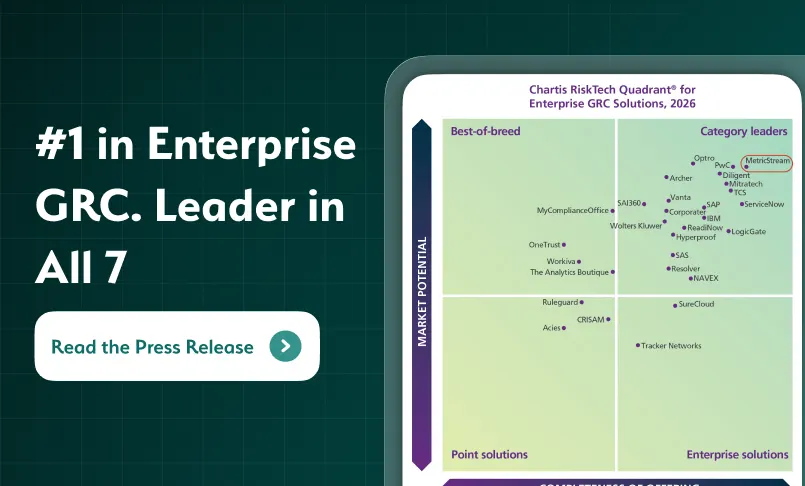
MetricStream ranks number one in Chartis RiskTech100 for Operational Risk and Audit, with pre-mapped content for DORA, NIS2, NIST CSF 2.0, ISO 27001:2022, and over 100 frameworks, AI-powered risk intelligence, and native Connected GRC integration.